Completed does not mean invoiced: Where IT service providers lose daily revenue
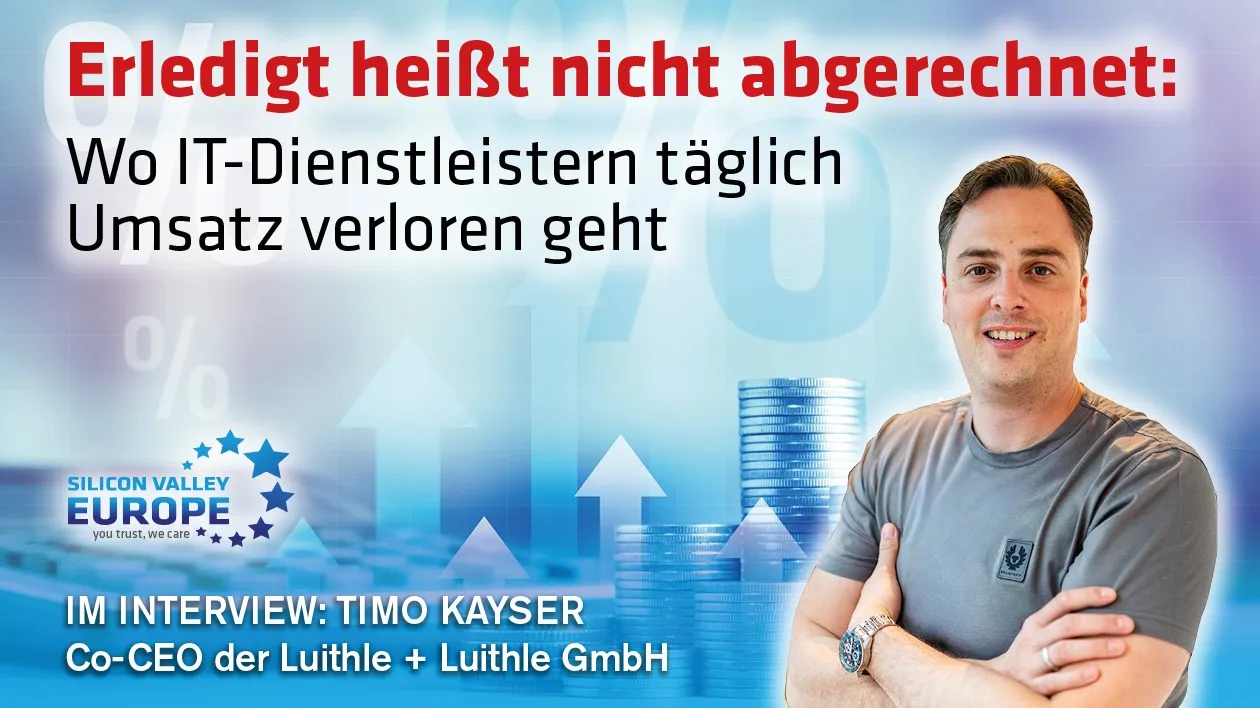
In the interview with Timo Kayser, Co-CEO of Luithle + Luithle GmbH
Done doesn’t mean billed: Where IT service providers lose revenue every day
In an interview with Timo Kayser, Co-CEO of Luithle + Luithle GmbH
Ticket closed, problem solved, customer satisfied. And yet, money remains uncollected at the end. What sounds like minor issues quickly becomes a margin problem for IT service providers, system houses, and Managed Service Providers (MSPs). The technical term for this is revenue leakage: revenue that is lost because services rendered are not fully recorded, not assigned to the correct contract, or simply not billed.
The brief support call in between, the quickly replaced spare part, the additional service via email, or a service contingent that has long since been exhausted: usually, it’s not one major error, but many small oversights that add up over weeks and months. Why do these gaps go unnoticed for so long, even though almost every service provider uses ticketing systems, time tracking, and ERP? And what really helps to prevent this?
Timo Kayser is Managing Director and Co-CEO of Luithle + Luithle GmbH. The full-service IT provider has been supporting companies with IT solutions, managed services, IT security, and hosting since 1991. Kayser started as a software engineer and has been part of the management team since 2019. He knows the topic from both a technical and commercial perspective.
Silicon Valley Europe spoke with him about where revenue leakage occurs in everyday operations, why the problem rarely starts in accounting, and what role contracts, processes, and artificial intelligence play in this. One thing upfront: the goal is certainly not to bill every little detail or to monitor employees.
Silicon Valley Europe: You’re currently talking a lot about “revenue leakage.” What does that mean, and why should IT service providers take a closer look?
Timo Kayser: Revenue leakage simply means that a service was performed but is not or not fully listed on the invoice. This is rarely a single major error. Instead, the revenue disappears gradually, somewhere between the request, ticket, contract, and invoice. The work is done, the customer is satisfied—only commercially, the service doesn’t appear. And because no one notices it directly, it’s often only after months that you realize what has accumulated.
Silicon Valley Europe: Why does this particularly affect IT service providers, system houses, and MSPs so strongly?
Timo Kayser: Because our business consists of many small, recurring services: support, maintenance, managed services, service-level agreements, and agreed-upon quotas. Each individual service is manageable, but in total, it amounts to a lot of money. MGI Research estimates revenue leakage at three to five percent of revenue, while SPI Research finds that professional services companies lose an average of around 4.5 percent. When you compare that to the usual margin in service business, it really hurts.
Silicon Valley Europe: Can you give us a few typical everyday examples?
Timo Kayser: Everyone who has ever worked in service knows the classics. A technician solves a problem, closes the ticket, and in the meantime has made a few phone calls and written some emails. Five minutes here, ten minutes there, and suddenly part of the service isn’t documented anywhere. Or a spare part, a patch cable, or a monitor is installed but not recorded in the process. Then there are requests that come in via phone, email, or Teams and never become a ticket in the system. Exceeded quotas are also an issue, as are additional users, devices, and licenses that aren’t included in the monthly flat rate. And then there’s the phrase everyone knows: “We’ll just take care of that real quick.”
Silicon Valley Europe: Most companies have long since documented their work in a ticketing system and use ERP and time tracking. Why isn’t that enough?
Timo Kayser: Because documentation and billability are two different things. Documentation tells me that a service was performed. For billing, however, I need to know which customer, which contract, and which item it belongs to. A note in the ticket doesn’t help if the contract reference is missing, the materials aren’t recorded, or no one knows whether the service was already included. What matters isn’t how many systems you have, but how well they work together. Media discontinuities, duplicate entries, and manual transfers to the ERP are typical weak points. And a request that never makes it into the ticketing system can’t be billed, no matter how good the system is.
Silicon Valley Europe: You like to say, “Done doesn’t mean billed.” What do you mean by that?
Timo Kayser: For the technician, a case is done when the problem is solved and the ticket is closed. From their perspective, that’s correct. For the company, however, the process isn’t complete until the service is clearly assigned and can be billed. Revenue is lost in the gap between these two perspectives. That’s why we need to raise awareness that a closed ticket doesn’t necessarily mean complete billing.
Silicon Valley Europe: So is revenue leakage an invoicing problem, a process problem, or a leadership issue?
Timo Kayser: This usually becomes visible in the billing. However, the causes lie much earlier: at the first inquiry, in the documentation, in the contract logic, or during the handover to invoicing. Accounting is rarely the source. For me, it is primarily a process problem. It becomes a leadership issue when decisions are made based on gut feeling because there are no clear rules. What is needed are binding procedures and a shared understanding of when a service is billable. Ensuring this is the task of leadership.
Silicon Valley Europe: Why do such losses often go unnoticed for so long?
Timo Kayser: Because each individual gap appears harmless. If a short additional service is not recorded, no alarm is raised. And what isn’t documented doesn’t appear as missing in any report. Usually, it only becomes apparent when a customer complains about an invoice or when the numbers are reconciled at year-end. Then, suddenly, you see what has accumulated over months.
Silicon Valley Europe: This topic seems to become particularly acute at year-end. Why?
Timo Kayser: In December, there is suddenly a need to clean up what has been happening alongside the day-to-day work all year. Open tickets are closed, times are added, quotas are checked, Excel lists are created, and data is manually transferred into the ERP system. The pressure doesn’t start in December; it builds up over months. At the same time, contracts and quotas expire or need to be renegotiated. That’s when you finally see which services were actually delivered and whether they ended up on the invoices.
Silicon Valley Europe: What should IT service providers check before the new fiscal year?
Timo Kayser: I would start with a few honest questions. Are all inquiries really logged in one system, or are there shadow processes via email, Teams, phone notes, and Excel? Do employees always know what is covered by the contract or quota and what can be billed additionally? Do we detect overruns in time or only when invoicing? How much time is spent on rework and clarification cases? And do we have reliable figures to recalculate expiring contracts? Those who answer these questions honestly will quickly see where the issues lie.
Silicon Valley Europe: What does a clean process look like that doesn’t unnecessarily complicate daily work?
Timo Kayser: The most important thing is a clearly defined process that is actually followed. This requires a written Standard Operating Procedure, or SOP for short. It regulates how services are recorded and when a process can be closed. Every request is logged as a process upon receipt, whether it comes through the portal, by email, by phone, or from monitoring. Time and materials are documented promptly, ideally in a single system. The process is linked from the start to the correct customer and the appropriate contract or quota. Additional services are announced to the customer in advance and approved by them. Quotas are continuously monitored, and before invoicing, a clearly designated person reviews everything. Ideally, the data then flows automatically into the ERP and billing system without manual re-entry.
Silicon Valley Europe: You mentioned contracts and quotas. What role do they play?
Timo Kayser: A very significant one. Contracts and quotas determine whether a service is included or billed additionally. If employees cannot immediately see what is covered and where the limit lies, the service becomes commercially invisible. This leads to lengthy reconciliations between service and contract, and in the end, the invoices are incorrect. Often, a company doesn’t even know whether a quota is profitable at all. Without this transparency, neither billing nor service operations can be managed properly.
Silicon Valley Europe: The handover from the ticketing system to billing is often particularly critical. What goes wrong at this interface?
Timo Kayser: This is where responsibility shifts from service to billing, and often from one system to another. It’s at this point that it’s decided whether the recorded services actually make it onto the invoice. Every manual step costs time, and every transfer error leads to incorrect invoices, complaints, or corrections. This doesn’t just impact profitability but also customer satisfaction. That’s why this interface should be scrutinized closely, and media discontinuities should be minimized as much as possible.
Silicon Valley Europe: Can artificial intelligence help reduce revenue leakage?
Timo Kayser: Yes, in several areas. AI can assist employees with ticket and service documentation, identify incomplete entries, and highlight missing billable services. It also saves effort during invoicing and invoice review. However, a clean data foundation is a prerequisite. AI can only check what has actually been recorded and assigned to a customer or contract. So it doesn’t replace good processes—it makes good processes even better.
Silicon Valley Europe: What is the most common misconception when companies want to digitalize their service processes?
Timo Kayser: Believing that a new tool will solve the problem on its own. If I digitalize an unclear process, I end up with a digital unclear process. First, it must be clear when a process is truly completed and what information is needed for billing. Only then comes the technology. How difficult many find this is also shown by a Bitkom survey from this spring: 51 percent of companies in Germany struggle to manage digitalization. That’s why you shouldn’t just invest in software but clarify the underlying processes first.
Silicon Valley Europe: What key performance indicators should IT service providers monitor to detect revenue gaps early?
Timo Kayser: Particularly meaningful is the share of billable hours out of all recorded hours, ideally broken down by customer and contract. This is complemented by the share of post-capture entries and corrections, the time between service delivery and invoicing, and the number of invoice corrections and complaints. The consumption of service packages also matters: How many overages are only noticed when invoicing? Do the billed users, devices, and licenses match what is actually managed? And how many processes are closed despite missing contract assignments or billing data? Regularly reviewing these metrics helps identify issues early, avoiding a frantic cleanup in December.
Silicon Valley Europe: Suppose an IT service provider wants to start tomorrow without launching a major transformation project. What three questions should they ask themselves?
Timo Kayser: First: Do we have a binding process that defines when a service is billable, and is it actually being followed? Second: Which services are delivered outside our ticketing system—via email, phone, or Teams? And third: What financial impact would closing the gap between delivered and billed services have? These three questions give a good sense of where you stand and what to tackle next.
Silicon Valley Europe: And how do you determine the actual size of the gap?
Timo Kayser: You don’t need to overhaul the entire company to do this. A pragmatic starting point is to pick one month and one customer with a service contract, then work backward: Which services were delivered, which appear on the invoice, and where are the discrepancies? Supplementing this with an honest self-assessment of process steps—such as task capture, service documentation, contract assignment, and ERP handoff—helps. If you’d like support, you can use our free Revenue Leakage Check. It takes 30 minutes, and afterward, you’ll know three potential revenue leaks and two concrete process levers.
Silicon Valley Europe: What should companies absolutely avoid doing?
Timo Kayser: Do not automatically bill every minor detail, as this can strain customer relationships. Generosity is perfectly fine, but it should be a conscious decision rather than happening because a service was simply not recorded. Secondly, do not look for culprits. Gaps almost always arise from numerous minor weaknesses in the interplay rather than a single person failing. And thirdly, do not leave the issue until the end of the year or quickly introduce a new tool before the processes are clarified.
Silicon Valley Europe: If our readers take away only one message from this conversation: what should it be?
Timo Kayser: A service process is only complete once the service has been billed, not when the ticket is closed. Companies need to close this gap between technical completion and commercial billing. Ultimately, the reminder is not a good basis for invoicing.