With SmartDocuments, XRechnungen can be created efficiently, legally compliant, and without in-depth technical knowledge.
How to generate XRechnungen with SmartDocuments
Introduction
The electronic invoice (E-invoice) is no longer a future topic, but a mandatory requirement in the public sector and increasingly in the private business environment. With the XRechnung, Germany has created a uniform standard that structures, secures, and automates electronic invoice exchange. With the gradual expansion of the E-invoice obligation to the B2B sector, this topic will become mandatory for companies of all industries in the coming years. For many organizations, the question arises as to how XRechnungen can be efficiently integrated into existing processes without fundamentally changing established specialist procedures or document processes. This is exactly where SmartDocuments comes in.
What is an XRechnung?
The XRechnung is not a visual document but rather a purely structured data format based on XML. It contains all the information relevant to an invoice – such as the invoice issuer, invoice recipient, invoice items, taxes and payment information – in clearly defined data fields. Unlike traditional PDF invoices, the focus of the XRechnung is not on presentation but on machine processing. Specialist procedures can automatically read, check and further process the contents without any manual intervention. This means that the XRechnung meets both legal requirements and provides the basis for end-to-end digital invoice processes.
Legal requirements and timeline
The introduction of the XRechnung is part of a Europe-wide initiative to digitalise accounting. The legal basis is the EU Directive 2014/55/EU, which was already adopted in 2014 and obliges public contractors to be able to receive and process electronic invoices in a uniform, structured format. In Germany, this requirement was implemented and gradually introduced via the E-Invoicing Ordinance (ERechV).
The XRechnung was initially introduced for federal authorities in November 2017. Since April 2020, federal states and municipalities have also been obliged to accept electronic invoices in accordance with the XRechnung standard. The actual obligation for suppliers to send invoices followed in November 2020. Since then, invoices to federal authorities must be sent as XRechnung.
Sending paper or pure PDF invoices is no longer sufficient in this context, as these formats do not allow for automated further processing. Since January 2024, this obligation has applied to suppliers in relation to all public contracting authorities. At the same time, electronic invoicing is gradually becoming mandatory in business-to-business (B2B) transactions. Since 1 January 2025, all companies in Germany must be able to receive and process structured electronic invoices. This obligation to receive applies regardless of whether companies themselves already send electronic invoices.
The obligation to send structured e-invoices in the B2B environment will be introduced gradually. From 1 January 2027, companies with an annual turnover of more than 800,000 euros will be required to send electronic invoices. For 2027, there will be a transition period during which paper invoices will still be permitted under certain conditions. From 1 January 2028 at the latest, electronic invoicing will become mandatory for all B2B companies. From this point on, paper and pure PDF invoices will no longer be permitted in business transactions between companies. While the XRechnung is the mandatory standard in the public sector, other structured, EN-16931-compliant formats can also be used in the B2B environment. Regardless of the specific format, electronic invoicing is thus developing into a general standard in accounting. Companies that adapt early on will create the basis for legally secure, efficient and future-proof invoicing processes.

Create XRechnungen with SmartDocuments
SmartDocuments enables the creation of XRechnungen based on existing processes and data sources without users having to fundamentally change their accustomed workflows. Regardless of whether invoice data is entered manually or already imported from upstream systems, SmartDocuments ensures legally secure, standards-compliant output in the XRechnung format. The technical implementation is carried out entirely in the background and remains transparent to users. In principle, there are two ways to do this: creating new XRechnungen via the SmartWizard and processing invoice data from third-party applications.
1. Creating new invoices via the SmartWizard
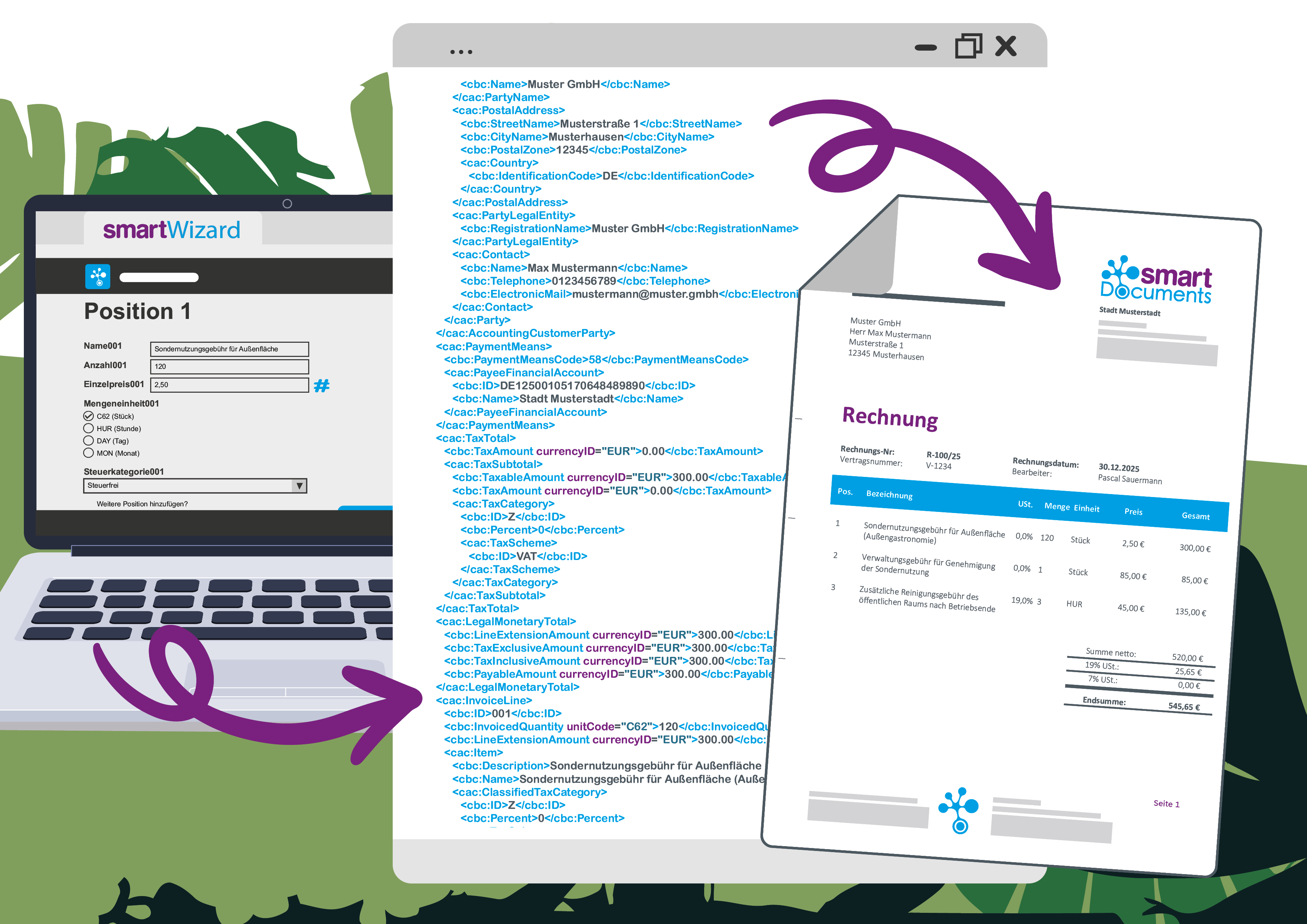
When creating new XRechnungen, users utilize our SmartWizard as the central input interface. The SmartWizard guides users in a structured and user-friendly manner through all relevant input pages and ensures that all information required for an XRechnung is captured completely and transparently. This includes, among other things, invoice data, supplier and ordering party information, as well as item-related details. Upon completion of data entry, SmartDocuments automatically generates a structured XML file that fully complies with the requirements of the XRechnung standard. The necessary transformation into the standardized XRechnung format is carried out fully automated, without any additional user intervention. In parallel with the XRechnung, a visually prepared document can optionally be created as a PDF or DOCX. This serves human readability, internal review, or archiving and complements the machine-processable XML invoice in a meaningful way. This allows structured data processing and classic document presentation to be optimally combined.
2. Data from third-party applications
Alternatively, XRechnungen can also be created based on data from existing specialist or pre-systems. In this scenario, there is no manual entry via the SmartWizard or only in a supplementary form. Instead, the necessary invoice data is transferred to SmartDocuments via interfaces, database access, or other integration mechanisms. SmartDocuments takes this data, checks it structurally, and automatically converts it into an XRechnung-compliant XML file. Here too, compliance with the XRechnung standard is fully handled in the background, regardless of the source of the data. Existing IT landscapes can thus be integrated into the XRechnung process without any media discontinuities. As with new creation via the SmartWizard, a visually prepared invoice document can also be generated as a PDF or DOCX in this case. This gives companies a uniform, legally secure solution for electronic invoicing – regardless of whether the data is entered manually or automatically taken over from third-party applications.
Conclusion
With SmartDocuments, XRechnungen can be created efficiently, legally compliant, and without in-depth technical knowledge. Existing processes remain intact, while all requirements for the XRechnung format are reliably met in the background. Organizations benefit from high automation, a clear separation between data capture and format compliance, and the ability to continue using visual invoice documents. This makes SmartDocuments a future-proof solution for electronic invoicing. The use of XRechnung offers concrete organizational and economic advantages for both public contractors and suppliers.