Blog post
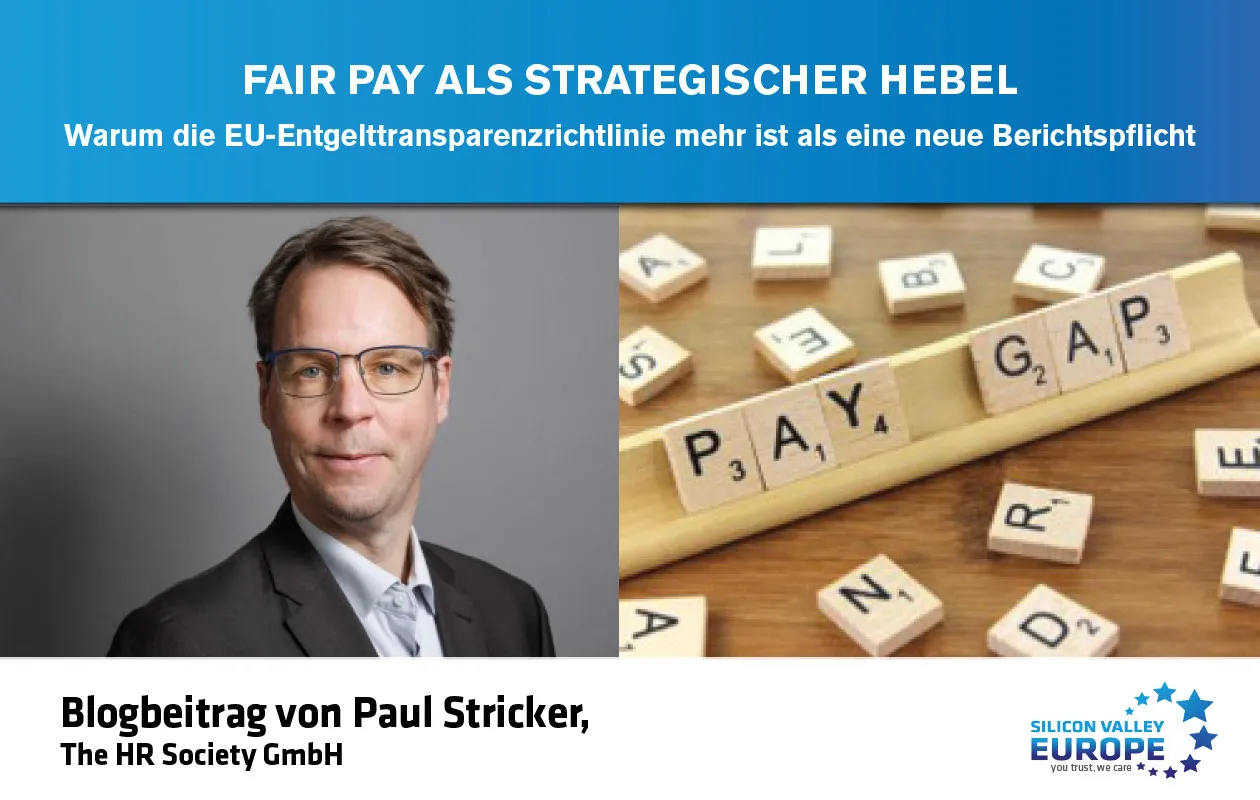
With the new EU Pay Transparency Directive, “Fair Pay” is becoming a binding reality for companies across Europe. What was often seen as an HR initiative or cultural signal is now taking on a clear legal dimension: transparency, documentation, and verification obligations are becoming mandatory – particularly for companies with more than 100 employees.
For managing directors and executives of SMEs, the question is no longer whether they should address the issue, but how strategically they should approach it.
The good news: those who implement Fair Pay early and systematically not only meet regulatory requirements – they also unlock sustainable competitive advantages.
1. The new legal situation: obligations, risks and pressure to act
The EU Pay Transparency Directive obliges companies, among other things, to:
• Transparency regarding salary bands during the recruitment process
• Clearly defined and documented criteria for salary decisions
• Regular reporting on the gender pay gap
• Active measures in the event of significant pay differences
• Extended rights of employees to request information
• Potential penalties for violations
For many SMEs, this means a paradigm shift. Historically grown, individual salary structures – often shaped by negotiation skills, length of service or situational decisions – are coming under scrutiny.
From a purely formal perspective, implementation is a compliance task. Strategically, however, it represents an intervention in remuneration systems, leadership culture and employer positioning.
2. Why waiting is not an option
In the SME sector, there is often a tendency to “wait and see” regarding regulatory changes until concrete deadlines take effect. With pay transparency, this is risky – for three reasons:
1. Reputational risk: Intransparent or inconsistent remuneration structures are quickly discussed – internally and externally.
2. Liability and cost risk: Lack of documentation or non-transparent salary differences can lead to back payments, legal disputes and reputational damage.
3. Competitive disadvantage in the labour market: The skilled labour market remains tight. Candidates increasingly expect transparency and fairness as standard.
Companies that only react when pressure mounts are usually on the defensive. Those that take proactive action can strategically position themselves on the issue.
3. Fair Pay as a competitive advantage
When implemented correctly, Fair Pay is not a cost factor, but a value driver.
3.1 Strengthening the employer brand
Transparent salary bands and clearly defined development paths build trust. They signal professionalism and fairness – two factors that are crucial, particularly for qualified specialists and managers.
3.2 Increased employee retention
Unclear or perceived as unfair compensation is one of the most common reasons for quiet quitting and fluctuation. Transparent structures reduce speculation and strengthen the perception of fairness.
3.3 Professionalisation of leadership
When salary decisions are no longer primarily driven by negotiation but are based on comprehensible criteria, the quality of leadership decisions increases. Managers gain more confidence and argumentative strength.
3.4 Strategic controllability
A structured compensation system enables better budget planning, clearer career paths, and more informed talent decisions. Compensation becomes a control instrument rather than a cost block.
4. Typical challenges in SMEs
In practice, recurring patterns emerge:
• historically grown individual decisions
• missing job evaluations or competency models
• inconsistent salary ranges
• little documentation of decision-making bases
• reluctance towards transparency due to concerns about unrest
These challenges can be solved – but require a structured approach and a clear positioning by the management.
5. From mandatory project to strategic initiative
For Fair Pay to have an impact, the topic should not be isolated within the HR department. Three factors are crucial for success:
5.1 Clear stance of top management
Compensation is a strategic control instrument. When the board or management visibly prioritises the topic, acceptance is created throughout the company.
5.2 Systematic analysis
A sound salary and structure check creates transparency about the current state, risks, and fields of action. This is not only about gender pay gaps but also about the coherence of the entire system.
5.3 Communicative support
Transparency without explanation creates uncertainty. Transparency with clear communication creates trust. Professional change management is therefore an integral part of implementation.
6. The strategic view ahead
Fair Pay is not a short-term trend, but an expression of a societal shift. Transparency, equal treatment and traceability are becoming the standard of modern corporate management.
For medium-sized companies, this opens up multiple opportunities:
• Positioning as a fair and modern employer
• Professionalisation of compensation and career architectures
• Strengthening corporate culture
• Increasing attractiveness in the competition for talent
The real question is therefore not how high the implementation effort is – but what strategic added value a well-thought-out compensation system creates in the long term.
Conclusion: Fulfill obligations – utilise potential
The EU Pay Transparency Directive sets a clear regulatory framework. It forces companies to address their compensation structures. However, if Fair Pay is seen exclusively as a legal obligation, potential is missed. For managing directors and board members of medium-sized companies, this is now an opportunity to turn a regulatory necessity into a strategic initiative – with positive effects on culture, reputation and competitiveness. Fair Pay is therefore not just a compliance issue. It is a leadership and future topic.
Contact
The HR Society GmbH
Paul Stricker
pstricker@hr-society.de
Tel.
+49 176 35 15 81 55
+43 699 1947 52 15