Exclusive interview with Waltraud Gläser
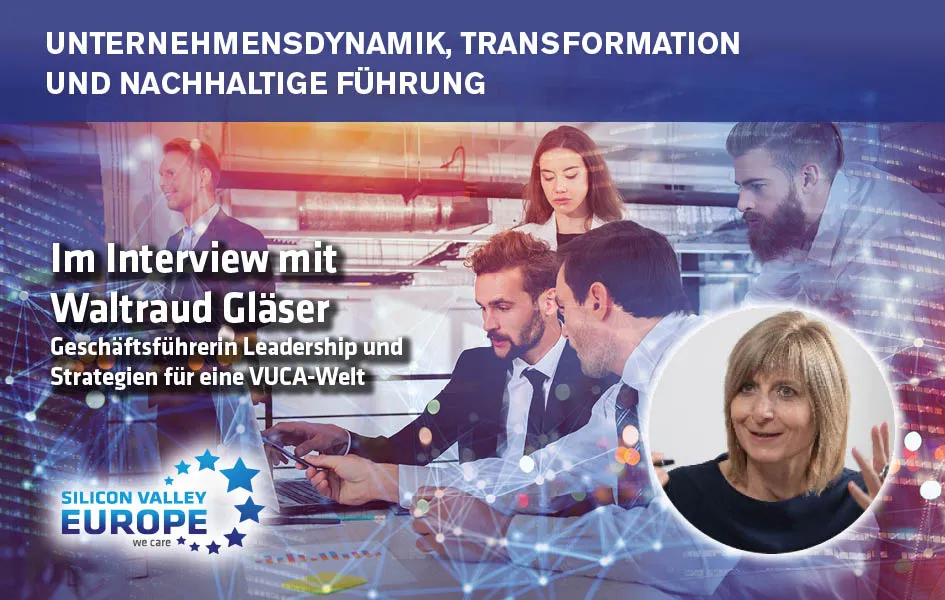
We are delighted to present you with an exclusive interview with the renowned expert in organizational consulting, Waltraud Gläser. In conversation with Silicon Valley Europe, we delve deep into the challenges and opportunities of modern corporate management and explore in particular the concept of VUCA—a mindset that helps companies successfully navigate our digital and disruptive world.
As a systemic organizational consultant, Waltraud Gläser views companies as living social systems that cannot be steered in a simple linear fashion. Instead of relying on standardized “best practices,” she focuses on recognizing, understanding, and changing interaction patterns, communication structures, and cultural dynamics. Her philosophy is based on “best thinking”—jointly developing individual solutions for sustainable change.
A key focus of her work is the Tag der Orientierung (Day of Orientation), an innovative approach to corporate analysis. This involves shifting perspectives in an open dialogue, identifying challenges, and jointly developing viable solutions. She also offers executives individual sparring that promotes reflection and further development, as well as inspiring keynotes and moderations that bring fresh impetus to mindsets and corporate structures.
In the interview, we also address another central topic of her work: the risk assessment of psychological stress, and we discuss the concept of VUCA, which is far more than just a buzzword.
Silicon Valley Europe: Ms. Gläser, you describe companies as living social systems. How does your approach differ from traditional management consulting?
Waltraud Gläser: The approach of viewing companies as living, social systems goes back to the German sociologist Niklas Luhmann and his systems theory, which he developed as early as the 1960s. According to this theory, the social system of an organization consists of people and their interactions, communication, attitudes, values, and identity, among other things. It is also divided into subsystems, so-called organizational units. This is where the greatest difference in basic understanding between organizational consulting and traditional management consulting begins. In traditional management consulting, the focus is on professional expertise, figures, strategies, and processes. The consulting approach is often linear and goal-oriented with regard to action plans and concrete implementation proposals, which are also frequently based on the “best practice” principle and therefore often correspond to a “one size fits all” approach. I view companies as complex, living systems with interactions. I first observe and understand “what is happening?” before addressing “what needs to be done?” My role as a consultant is that of a process facilitator who encourages reflection and jointly designs change processes with the system. The principles are dialogical, resource- and solution-oriented; they do not correspond to “patent recipes” and encourage “best current thinking,” because there is no single truth, but rather different perspectives that need to be considered.
Silicon Valley Europe: The “Day of Orientation” is an exciting concept. What exactly happens on this day and what insights do companies gain from it?
Waltraud Gläser: I developed this workshop concept precisely for the reason described above. When I am commissioned by a customer, I initially hear about things that are perceived as problematic and in need of change. It is therefore often only one perspective—the perspective of the management—that takes place during the initial clarification discussion. Where the shoe really pinches and what the difference is between symptoms and causes is often not initially understood. That is why I propose the “Day of Orientation” as an interactive workshop format at the beginning of a process facilitation to better understand the actual reasons for the need for action by involving the diverse perspectives of the people or organizational units within the company. I thus act as a kind of translator who helps the company understand the complex situation. The fact that employees are invited to participate also corresponds to at least one principle for successful change management. I have often experienced that the moderated dialogue that arises during the workshop is already part of the solution, and that the interest in jointly examining difficult situations in the company is perceived as highly appreciative.
Silicon Valley Europe: Executives in Europe’s Silicon Valley often face immense pressure. How can sparring with you help them make better decisions?
Waltraud Gläser: We live in a volatile, uncertain, complex, and ambiguous world—also known as the VUCA world—where “better” decisions are almost a secondary step. The first step is often simply the willingness to make a decision that could potentially be wrong. This is where many fall short. Out of fear of making the wrong decision in a complex, non-linear context, many companies opt for a “business as usual” approach. This is fatal and sends the wrong signals to an organization that expects its leaders to act decisively. In sparring sessions, we jointly examine challenges and problems and identify areas where action is needed. By gaining a better understanding of necessity, we can also shed light on patterns and beliefs that have previously guided corporate actions—and may need to be replaced or reshaped. Sparring also encourages looking at things from a different perspective and taking risks. I like to call this “thinking with no box” rather than “out of the box,” where the old box often remains intact.
Silicon Valley Europe: Psychological risk assessments are mandatory for companies. What challenges do you see in their implementation, and how can they be sustainably managed?
Waltraud Gläser: You are referring to § 5 para. 3 no. 6 of the German Occupational Health and Safety Act (ArbSchG), which stipulates that all employers, regardless of company size, must assess workplaces for potential psychological hazards—even with just one employee. This involves responsibility for their safety and well-being, as well as concrete, effective, and efficient measures to eliminate risks. The first step is to take the identified results seriously. However, this is often where the first challenge arises. For example, if quantitative overload is identified—something that could only be resolved by filling long-standing vacancies—the labor shortage may prevent closing this gap. In such cases, it is important to look for alternative solutions together with employees, such as redefining requirements. If, on the other hand, there is a need for clear and tangible leadership—which often correlates with some classic hazards—solutions can be implemented immediately, for example by reflecting on one’s own leadership understanding or making time for leadership development—provided that managers are willing to do so. In general, I recommend fostering a willingness for dialogue between employers and employees and providing opportunities for involvement as prerequisites for feasible and sustainable implementation.
Silicon Valley Europe: VUCA is still an abstract concept for many. Can you give an example of how companies can apply this concept in practice?
Waltraud Gläser: The term VUCA was coined in the 1980s by two university professors in the USA to prepare companies for a world increasingly characterized by volatility, uncertainty, complexity, and ambiguity. There is almost no greater VUCA than what we experience today, 40 years later. Therefore, the first step remains to analyze your own business and organizational model in terms of individual VUCA exposure and develop the ability to respond. This includes, for example, the impacts of digitalization and AI or the collaboration of different generations, which in turn influences organizational structure and culture as well as leadership understanding. In this context, the question also arises about the skills the company has needed so far and will need in the future. The second step is then to replace the original phenomena with vision, insight, clarity, and adaptability—the so-called VUCA Prime. This positive translation contains approaches and solutions that the company ideally develops and tests together with its employees. Dealing with VUCA also means a changed mindset. In addition to expanding your own contextual competence, it’s about adopting a both-and attitude instead of an either-or perspective. In modern terms, this is referred to as ambidexterity, meaning the ability to use both hands. Companies maintain what will endure while simultaneously creating the conditions for new developments, thereby increasing their VUCA fitness.
Silicon Valley Europe: What initial steps do you recommend for companies wanting to prepare for the VUCA world?
Waltraud Gläser: Most companies are already navigating the VUCA world successfully without being fully aware of it. However, past success does not automatically guarantee future success. It’s therefore helpful to understand what the previous success factors were and whether they will remain relevant in the future. Fundamentally, a greater emphasis on systemic thinking and understanding is important, especially as complexity increases. Due to the dynamics in a digitalized and increasingly fragmented world, predictability decreases, which is why traditional forecasting processes should be replaced with backcasting. This approach enables thinking and planning “backwards” based on future scenarios, allowing for earlier adjustments—something that also aligns with the principles of agile working.
Silicon Valley Europe: How can a corporate culture be created that not only allows but actively promotes change?
Waltraud Gläser: First, I’d like to define corporate culture as the observable behavior of people within an organization. The well-known saying that nothing is as constant as change should be the guiding principle for companies. Shaping change and the necessary adaptations is therefore part of the DNA of future-ready organizations. However, this requires consistent and coherent communication, as well as a view of people that assumes they do not resist change itself, but rather the idea of having to change—often without being asked or informed. Here, it is wise to understand and apply the principles of successful change and transformation management. This includes inviting employees to help shape change processes and take on the responsibility required for them, rather than imposing change from above and hoping it will work out. Other important aspects include trust and confidence from leaders, as well as a willingness to continually adjust—for example, through regular feedback and jointly finding more suitable approaches to best address challenges and problems. In summary, companies need a culture of responsibility that replaces a common “(not) responsible culture.”
Silicon Valley Europe: What mistakes do you frequently observe in change processes, and how can companies avoid them?
Waltraud Gläser: I often observe that reactions come far too late. The English say, “no pain, no gain,” while in German we say, “people learn from love or suffering.” Too often, suffering is the trigger for actively tackling necessary changes. These are costs that companies incur, which could be avoided—for example, if preparing for a changing business world were recognized as a continuous investment in corporate development. This includes knowing trends, proactively observing markets and developments, not resting on past successes for too long, and—above all—focusing on the customer as the purpose of the business rather than self-absorption. It means thinking from the market’s perspective about the consequences for the business model. A core principle of agile approaches is exactly this—it’s about involving the customer in the business strategy and collaboration models that enable collaboration and co-creation.
Silicon Valley Europe: What role do digitalization and new technologies play in organizational consulting and the development of resilient companies?
Waltraud Gläser: Digitalization and new technologies play a central role. They not only change the way organizations work but also the approach to strategic corporate development. Digitalization is not an end in itself, but a strategic tool for strengthening resilience, agility, and innovation capability. That is what I convey to my customers. It is about the interplay between technology competence, change capability, and systemic thinking. Consulting can act wonderfully as an enabler of digital transformation and, through guidance tailored to the company, can support not only the use of new technologies but also topics such as cultural change, new leadership models, competence building (digital skills), establishing innovation structures, and introducing agile working methods. This in turn strengthens the resilience and responsiveness of a company. Incidentally, it should be mentioned here that there are funded programs, such as INQA-Coaching, for which I am accredited as a consultant. SMEs receive 80 percent funding with a personal contribution of €2,400 for a process that lasts 7 months and helps lay the foundation for an attractive and resilient organization.
Silicon Valley Europe: What is your most important message to leaders who want to future-proof their company?
Waltraud Gläser:My most important message to leaders is: "Future viability is created at the intersection of technology, culture, and purpose."
In a world characterized by uncertainty, complexity, and digital change, it is no longer enough to focus solely on efficiency or short-term growth. Instead, leaders must concentrate on three central areas:
Strategically leverage technology – don’t digitalize blindly
Build and expand a resilient and learning culture
Provide meaning and direction
Silicon Valley Europe: Thank you very much for this detailed conversation and the great messages we can send to our readers with it.