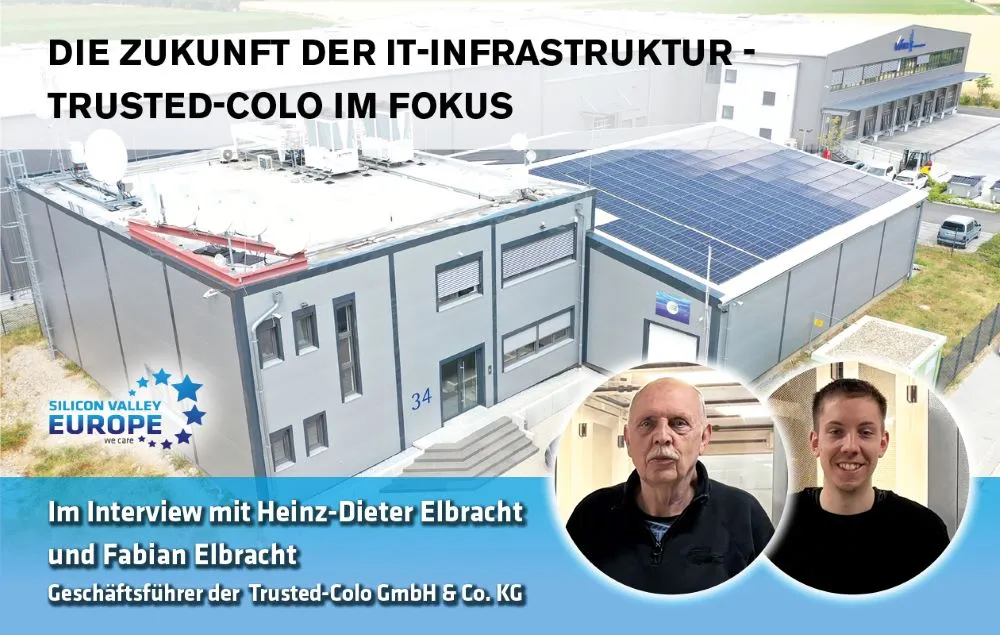
in the exclusive interview with Heinz-Dieter Elbracht and Fabian Elbracht, Managing Directors of Trusted-Colo GmbH & Co. KG
IT infrastructure requirements are constantly growing, especially for small and medium-sized enterprises (SMEs). Secure, high-performance, and sustainable solutions are provided by colocation data centers. But what exactly does this concept entail, and what benefits does it offer to businesses?
In an interview with Heinz-Dieter and Fabian Elbracht, Managing Directors of Trusted-Colo GmbH & Co. KG, we explore these questions. The company operates a state-of-the-art colocation data center in Alsbach-Hähnlein and enables businesses to run their IT infrastructure in a secure and professional environment.
A key aspect of the discussion is why SMEs in particular can benefit from outsourcing their IT. What specific advantages does Trusted-Colo offer compared to other providers? How does the company ensure sustainability, and what role does energy efficiency play in modern IT? We also take a look at the process of moving into a colocation data center and the challenges to consider.
With fail-safe TIER IV standards, redundant infrastructure, and direct connections to Frankfurt, Trusted-Colo positions itself as a future-proof solution for companies with high demands on security and performance.
Silicon Valley Europe: Mr. Elbracht, many companies still run their IT in-house. What exactly is a colocation data center, and why should companies consider taking this step?
Mr. Heinz-Dieter Elbracht:
A colocation data center is a specially designed, highly secure facility where companies can securely host and operate their own IT systems and servers. Unlike traditional on-premises operations, where companies run their IT infrastructure on their own premises, a colocation provider supplies the physical environment, power supply, cooling, network connections, and security measures. Companies retain full control over their hardware and data while benefiting from the advantages of a professional data center environment.
Silicon Valley Europe: What specific benefits does outsourcing IT to your data center offer, particularly for small and medium-sized enterprises?
Heinz-Dieter Elbracht:
Outsourcing IT to a colocation data center offers small and medium-sized enterprises many advantages typically reserved for large corporations. For one, high investment and operating costs are eliminated, as infrastructure, cooling, and security measures are shared among multiple customers. Modern data centers feature highly available and redundant cooling systems that extend hardware lifespan and efficiently manage energy consumption. Additionally, companies benefit from highly available, redundant power and internet supply, significantly increasing failover security.
Another crucial point is security: Modern data centers provide physical access controls, fire protection, and cybersecurity measures at the highest level. They also meet important compliance standards such as ISO 27001, which is essential for companies handling sensitive data.
A major advantage is scalability: IT resources can be flexibly adjusted without worrying about expanding operational infrastructure. At the same time, the internal IT department is relieved of maintenance and operational tasks, allowing it to focus on strategic projects instead.
Overall, colocation offers SMEs a secure, high-performance, and cost-efficient alternative to an in-house server room—with professional infrastructure, predictable costs, and future-proof technology.
Silicon Valley Europe: IT security is a central issue for companies. How do you ensure that your customers' data is optimally protected?