In conversation with Harald Kirsch - Founder of Transformation Z
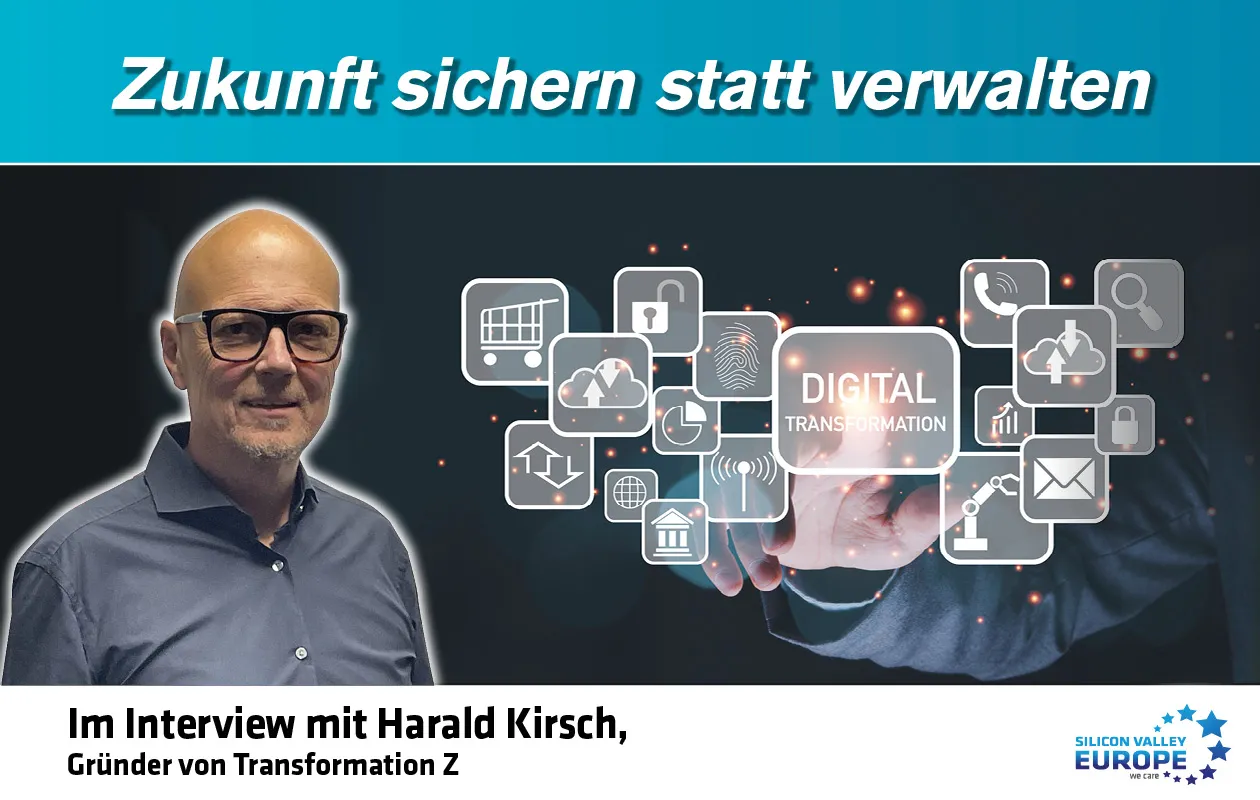
Securing the future instead of just managing it – In conversation with Harald Kirsch – founder of Transformation Z
In an era where technological leaps, global uncertainties, and societal change challenge and transform companies alike, voices that provide orientation are needed. One such voice is Harald Kirsch – a strategic business developer, technology manager, and thought leader for digital future viability. With over twenty years of leadership experience in industry, IT services, software, and special machine construction, he combines technological depth with entrepreneurial clarity. This very mix makes him one of the most exciting interview partners of our time.
For Silicon Valley Europe, I conduct an exclusive interview with an expert who doesn’t just talk about transformation but actively shapes it. We explore why continuous business model development is now a must rather than an option, how intrapreneurs become strategic enablers within companies, and why resilient digital platform structures determine future success or stagnation.
Harald Kirsch shows what modern organizations need to not only survive but thrive in a VUCA world: robust IT emergency planning, genuine digital resilience, data-driven decisions, and a corporate culture that takes learning, innovation, and responsibility seriously.
Another focus: his consulting approach “Transformation Z”. He explains how companies can use a systemic future viability check to identify their strengths and weaknesses, reorder priorities, and develop sustainable strategies – from regulatory requirements to stakeholder needs and innovation potential. The result: greater resilience, clearer decisions, and a strategic advantage in global competition.
Get ready for an interview that speaks plainly: about the opportunities and risks of digital transformation, about leadership in complex international structures, and about the question of how companies must act today to succeed tomorrow. This discussion provides impetus, background, and real-world perspectives – for anyone who doesn’t want to wait for the future but shape it.
Silicon Valley Europe – How important do you consider continuous business model development in responding to technological and societal changes, and what key competencies do companies absolutely need today?
Harald Kirsch – “For me, continuous business model development is no longer an extra – it’s a management discipline. It’s not something you do every few years in a strategy project, but something that must be permanently embedded in operations.
Why? Because several forces are acting simultaneously right now: AI and automation are changing value creation at breakneck speed, and then there’s sustainability, regulation, demographics, and a palpable shift in values. If I’m operating with a static business model in this environment, I quickly lose relevance.
The important thing, however, is this: “Continuous” doesn’t mean chaos, erratic behavior, or knee-jerk reactions. On the contrary. What’s needed is a robust vision—something that provides credible guidance—and then a target system that is adaptable and scalable. In other words, stable in direction, flexible in approach.
And companies need a few core capabilities to achieve this:
- They must think about market and technology together—not business here and IT there.
- They must consistently think from the customer’s perspective, not from their own organizational chart.
- They must understand ecosystems: partners, platforms, data, services.
- And they must be able to experiment—test hypotheses, learn, and scale.
- That’s the new pace of business.
My conclusion: Most companies don’t fail because of a lack of technology.
The “hands-on mentality”—a practical, implementation-oriented attitude where someone doesn’t just plan, analyze, or delegate, but takes responsibility and gets things moving—has somehow gotten lost.
And so, many companies fail because they’re unable to prove that it works and because they lack the ability to continuously develop their organization and business model based on market insights and their own findings.”
Silicon Valley Europe - What role does intrapreneurship play in modern organizations? And how can companies support those “lateral thinkers” who identify future fields of action early on?
Harald Kirsch - I’d like to take a broader view on this topic:
When it comes to intrapreneurship, we repeatedly see systematic errors—especially in how purpose and ownership are handled.
Many companies invest a great deal of energy in purpose statements, guiding principles, and narratives. The weakness, however, lies less in the wording than in translating these into everyday practice. Purpose often remains abstract, emotionally charged—but operationally ineffective.
A key mistake is confusing purpose with motivation.
Purpose should create meaning, but is often understood as a communication tool – not as a decision-making logic. Leaders reference purpose in speeches but continue to make everyday decisions purely based on KPIs. This inconsistency breeds cynicism and undermines trust.
Another weakness is the decoupling of purpose and ownership.
If purpose is not clearly linked to responsibilities, priorities, and decision-making rights, it remains ineffective. Employees are expected to act “in the spirit of the purpose” without knowing where they are actually allowed to decide – and where not. This leads to uncertainty rather than entrepreneurial action.
Often, purpose is defined top-down but not anchored within the team.
It is announced rather than collectively translated. Teams understand the “why,” but not the “what does this mean for us in concrete terms?” or “Which conflicting goals are we allowed to resolve in line with the purpose?”
Modern intrapreneurship therefore means understanding purpose as a working tool – not as a guiding motif.
Purpose must help make decisions, set priorities, and take risks. This is precisely where the connection to intrapreneurship lies: intrapreneurs and innovators need a clear sense of purpose within which they are allowed to experiment – not just inspiring slogans.
At the same time, this shows why intrapreneurship is increasingly less a solo effort. Purpose only takes effect through team collaboration: when goals are negotiated together, ownership is clearly assigned, and leaders actively create space for responsibility instead of demanding it rhetorically.
Without this clarity, purpose becomes a brake rather than an accelerator – and intrapreneurship remains mere lip service.
“For me, intrapreneurship is a key factor if companies truly want to remain future-proof. It is the mechanism through which entrepreneurial thinking systematically comes from within – rather than seeking innovation only externally, from start-ups or acquisitions.
Intrapreneurs are close to customers, products, and technologies. They often see new problems earlier than any strategy department.
And they also serve as a bridge: they connect core business with future topics – and prevent innovation from happening in an ivory tower or from merely optimizing the status quo.
Why are these “drivers or lateral thinkers” still often held back?
Because many organizations officially want innovation but in practice reward conformity. Short-term KPIs dominate, mistakes are penalized, and hierarchies decide on budgets – not hypotheses.
Good ideas then remain informal or people leave.
What helps?
- Protected spaces. Time, budget, sponsorship – and a real separation between exploration and day-to-day business.
- Rethinking leadership. Top management sponsorship is not an option; it is a prerequisite.
- Incentives. Those who try something new must not risk their careers.
- And fourth: methods – so that thinking outside the box also becomes actionable, with business model innovation, lean approaches, and market validation.
Intrapreneurship is therefore not just a cultural issue, but a structural and strategic one. Companies that want to promote intrapreneurs and lateral thinkers must: provide spaces, share risks, reward learning, and scale successes.
And one point that is becoming increasingly important to me:
From a long-term perspective, promoting intrapreneurship also addresses a very critical development: the “drying up” of leadership skills in companies, because demographic change has now created a leadership problem. There is a wide gap between the “old guard” and the “young potentials.”
To illustrate this, I would like to refer to two examples that I use in my lectures on, for example, business startups, strategic career planning, requirements engineering, or building digital ecosystems:

This trend must be countered sensitively.
Silicon Valley Europe - Digital platforms and ecosystems are considered the heart of future business models. How can resilient platform structures be built – especially when transitioning from classic architectures to modern digital systems?
Harald Kirsch - “Building resilient digital platforms is, in my view, not an IT project, but a strategic transformation task. It affects technology, organization, and business model simultaneously.
And I would clearly define resilience here:
- Resilience is not just high availability.
- Resilience means: remaining functional under change.
- Technically robust, organizationally adaptable, and ecosystem-friendly – meaning attractive for partners and developers as well.
The biggest hurdle during the transition is usually entrenched – “legacy” structures: monolithic systems, tightly coupled, business logic deeply embedded, slow release cycles, governance as a brake – and often no real API- or platform-thinking.
What works is rarely a big bang. I recommend controlled evolution instead
- Decouple step by step, for example using Strangler approaches, Blue-Field strategies, modularization along business domains and clearly defined services.
- Then comes API-first. APIs are products and not an afterthought.
- Add event-driven design, because loose coupling creates speed and adaptability.
- Cloud-native principles help – but cloud is not an end in itself; companies need to carefully consider in which dimension they want to take this step.
- Resilience must be designed in from the start: observability, automation, CI/CD, infrastructure as code.
And most importantly: Rethink governance. Less control, more orchestration. Clear rules, standards, roles – so that innovation is possible without creating chaos.
In the end, the following applies:
- Platforms rarely fail due to technology – but because
requirements, priorities and target systems were not clearly defined.
the benefits for third parties are not clear. - Developer experience, monetization, partner value – these must be consciously designed.”
Silicon Valley Europe - Many companies are digitalizing processes without considering their business-critical dependencies. How can we ensure that IT emergency planning and continuity management keep pace with digital transformation?
Harald Kirsch - “This is really an underestimated risk:
- Many digitalize processes locally, but they do not understand the end-to-end business-critical dependencies. Then the organization becomes more efficient – but also more fragile.
- The key is to see IT emergency planning and business continuity not as a downstream compliance issue, but as an integral part of the transformation.
- Classic BCM approaches often fall short because digital transformation creates new dependencies: cloud, SaaS, APIs, partner platforms – and the failure patterns are different. It’s not just about ‘system down’, but about degraded services.
That’s why I always start with a change of perspective: away from systems, towards services.
Also: Which end-to-end services are business-critical – including processes, data, people and third-party providers? This requires service maps, not just application lists.
Then the Business Impact Analysis needs to be redone: impacts on revenue, security, reputation – and from this, RTO/RPO are derived from a business perspective, not based on IT feasibility.
Furthermore, resilience must be embedded in the architecture: decoupling, targeted redundancy, “graceful degradation”.
Key takeaway: Resilience is an architectural decision – not merely an operational measure.
And cloud does not mean “outsourced”. Exit strategies, provider failure scenarios, region outages – these all belong in BCM.
Emergency capability must be co-developed, for example through failover tests or chaos engineering – not retrofitted. Or rather, with regard to the temporal, logical and functional relationship between “predictive” and “preventive” measures – especially in the areas of risk management, maintenance, BCM, security and AI-supported systems.
So:
- Predictive identifies what could happen
- Preventive prevents it from happening.
A final thought on the topic of AI, because in my view this technology will play a key role in dealing with risks and crises.
If you pull together all the previous aspects, then AI primarily changes our attitude towards resilience. We are moving away from static emergency plans and towards learning systems. Away from reacting – towards anticipating.
AI helps us detect weak signals earlier, make dependencies visible and better prepare decisions under uncertainty. But it does not absolve us of responsibility. It creates clarity – people must still make the decisions.
And that is exactly the point: resilience is not created by technology alone, but through the interplay of data, architecture and leadership. AI is a powerful amplifier in this context – but only if it is integrated into business logic, decision-making processes and accountability.
Perhaps it can be put this way: The future of BCM is not automated, but anticipatory. And that is exactly where AI transitions from a tool to a genuine strategic lever.”
Conclusion: “Digital transformation can increase operational efficiency. Without integrated BCM, however, it shifts the risk profile – and increases the organization’s systemic vulnerability.”
Silicon Valley Europe - You often talk about the “Data-Driven Company.” What skills, methods, and cultural prerequisites must companies establish to truly embed data-driven decisions in everyday practice?
Harald Kirsch - “A Data-Driven Company doesn’t emerge from dashboards. It emerges when data truly steers decisions in daily operations. Many companies have data—but they use it more for information or justification than for decision-making.
There are three levels: skills, methods, and culture.
- Skills mean: leaders must be able to translate business questions into data questions. And they must understand that data isn’t just about providing ‘proof’—it involves uncertainty, causality, and forecasting. Understanding analytics and AI is now part of management competence.
- Methodologically, what matters to me is this: the starting point is the decision, not the report. Who decides what—what options exist—and which data influence this decision? Then we work with hypotheses and experiments instead of opinion debates. And we embed analytics where decisions are made: in workflows, systems, and processes—not as a monthly report.
- And culturally, things get really interesting: leadership must visibly model data-based decision-making. Data can also be uncomfortable and disprove hypotheses. Psychological safety is essential. Otherwise, no one will use data honestly.
In short: being data-driven isn’t about more data—it’s about better decisions.”
Silicon Valley Europe - In your projects, the interplay of technology, organization, and people plays a central role. Why is this collaboration crucial for sustainable innovation?
Harald Kirsch - “Because innovation ultimately doesn’t fail due to technology—but due to acceptance. And acceptance is a human issue.
Technology can work. Organizations can define processes—but if people are afraid, innovation gets blocked.
I experience this in almost every transformation project: fear of job loss, loss of control, uncertainty. And from that quickly arises something like digital paranoia.
People ask themselves: Will I be replaced? Will I be monitored? Will I lose significance?
From a psychological perspective, a mechanism often underestimated comes into play here: cognitive dissonance.”
People know rationally that digitalization, automation, or AI are necessary—for competitiveness, efficiency, or securing the future. At the same time, they experience an emotional threat to their role, their competence, or their self-worth.
This inner contradiction creates tension. And this tension is rarely addressed openly. Instead, it is resolved by relativizing, delaying, or devaluing the new.
Then it’s not: “I’m afraid of change,” but rather:
- “The technology isn’t mature yet,”
- “That doesn’t fit our culture,” or
- “We don’t need that right now.”
Digital paranoia is therefore often not a rejection of technology, but a self-protection mechanism.
An attempt to balance internal contradictions between knowledge, expectations, and one’s own identity.
If these tensions remain unaddressed, resistance arises—openly or covertly. Then new developments are circumvented, slowed down, or used only pro forma.
Organizations play a key role here. They decide whether technology is experienced as a threat or as an enabler.
Unclear roles, contradictory messages, or a logic reduced purely to efficiency amplify cognitive dissonance—and thus fear.
Clear responsibility, involvement, and genuine development perspectives, on the other hand, help to resolve these tensions.
And technology itself is never neutral. It changes power, transparency, and decision-making spaces. If this is not openly discussed, mistrust arises—especially with AI and automation.
Sustainable innovation therefore only succeeds when all three dimensions are considered together:
- Technology as a tool, not a replacement.
- The organization as a framework that provides security.
- And the human as an active shaper, not an object of transformation.
Or, to put it more sharply:
- No acceptance, no use.
- No use, no impact.
- And without impact, every innovation is expensive—and above all, wasted time.”
“Digital paranoia arises where technology is introduced without providing meaning, security, and perspective—and where cognitive dissonance is not resolved, but ignored.”
"When it comes to AI, success is not determined by the algorithm itself, but by the trust of the people who are supposed to work with this technology."
Silicon Valley Europe - How can companies systematically identify the opportunities and risks for their core business – and which tools do they use to make dependencies and priorities in business models visible?
Harald Kirsch - "The most important shift in perspective is this: Not just collecting trends, but understanding how they impact your own business model. To do this, you need to explicitly model your core business – not assume it implicitly.
"The crucial point is to first structure complexity clearly – before evaluating it. Many companies jump too quickly into trends, solutions, or technologies without truly understanding what they actually need and why.
"The first step is always the same: Structure complexity clearly before evaluating it. Many companies jump straight to technologies – currently often AI or cloud – without having clarified why they actually need them.
For me, this starts with proper requirements engineering. I deliberately call it the mother of all methodological skills. Because this is where it is decided which problems are relevant, which goals are pursued – and which assumptions underpin the business model.
This is particularly crucial in the context of AI. AI amplifies what already exists: good requirements just as much as bad ones. If goals, decision-making logic, and quality criteria are unclear, AI does not scale intelligence – it scales uncertainty.
Requirements engineering helps to make these foundations explicit:
- Which decisions should be improved?
- Which processes are truly business-critical?
- What data is needed – and with what quality?
- And where do acceptance, risk, or compliance boundaries lie?
Based on this, we model the core business – for example using the Business Model Canvas, value chains, or service blueprints. The goal is transparency about value propositions, revenue logic, and above all dependencies.
Another key step is making critical assumptions visible. Every business model is based on hypotheses. AI can help test these hypotheses more quickly – but only if they have been clearly formulated beforehand.
External impulses such as technology, regulation, or market changes are then specifically reflected in the model.
Dependency Maps, capability maps or service and platform maps reveal cascade effects, lock-ins and single points of failure – particularly in data- and AI-driven architectures.
Ultimately, it’s about prioritization and decision-making:
- What do we secure?
- Where do we invest strategically?
- And where do we consciously say no?
In summary:
Without robust requirements engineering, companies discuss solutions.
- With robust requirements engineering, they decide on impact.”
- “Requirements engineering is not a technical discipline – it is the strategic basis for decision-making.”
- “Many transformation problems are not technology issues, but poorly formulated requirements.”
Let me illustrate this using AI as an example:
“If you introduce AI without having formulated the right questions clearly, you’ll quickly get very precise answers to the wrong problems.”
Only when these requirements are explicit can opportunities and risks be meaningfully analyzed.
Silicon Valley Europe - The consulting model “Transformation Z” focuses on the future viability of organizations. What typical insights do companies gain when they have their digital maturity assessed?
Harald Kirsch – “Companies gain strategic clarity above all – not just about how digital they are, but about how future-proof they truly are. And something very important often happens: they regain the courage to act.
There are typically five areas of insight:
- Where digitalization creates real business value – and where only technology is being modernized. Many are digital in support processes, but the impact in core business remains small.
- Invisible dependencies. Maturity assessments reveal lock-ins and structural risks – in terms of organizational structures, systems, providers and platforms.
- The gap between strategy and implementation. Many have great strategies, but the organization isn’t aligned with them – roles are unclear, governance is holding things back.
- Data and AI maturity. Data exists, but decisions remain intuitive. Trust in data quality is lacking, and AI doesn’t scale.
This is not a school grade. This is a basis for decision-making.”
The Transformation-Z approach uses the findings from the topics described above and reflects them in a coaching and mentoring model for harmonizing and further developing organizational, process, and system landscapes
The challenge of digitalization in SMEs can no longer be described by a single term.
Key topics such as innovative or sustainable technologies, digitalization, cybersecurity, intelligent applications, and proactive action are already on the agenda of many successful company leaders—and it pays off.
According to studies by leading analysts, increasing digital transformation can lead to positive revenue growth and significant improvements in profitability.
Poorly digitalized processes, on the other hand, are characterized by strong heterogeneity, high complexity, and numerous media and system gaps. This often results in inefficient and costly processes as well as error-prone workflows. This is further compounded by fluctuating quality of process results within and between process variants, as well as a lack of flexibility due to rigid, latent scalable, and decentralized processes.
Against the backdrop of strong growth in the German SME sector, flexibility in adaptation and scalability will be key requirements for business processes in the future.
To address these challenges, implementing a central Digital Innovation HUB within a corporate network is ideal. This increases the degree of automation and digitalization of existing processes by replacing local and partly manual process variants with centralized and standardized processes, which in turn are based on a uniform and consistent system support.
In addition to these benefits of leaner and automated processes, a central Digital Innovation HUB also creates the structures needed to continuously and easily implement further optimization and transformation initiatives (keyword: “change organization”) through the concentration and standardization of processes.
This helps overcome today’s barriers to digital transformation, such as high investment costs due to a lack of standards or poor forecasting ability due to opaque business processes.
A central Digital Innovation HUB supports the development of skills, value creation, quality, efficiency, flexibility, and the automation and digitalization of business processes
- The replacement of decentralised process variants increases:
- process quality and efficiency
- flexibility for adapting and scaling processes
- potential for cost reductions
Centralised deployment of best practices enhances process performance by:
- reducing media and system discontinuities
- providing employees with continuous tool-based support throughout workflows
- replacing systems and integrating them without costly ERP solutions
Company-wide optimisation potential is realised for:
- digital transformation
- establishing a change organisation
- and the associated ongoing transformation
The Digital Innovation HUB creates added value by pooling expertise within a corporate network. It also serves as an advisory body for companies on future viability issues, such as:
- building a learning organisation, to respond flexibly to external and internal influences and continuously evolve
- building trust through a lived culture of trust within established ecosystems of cooperating networks
- forming an agile ecosystem, that drives digitalisation through cultural agility and ensures economic agility
- initiating learning-by-doing programmes
- developing systemic thinking, particularly in requirements engineering
Silicon Valley Europe - Many organisations are struggling with globalisation, skills shortages and accelerated innovation cycles. What specific steps do you recommend to become more resilient and competitive under these conditions?
Harald Kirsch - “Under these conditions, optimisation is no longer enough. What is needed is a practical approach that simultaneously addresses strategy, organisation, technology and people.
- Focus. A maximum of a few action areas, ending projects that do not contribute. Make resources effective instead of distributing them.
- Secure critical capabilities. Capability mapping, making dependencies on people and locations visible, building knowledge redundancies.
- Align the organization for speed. Product- and value-stream-oriented teams, decision rights delegated downward, clear guardrails instead of micromanagement.
- Technology as a resilience lever: modularization, API-first thinking, embedding resilience requirements into architectural decisions.
- Actively manage globalization: transparency over dependencies, dual sourcing, strategic partnerships.
- Strategic approach to skilled labor shortages: upskilling/reskilling, attractive learning paths, automation and AI to relieve pressure.
- Institutionalize innovation: mandates, budgets, intrapreneurship, systematic experimentation.
- Leadership and culture – enablers rather than gatekeepers, a culture of learning from mistakes, clear communication.
My conclusion: Resilience is not achieved through maximum efficiency, but through conscious prioritization, robust bundling of key capabilities or core competencies, and a “learning organization.”
Silicon Valley Europe - What significance do social and ecological factors have today in strategic corporate development – and how are they changing leadership requirements?
Harald Kirsch - Today, social and ecological factors are not merely supplementary but have a structurally formative significance in strategic corporate development.
They are no longer just questions of compliance, reputation, or sustainability reports – they directly influence business models, investment decisions, supply chains, talent acquisition, and innovation capacity.
What has fundamentally changed is the expectation: customers, employees, investors, and regulators no longer accept a separation between economic success and social responsibility. Companies are no longer judged solely on what they earn, but on how they earn it.For leaders, this means a clear shift in roles. They must actively manage trade-offs between growth, efficiency, social responsibility, and ecological impact – and make these tensions transparent rather than simplifying or suppressing them. Leadership thus becomes less about control and optimization, and more about providing orientation, integrity, and the ability to make decisions under uncertainty.
In summary:
“Social and ecological factors are no longer ‘soft issues.’ They are hard determinants of competitiveness, risk, innovation, and access to capital.”
What was once compliance now directly impacts customer decisions, employer attractiveness, ESG ratings, and supply chain stability. Sustainability is becoming a differentiator.
And it is transforming leadership: managers must simultaneously steer economic, environmental, and social goals—including conflicting objectives. This requires systemic thinking: flexible supply chains, stable ecosystems, and long-term impacts.
Credibility also plays a key role. Greenwashing is a trust killer. Trust is becoming the new currency of leadership. And stakeholder management is becoming more dialogic—with employees, customers, the public, and partners.
In short: Social and environmental factors are no longer a specialist topic—they are now part of modern leadership.”
Silicon Valley Europe - You have decades of experience in international, cross-functional teams. Which leadership principles do you consider indispensable in an increasingly complex world?
Harald Kirsch - “For me, leadership in complex environments shifts from control to enablement—and from control to trust.
- Clarity about direction, not about every step. Target images, priorities, guardrails—and transparent decision-making logic.
- Trust is a productivity factor. Delegate responsibility where competence lies. Treat mistakes as learning opportunities. Reliability over formal authority.
- Think systemically instead of in silos. Consciously manage end-to-end value streams, dependencies, and conflicting goals.
- Decide under uncertainty—hypothesis-driven, provisional, with course corrections. Speed beats perfection.
- Leverage diversity—create psychological safety and moderate conflicts productively.
- Institutionalize learning. Today, we already face the major challenge that technology is evolving faster than the required number of experts who can master the use of new technologies. Knowledge becomes obsolete quickly; learning ability is the new stability—in collaboration with established ecosystems whose participants can support me immediately if needed.
- Communicate purpose and responsibility. People follow attitude, not PowerPoint.
Direction over detail, trust over control, system over silos, learning over knowledge, attitude over hierarchy.”
To make this more concrete, I have applied it to our introductory aspect of intrapreneurship:
An intrapreneur is an “entrepreneur within a company.” Intrapreneurs share the same entrepreneurial mindset as entrepreneurs but work within an existing company and are responsible for driving innovation and change.
Typical characteristics of an intrapreneur:
- Innovation: Intrapreneurs are creative, systemic thinkers who seek ways to improve processes and products within the company or create new business opportunities.
- Proactive problem-solving: Intrapreneurs take responsibility and are willing to tackle challenges independently without waiting for solutions to be handed to them.
- Learning and solution platforms within the company and in the ecosystem. To be able to respond quickly to acute changes
- Collaboration: They work closely with other departments or teams and often bridge different areas within the company.
- Risk management: While entrepreneurs often take big risks, intrapreneurs typically operate in a safer environment and must minimize and manage risks instead.
- Leadership without formal authority: Intrapreneurs must be able to inspire and motivate others even without holding a formal leadership position.
- Company understanding: They must have a deep understanding of the company's strategy and culture to act successfully within the organization.
Silicon Valley Europe - In conclusion: What message would you like to share with decision-makers in Europe who want to set a clear course for the future of their companies?
Harald Kirsch - “My message to decision-makers in Europe is quite clear:
Future viability does not come from waiting or playing it safe, but from decisive action – based on your own strengths.
Europe does not need to copy platform capitalism or chase other models.
We are strong in industry, engineering, quality, security, and complex B2B ecosystems. That is not a disadvantage – it is the starting point for differentiation in the digital age.
What we need is the courage to focus. Many companies get sidetracked between efficiency, digitalization, and sustainability.
The future is not created by ‘more of everything’, but by clear priorities – and deliberate non-decisions.
Technology is a means to sovereignty. Digital dependencies are strategic risks.
That’s why:
Build platform and data expertise, create resilient architectures, strengthen European partnerships – not out of protectionism, but to secure our ability to act.
And we must not forget the people: qualification, empowerment, meaningful work environments, leadership that builds trust. Technology only scales where people support it.
If I were to sum it up in one sentence:
The future is not just a question of speed – but of clarity in thinking, consistency in action, and attitude in leadership.”
Closing remarks – “Thank you for the conversation.
I hope we were able not only to provide perspectives, but also to inspire courage – for confident, consistent action.”