In the interview with Adrian Nitu, Business Unit Manager at Berg Software.
Berg Software is a software company run by Romanian-German owners with nearly 30 years of solid experience in implementing complex IT projects worldwide. Core competencies include, among others, digital transformation, custom application development, business intelligence & advanced analytics, cloud, SAP, technical support & maintenance. The key premise is to specifically address the unique needs of clients in optimizing their data-driven workflows.
DIGITAL FUTUREmag: Mr. Nitu, your goal is to provide customers with the best possible complete software solutions to sustainably ensure their individual digital (data) transformation. Especially in the current corona pandemic, this is an absolute must so that companies can continue to reliably run their own business processes despite home office regulations for employees or the temporary ban on maintaining face-to-face business relationships, right?
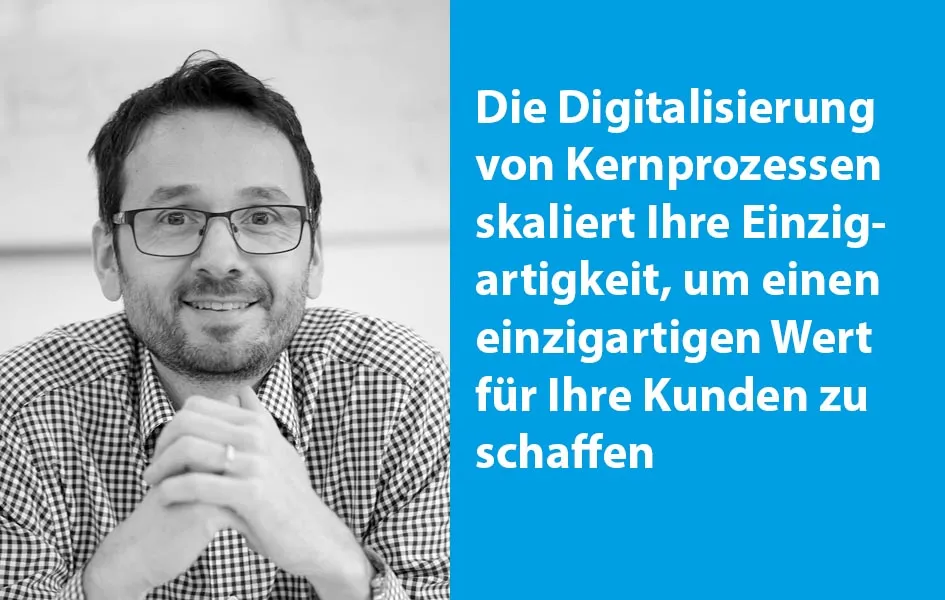
Adrian Nitu: Absolutely. In times like these, we all rethink what is actually valuable. Currently, everything is a bit more complicated, so we want to make the best of it. We at Berg Software believe that digitalizing core competencies and processes brings the highest added value. By scaling the unique and special areas of your company, you increase your competitive advantage in the market and multiply the value for all stakeholders: customers, employees, owners, etc. Even if you "only" automate regular business processes, this alone increases speed, reach, and quality at lower costs. Digitalization is therefore definitely the right path.
DIGITAL FUTUREmag: So crises also create opportunities to seize. One might think that, especially in collective, barely controllable exceptional situations, more and more people are becoming aware that functioning digitalization not only creates competitive advantages but also significantly helps to remain more independent and maneuverable. Is this now a phenomenon due to the acute situation, or do companies, regardless of their size, generally struggle to tackle their own digitalization agenda? If so, why is that, and what would you advise entrepreneurs to do now to become more action-oriented and decisive in the short term?
Adrian Nitu: What we are seeing today is a mix. On the one hand, the current crisis is accelerating previous trends – for example, remote work. On the other hand, there are many new challenges, such as the need for additional hygiene and distancing in the workplace, the new balance between individual privacy and community safety, the expected decline in business travel and events, and so on. The good news: All these trends are aligned with and can be addressed through digitalization. Non-software companies traditionally think twice before investing in digitalization. The perceived costs and level of transparency are common issues that deter entrepreneurs. Some companies may also lack the technical expertise, necessary internal alignment, or a clear business model.
There are solutions for all of this: With tools like Jira, everyone is always informed and aligned on strategies, dependency management, plans, and progress. Basic management processes should ensure that you have internal buy-in. And more important than ever: The business model for digitalization should be stable. When it comes to the actual software part, we have the expertise to develop it from a simple PowerPoint idea into a 100 percent functional product serving millions of users.
That’s why we want to draw the audience’s attention at the DIGITAL FUTUREcongress to two aspects. First: You are not alone. By outsourcing your digitalization processes, you gain access to the relevant expertise, increase the quality and speed of development, and keep costs under control. So don’t be afraid: Bring in the right partners.
Second: Stay resilient and agile. Respond quickly and decisively, approach your work flexibly, whether in planning, budgeting and procurement, or in the actual software product development.
DIGITAL FUTUREmag: You specialize in technical consulting, software development, and outsourcing for both medium-sized and large companies. What are the key benefits for SMEs when they use your services?
Adrian Nitu: Every company is unique, especially SMEs. What’s more, for SMEs, the stakes are much higher because it can mean the difference between success and bankruptcy.
That’s why quick and flexible access to skills is so important. Berg Software’s engineers bring both technology- and industry-spanning expertise that can be applied to companies on the brink of scaling up. For all complex areas such as future-proof software technology and architecture or product development and management: We are your solution.
What also hurts small companies is money. But software development doesn’t have to be prohibitively expensive. Our model of “outsourcing within the EU” combined with the right methods of resource allocation ensures that customers benefit from high-quality software at reasonable prices.
DIGITAL FUTUREmag: Your approach includes aspects of Agile methodology and Design Thinking. In short: What additional benefits can a customer expect compared to traditional project work methods when it comes to developing business solutions tailored to their specific requirements—and what is truly visionary about these methods?
Adrian Nitu: There are several ways in which Agile and Design Thinking methods create added value. First, business value is created early and at a constant pace—unlike traditional methods, which are slow and only deliver most of the value toward the end of development.
The Agile method also provides full transparency and control throughout the development phase, not just at the beginning and end. Short and frequent iterations give company representatives multiple opportunities to evaluate results and plan accordingly.
Speed and adaptability are high. We know that plans and the business environment can change, and the software product must be able to adapt. Responding to change is a core value of the Agile method and ensures that the project does not stall due to outdated requirements.
Last but not least, Design Thinking helps find simple, innovative solutions to complex challenges. By deconstructing the roots of a specific topic and reassembling everything in a creative way, companies can gain unique competitive advantages.
Ultimately, we believe that Agile and Design Thinking methods empower people and increase the value of their interactions. Every day, we see how just a few people standing in front of a (digital) whiteboard overcome barriers and achieve great results with ease.
DIGITAL FUTUREmag: Berg Software has been active since 1991, with over 2,700 successfully completed IT projects in 24 countries. In addition, you have extensive industry expertise and have created innovative applications, for example, for automotive, healthcare, telecommunications, logistics, or government organizations. How do smaller customers with a manageable workforce but complex Big Data challenges benefit from this expertise, and how can it be adapted cost-effectively for their purposes?
Adrian Nitu: With many of our customers, we do exactly that: Regardless of the industry, our BI solutions provide crucial insights for both non-specialists and power users. Even when working with large data volumes (sometimes across multiple sources and platforms), we package everything into simple, visually rich, and easily understandable formats.
To keep it simple and cost-effective, we always adapt to the customer's infrastructure and make optimal use of existing resources. For example, many customers' software license packages already include access to a BI platform that is either not used at all or only with very limited capacity.
What we do, therefore, is evaluate the customer's assets, create a development plan tailored to the customer's needs and expertise, and then deliver usable, cost-effective solutions.
DIGITAL FUTUREmag: Keyword scalability: How does your technology ensure the availability, security, and flexibility of sensitive corporate knowledge, internal data sources (sometimes distributed), or organization-wide expertise?
Adrian Nitu: As expected, we strictly adhere to the European GDPR. This regulation has inherently raised data security standards, benefiting both businesses and end users. However, at Berg Software, we established guidelines for accessing and using customer data based on high industry standards long before GDPR, and we consistently strive to comply with them.
For customer-specific, privacy-sensitive projects, we ensure, for example, that a security solutions architect is involved early in the project so that everything is built with security in mind.
We also recommend using current cloud-based (either full or hybrid) technologies. For instance, Open Telekom Cloud (based in Germany) and Azure (with German servers) are subject to stricter EU laws. Combined with tools like GitLab, they ensure maximum security, service availability, and scalability.
Finally, we can have any critical software product requiring security standard approval certified by independent auditors.
DIGITAL FUTUREmag: As an international provider, you will be an exhibitor at the DIGITAL FUTUREcongress in Munich on 09/17/2020. The largest networking platform for digitalization in SMEs will premiere there as a user meeting for the southern German region and aims to attract interested parties from neighboring Switzerland and Austria as well. What content will you present to decision-makers and (IT) managers from the D-A-CH region to inspire them? Are there any special offers or actions you plan?
Adrian Nitu: We are thrilled and energized to be participating in the DIGITAL FUTUREcongress! We look forward to meeting leading (Southern) German, Swiss and Austrian entrepreneurs and IT professionals and would like to cordially invite them to visit www.berg-software.com to learn about our technical and industry-specific expertise, read our customer reviews and references, and discover everything else we have to offer.
We will be happy to provide each of them with suggestions on how to best digitalize core competencies and unique, differentiating processes. We focus on customized software solutions that give our partners a competitive edge. So feel free to get in touch with us.
DIGITAL FUTUREmag: Thank you for the interesting conversation and we look forward to your active, committed participation at the DIGITAL FUTUREcongress.
The interview was conducted by Stefan Garhammer.
Contact:
Berg Software
Romania
SC Berg Computers SRL
Str. Lugoj, Nr. 4
307200 Ghiroda, TM
Tel.: +40 256 225 223
E-Mail: contact@berg-software.com
Germany
83022 Rosenheim, Bavaria
Tel.: +49 1511 4169431
E-Mail: contact@berg-software.com