In the interview with Andreas Zenger, Managing Director of connect4video GmbH
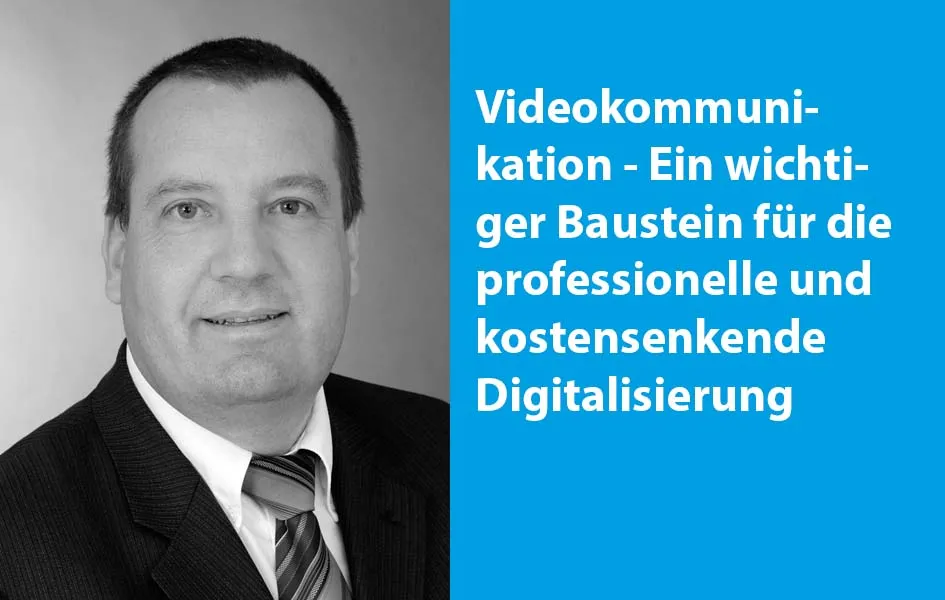
In recent years, video communication has steadily evolved and today ranks among the most important communication tools in the context of digitalization—not only for SMEs. While just a few years ago video communication was cumbersome and an exception in business interactions, today more and more companies are using this tool to communicate professionally with suppliers, customers, and even globally distributed organizations. In an interview with Andreas Zenger, we discuss today time and cost savings, increased productivity, and the future of video communication. Mr. Andreas Zenger is Managing Director of Connect4Video (C4V) and has been one of the most innovative companies in this field for years.
DIGITAL FUTUREmag: Mr. Zenger, looking back a few years, what are the most important insights you’ve gained from the field of video communication in recent months?
Andreas Zenger: There are two main takeaways: First, employees in companies are increasingly embracing video communication—the usage rates are rising. Acceptance is growing partly because more people already have experience with video communication in their private lives, and partly because the applications are becoming easier to use and can be accessed on practically any internet-enabled device, whether it’s a PC, laptop, or smartphone. In addition, we also facilitate our customers’ entry into this space with our comprehensive service and training offerings.
Second, we’re seeing that our customers are placing ever greater emphasis on data protection—not least because of the GDPR. We fully support this, as we also prioritize data security and leverage all available means to ensure it.
DIGITAL FUTUREmag: Many companies fear that when using such technology, compatibility issues may arise when communicating with other providers. Is this still a problem today?
Andreas Zenger: The purely technical compatibility between different devices and services—i.e., at the hardware and software level—is constantly improving. Compared to the room systems that were common in the past, today many more services and devices can be connected in a single video conference.
However, I see the bigger challenge in the “incompatibility” at the human or corporate level. For example, if a company prohibits the installation of any software on workplace devices, the best video conferencing service is useless. Such barriers are harder for us to overcome than purely technical ones.
DIGITAL FUTUREmag: You now serve well over 100 customers with your company, including in Switzerland and Austria. How is the overall security of such video communication handled in these regions?
Andreas Zenger: Naturally, different customers from different industries and/or countries have different security requirements. However, thanks to our decades of experience, we have no problems with this and can offer each customer the service that meets their needs. This starts with the mandatory encryption of connections, followed by secure traversal through the company's own firewall and handling communication via our own servers in certified data centers in D-A-CH. In addition, we advise our customers in detail about the possibilities and limitations of the technology. Through the measures mentioned and others, we achieve the highest possible level of security.
DIGITAL FUTUREmag: Video communication is a significant factor in travel cost optimization. What experiences have you had and what savings can be achieved... or when is video communication useful?
Andreas Zenger: Simply put: a video call is always more useful than a phone call. Human communication works mainly through body language, facial expressions, and gestures—but these things are completely missing in a phone call. In our company, video communication has already completely replaced telephony because, thanks to screen sharing and whiteboards, it is just as efficient and productive as an in-person meeting. It’s as if you were sitting at the table with your colleagues. What’s more, video communication is even cheaper than making phone calls.
This brings us to the financial aspect: video communication not only saves on telephone charges but also travel costs and time. We have figures that show some of our customers save several million euros per quarter. In addition, some companies pay twice as much for telephony as they do for our service. How much a company can save individually depends, of course, on its size and structure.
Given all these aspects—productivity, efficiency, time savings, cost savings—video communication should be used for the majority of business meetings and should completely replace telephony. Of course, it cannot replace social activities—we still prefer to meet in person for our Christmas party.
DIGITAL FUTUREmag: Many companies also fear high investments in hardware. Are there any special offers or options here?
Andreas Zenger: We don’t sell hardware; instead, we offer video communication services. These can be used very easily with the devices already available in the office, such as PCs, laptops, tablets, and smartphones. This means they can be used within minutes without any complex setups by specialized IT staff. The only requirements are a camera, microphone, and an internet connection. Unlike expensive room systems, there are no hardware costs at all. In addition, with our services, you are no longer tied to a specific technology from a hardware manufacturer.
DIGITAL FUTUREmag: When we look a little further into the future. What are the next milestones you aim to achieve with your company and in terms of solutions for your customers? Where is the journey with video communication heading?
Andreas Zenger: Usage rates will continue to grow. This is driven by increasingly simple operation, better compatibility, and mobile usage options. Added to this is the visual communication experience we’ve already described, which makes every phone call seem dull by comparison. That’s why, in the long term, every telephone will become video-capable, and devices without video will die out. Overall, video communication will replace telephony as the everyday commodity it is. And that’s exactly our goal.
DIGITAL FUTUREmag: At the upcoming Digital FUTUREcongress, you will be presenting your systems and making parts of Stage 1 in the event foyer visible. What can visitors expect to see at your booth, beyond just your system?
Andreas Zenger: Visitors can see for themselves at our booth how easy the software is to use. Both personal video calls and dial-ins to a video conference work just as quickly as phone calls. That’s what video communication should be like: simple, reliable, fast, and stable. We’re not just showing visitors this—we’re letting them try it out themselves.
In the foyer, visitors can experience another important application of video communication: a live stream of the stage presentations. This live stream will also be accessible online. Such live streams can also be used as webinars and are therefore important communication tools—not just for companies, but also for educational institutions, research institutes, or media outlets.
DIGITAL FUTUREmag: Then we look forward to a thrilling event with you. Thank you for the interview…