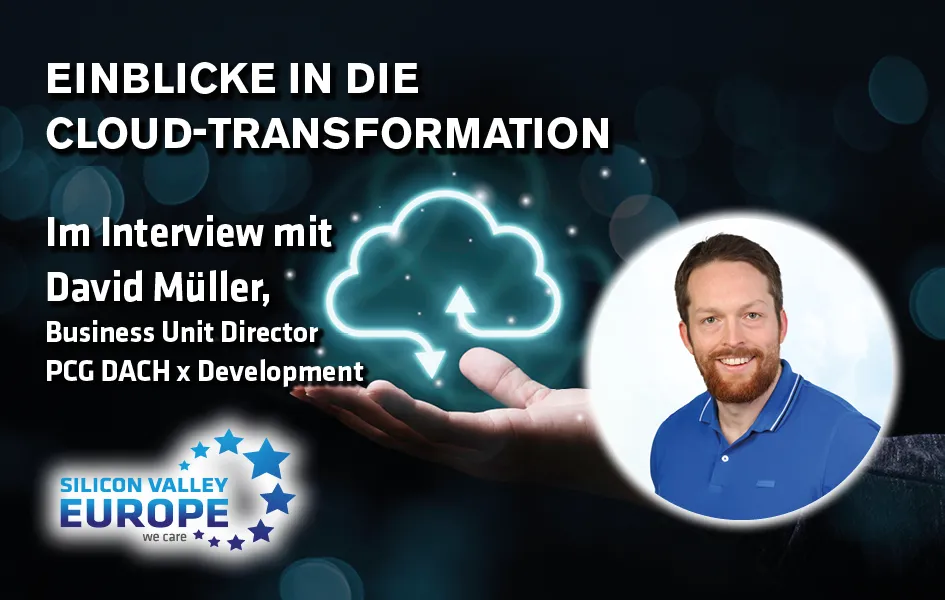
In the interview with David Müller (Business Unit Director PCG DACH x Development)
The Public Cloud Group (PCG) is renowned for its comprehensive support of companies throughout their entire cloud journey by leveraging public cloud solutions. As an experienced partner of leading hyperscalers – Amazon Web Services, Google, and Microsoft – PCG provides independent consulting and holds the highest certifications from these providers.
PCG supports companies not only in implementing and optimizing cloud infrastructures but also in key technological areas such as Data & AI, Security, Cloud-native Development, and SAP Cloud Services. With over 400 cloud experts across various locations in Europe, PCG serves more than 1,150 customers, including renowned names like Allianz, Burger King, Generali, and HelloFresh.
David Müller, as Business Unit Director, heads the PCG DACH x Development department and brings extensive experience in developing and modernizing scalable, cloud-native applications on AWS, Microsoft Azure, and Google Cloud. In addition to his role at PCG, he is also a lecturer at Darmstadt University of Applied Sciences for "Advanced Web Development." In previous positions, he successfully expanded a software development company from 2 to 100 employees, gaining valuable experience along the way.
In the interview, David Müller discusses how companies face the challenge of migrating their legacy systems to the cloud to remain competitive. He explains how PCG supports companies in making the right decision between modernizing existing applications and developing new ones. A particular focus is on increasing agility, reducing costs, and unlocking new business opportunities.
Another key topic of the conversation is PCG’s "Development-Team-as-a-Service" approach. This innovative model helps companies overcome capacity or expertise bottlenecks in their internal IT. Additionally, David Müller highlights how PCG supports independent software vendors (ISVs) in migrating their solutions to the cloud and assists them in developing new business models such as SaaS.
Get ready for an exciting and insightful interview with one of the leading experts in cloud development and gain valuable insights into the future of cloud transformation!
Silicon Valley Europe: Mr. Müller, could you give us a brief overview of Public Cloud Group (PCG) and its mission, and in particular answer the question of what sets PCG apart from other cloud providers on the market?
David Müller: The Public Cloud Group (PCG) supports companies in their digital transformation through the use of public cloud solutions.
We position ourselves with a portfolio that is designed to accompany companies on their cloud journey, regardless of their size and industry.
As an experienced partner of the three relevant hyperscalers (Amazon Web Services (AWS), Google Cloud and Microsoft Cloud), PCG holds the highest awards from each provider and advises you as our customers in your cloud journey independently.
What sets us apart is that our customers can access not only a broad portfolio but also the expertise of over 500 cloud experts. Working with PCG means working with a leading technology company with a clear technical vision. We are the cloud partner in Europe and offer our customers all solutions from a single source through our combined cloud expertise.
Silicon Valley Europe: Which aspects of the cloud journey does PCG cover, and how do you support companies in these phases?
David Müller: PCG offers a 360° perspective on the entire cloud journey. This means PCG supports companies at every stage of their cloud transformation, from strategy development and implementation to ongoing operations.
With 100% focus on public cloud, solutions are offered on all relevant hyperscalers.
PCG supports companies in the areas of cloud strategy, cloud security, cloud development, modern workplace, migration, consulting, data & AI, and managed services. It offers both strategic consulting and practical implementation support and, if desired, also takes over the ongoing operation of the cloud infrastructure.
With this holistic approach, PCG is an ideal partner for companies looking to successfully shape their cloud transformation.
Silicon Valley Europe: Could you tell us more about the specific technological focus topics such as Data & AI, Security, and Cloud-native Development?
David Müller: The areas of Data & AI, Security, and Cloud-native Development are where cloud technology is evolving the most. Data forms the foundation for new ideas. Artificial Intelligence (AI) enables us to get things done faster and discover new opportunities.
To leverage these new technologies, customized applications are developed. These can be used both for developing new business ideas and for modernizing existing applications.
The cloud makes it possible to implement innovative solutions quickly and easily. It is always ensured that the data and applications are secure.
PCG supports companies in getting the most out of the cloud and staying competitive.
Silicon Valley Europe: The PCG serves over 1,150 customers, including well-known names such as Allianz, Burger King, and HelloFresh. Can you share a success story or a special project that the PCG has recently completed and that you might be particularly proud of?
David Müller: A standout project that highlights our expertise in cloud transformation is our collaboration with Innoface, an independent software vendor (ISV). We supported Innoface in strategically realigning its business model by transitioning their existing on-premise application into a future-proof, cloud-native Software-as-a-Service (SaaS) model.
As part of this holistic transformation, we implemented a scalable cloud infrastructure based on cutting-edge microservices and AWS technologies. By migrating to the cloud, Innoface not only unlocked new revenue streams through recurring subscriptions but also significantly enhanced the company’s agility and flexibility.
The successful implementation of this project underscores our competence in designing and executing complex cloud transformation projects and our ability to help companies tap into new business areas while boosting their competitiveness.
Silicon Valley Europe: What are the most common challenges your customers face in cloud development, and how do you help them overcome these?
David Müller: A common challenge for our customers is outdated applications. These are often developed in-house and no longer meet current requirements in terms of security, stability, and scalability. Additionally, they are frequently maintenance-intensive.
To overcome these challenges, we start with a comprehensive inventory of existing systems. We then work with the customer to develop a strategic goal and create a pragmatic plan to achieve the greatest possible business value. Throughout the journey to the cloud, we support the customer at every step to ensure the transformation is smooth and successful.
Silicon Valley Europe: Companies face the challenge of migrating their legacy systems to the cloud. What factors should companies consider when deciding between modernizing existing applications and developing new ones?
David Müller: The decision between modernizing and redeveloping legacy systems for cloud migration depends on various factors—primarily the future viability of the chosen technology and cloud readiness.
If the existing software, for example, is based on outdated programming languages or no longer supported frameworks, modernization may be the right choice. Parts of the software can be reused, while others need to be redeveloped.
If the technology is still current and the software is fundamentally cloud-ready, migration can be achieved with minimal adjustments. By leveraging microservices and containers, the software can be modularized and scaled to fully exploit the benefits of the cloud.
PCG supports companies in making decisions and implementing solutions. We begin with a comprehensive analysis of existing systems and develop a tailored strategy in collaboration with the customer. We consider both technical and economic aspects to maximize the benefits of cloud migration.
Often, we face the challenge that our customers’ legacy systems no longer meet current requirements. They are frequently unreliable, unstable, and difficult to maintain. Through targeted modernization or redevelopment, we can resolve these issues and prepare the systems for the cloud.
Silicon Valley Europe: What advantages do you see in migrating legacy systems to the cloud?
David Müller: Migrating legacy systems to the cloud offers a wide range of benefits. Companies benefit from almost unlimited scalability, as cloud resources can be flexibly adapted to demand. In addition, the "pay-as-you-go" model enables cost-efficient use, as only the resources actually used are paid for.
Another advantage is increased employer attractiveness. By using modern cloud technologies, the company becomes more attractive to qualified professionals. At the same time, cloud migration increases the security level, as cloud providers typically have comprehensive security measures in place.
By automating many processes, operations become less labor-intensive, freeing up resources for other tasks. If the migration is accompanied by modernization of the applications, capacities that were previously tied up in non-value-adding activities such as troubleshooting can be used for innovative projects.
Migrating legacy systems to the cloud enables greater agility, cost efficiency, and competitiveness.
You offer a "Development-Team-as-a-Service" approach. Can you explain how this approach works and what benefits it offers to companies?
David Müller: Our "Development-Team-as-a-Service" approach is a flexible solution for companies that want to migrate their applications to the cloud but lack the necessary expertise in their own development team or are under time pressure.
We provide a team of experienced cloud experts who work closely with the customer's developers. This mixed team enables fast and efficient project implementation while simultaneously transferring cloud technology knowledge to the internal team.
This approach offers several advantages:
- Accelerated implementation: The additional expertise and capacity enable faster project completion.
- Knowledge transfer: Collaboration with our experts enables continuous knowledge transfer, allowing the internal team to benefit from new skills in the long term.
- Flexibility: The size of the team can be adjusted as needed to meet the specific requirements of the project.
- Risk minimization: Close collaboration and knowledge transfer minimize the risk of dependency on external service providers.
Our "Development-Team-as-a-Service" approach provides an effective way to accelerate cloud transformation while strengthening internal expertise.
Silicon Valley Europe: Which typical problems do you solve for your customers with this service?
David Müller: With our Development Team-as-a-Service, we primarily solve two problems for our customers: capacity bottlenecks and a lack of expertise.
Many companies struggle to implement their cloud projects in a timely manner because they lack the necessary resources. Our service provides experienced developers on short notice to support the customer’s team and eliminate bottlenecks.
At the same time, many companies lack specific cloud expertise. Our experts bring this knowledge and share it with the customer’s developers during the collaboration. This not only ensures the successful implementation of the current project but also strengthens the company’s long-term competence.
Silicon Valley Europe: How do you support independent software vendors (ISVs) in migrating their solutions to the cloud?
David Müller: Independent software vendors (ISVs) benefit from the cloud but often face challenges such as insufficient scalability, outdated systems, and the need to modernize their business model. At the same time, they must retain their expertise within the company.
Our Development Team-as-a-Service offering is the solution: We support ISVs in modernizing their software and migrating to the cloud while building expertise within their own team and protecting their intellectual property.
We analyze the existing software, develop a cloud strategy, support modernization and migration, share our knowledge, and provide long-term assistance. This enables ISVs to leverage the benefits of the cloud while maintaining their independence.
Silicon Valley Europe: Can you give examples of how transforming existing solutions into a SaaS model has opened up new business opportunities?
David Müller: A good example of the successful transformation of an existing solution into a SaaS model is our customer Leasehub. We supported Leasehub in migrating their outdated desktop software to a modern, cloud-based SaaS platform. This transformation enabled Leasehub to fundamentally renew its business model and tap into new markets. Within just a few months, the company gained an impressive number of new customers and has since been revolutionizing the leasing market. This example shows how migrating to the cloud and switching to a SaaS model can open up entirely new growth opportunities for companies.
Silicon Valley Europe: Let’s conclude by talking a little about current trends. Which ones do you see in cloud development and migration for the coming years?
David Müller: In the coming years, several important trends will emerge in cloud development and migration.
Artificial intelligence (AI) will play an increasingly significant role. It will not only enhance and modernize existing applications but also support developers in implementing solutions more efficiently. AI-powered tools and platforms will accelerate the development process and improve software quality.
Well-thought-out multi-cloud strategies are another trend. Companies will increasingly rely on multiple cloud providers to benefit from their different strengths and reduce their dependence on a single provider. It is crucial to develop a well-planned strategy to manage complexity and keep costs under control.
Germany is still at the beginning of its cloud transformation. There are still many untapped potentials and benefits that can be unlocked by moving to the cloud. We are ready to support companies on this journey and help them get the most out of the cloud.
Silicon Valley Europe: Thank you for the exciting interview and the insights into your work.