In the interview with Dieter Brockmeyer, co-founder and Director of Innovation at Diplomatic World Institute in Brussels.
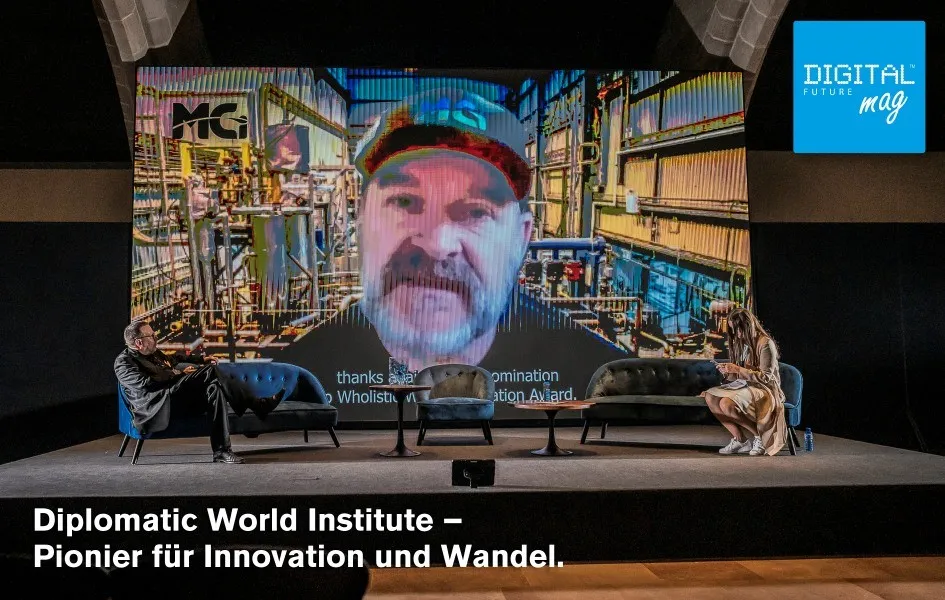
The Diplomatic World Institute (DWI), founded in 2019, is an independent initiative closely linked to the renowned Diplomatic World quarterly print and online magazine, which has been established as an opinion medium in diplomatic circles since the turn of the millennium—far beyond Brussels. Serving as an interface between diplomacy, business, and society, the DWI occupies a unique position, with a particular focus on fostering an innovation culture. In an era where addressing global challenges is crucial, innovation plays a key role. Dieter Brockmeyer, a well-known media and innovation expert and author, is at the heart of this movement. As Chief Project Officer (CPO) of Diplomatic World and co-founder of the DWI in the Belgian capital, he is instrumental in driving forward the vision of innovation and change. His passion for implementing new ideas is evident not only as the producer of the DWI video podcast “Today & Tomorrow,” but also in curating international industry congresses and creating the “Wholistic World Innovation Trophy.”
He and the DWI reflect the dynamics of today’s technological developments, from artificial intelligence to quantum computing. The focus is always on how these advanced changes can transform our economy and society—aligned with the goals of the United Nations’ sustainable progress by 2030.
In the following interview, we gain deeper insights into the vision and work of the Diplomatic World Institute and also explore the collaboration between the DWI and the IT-Cluster Silicon Valley Europe (SVE).
DIGITAL FUTUREmag: As a catalyst for change, you have significantly contributed to driving innovation and transformation forward. How do you view the role of technology, particularly progressive digital tools, in overcoming global challenges?
Dieter Brockmeyer: Innovation in the form of technological progress and the associated transformation in all areas of our society do not happen on their own. One drives the other—this spiral is accelerating further. Consider, for example, AI combined with quantum computing, which someone aptly described as AI on steroids. This will likely trigger even more profound societal change. Many people already feel overwhelmed by it. Humans need their comfort zone, which is increasingly disappearing. That’s where we come in: as a voice of warning and a catalyst, with the hope of triggering a wave, together with similar initiatives, to promote a new culture of innovation that makes it easier for us to deal with change. Because if we resist it, change will dominate us. But it should be the other way around.
DIGITAL FUTUREmag: The DWI has launched a number of initiatives, including the “Wholistic World Innovation Trophy.” Can you tell us more about it and its significance for today’s world?
Dieter Brockmeyer: Ultimately, there are two aspects to this: On the one hand, we want to help ensure that good ideas—whether new technologies or other projects with the potential to make a positive impact on the entire planet—become better known. On the other hand, we also want to spark a discussion about innovation and change, in line with the agenda we’ve outlined. We’ve deliberately chosen a holistic approach here. Because everything we do in a specific area has an impact on other areas. Yet we struggle with such interconnected thinking. We simply aren’t wired for it. We’ve now awarded the prize for the third time in Barcelona: in 2021 to “Indigital Edutech” from Sydney, which introduces indigenous children to virtual reality and opens up career perspectives; a year later to the London-based “What3Words,” which is revolutionizing logistics; and last November to “MCi Carbon” in Canberra, which converts CO₂ from the atmosphere into stone as a basis for building materials. As you can see, it’s a very diverse field. I’d like to thank everyone who has contributed to making this idea a reality, especially our globally composed jury, which does an outstanding job every time. But I must also mention our academic partner, the “Freie Universität Brüssel,” our congress partner in Barcelona, “D4a,” as well as the internationally renowned artist Ulrike Bolenz, who always creates wonderful individual pieces for the winners.
DIGITAL FUTUREmag: In your books “Pandemias Box” and “CAMPUS,” you explain the impact of technological innovations on our society. What role do ethical considerations play in this, and how can we ensure that such new creations are used for the benefit of all?
Dieter Brockmeyer: Unfortunately, we can’t guarantee anything. Every new technology can always be used for good or bad. As a society, we have to guide its use each time anew. We must handle it very consciously, because if we ignore a new technology, someone else will use it for their own purposes and ultimately dictate how we should use it. This has to do with our mindset. In the 1950s, there was boundless technological optimism. People wanted to power cars with atomic energy. Technology was seen as the solution to everything, though of course there was also a lot of nonsense. But we’ve lost that optimism, and today we often focus only on the potential negative consequences, especially here in Germany. The term “German Angst” has become established internationally. Yet all technologies can help solve problems—if used correctly. In “Pandemias Box,” which emerged from a white paper on the background of the award during the first year of the pandemic, I tried to analyze global contexts, while in “CAMPUS,” which will soon be available—initially only in English—I aim to spark a discussion about solutions.
DIGITAL FUTUREmag: In your DWI video podcast format “Today & Tomorrow,” you delve deeply into future tech trends. Which ones do you find particularly promising, and how might they change our lives soon?
Dieter Brockmeyer: This is exactly the discussion I explore in the podcast together with digitalization expert Sanjay Sauldie and innovation profiler Alexander Pinker, occasionally also with another guest. All new technologies somehow interlock and collectively drive change forward. Soon, there won’t be any activity where AI doesn’t operate in the background, and all our transactions will be stored and verified on a blockchain. Depending on our needs, we’ll switch between reality and the metaverse. Though the latter will still take a bit longer until it works seamlessly without technological disruption and with a fully immersive experience. But even this development could soon be accelerated enormously by quantum computing. We only know that it will have an impact. Exactly what or when remains unclear—that’s what makes predictions in this field so difficult.
DIGITAL FUTUREmag: The UN’s 2030 Agenda sets ambitious goals for sustainable development. How can technology contribute to achieving these target states, and what role can international cooperation play?
Dieter Brockmeyer: Our current problems are all so vast that they can only be solved across borders and through joint efforts. That’s why the UN initiative is the right approach. Unfortunately, global sentiment has been heading in the opposite direction for some time now, which means the 2030 target year will almost certainly not be met. Our society is becoming more selfish. Tolerance and respect are only valued if they’re extended to us. We urgently need to counter this trend.
DIGITAL FUTUREmag: As a new Silicon Valley Europe member, what specific advantages, skills, or offerings would you like to contribute to benefit the IT providers and users involved in this cross-border community platform?
Dieter Brockmeyer: Silicon Valley and Germany have long seemed incompatible concepts, despite the abundance of talent here—both in the past and still today. And as mentioned, cross-border communities are the right approach to tackle our complex problems. For us, this is an ideal platform to gain inspiration and also to provide impetus. I’m therefore looking forward to a lively exchange that hopefully leads to one project or solution approach or another.
DIGITAL FUTUREmag: Finally, we’d like to hear your personal take on what needs to change to improve collaboration between diplomacy and technology.
Dieter Brockmeyer: We need to rediscover genuine tolerance, respect for differing opinions, and a willingness to compromise across blocs worldwide. This will take some time. But, as history shows, it will happen again at some point. Until then, we must all work to ensure the cost isn’t too high.
DIGITAL FUTUREmag: Thank you very much, that’s encouraging and we look forward to a good partnership.