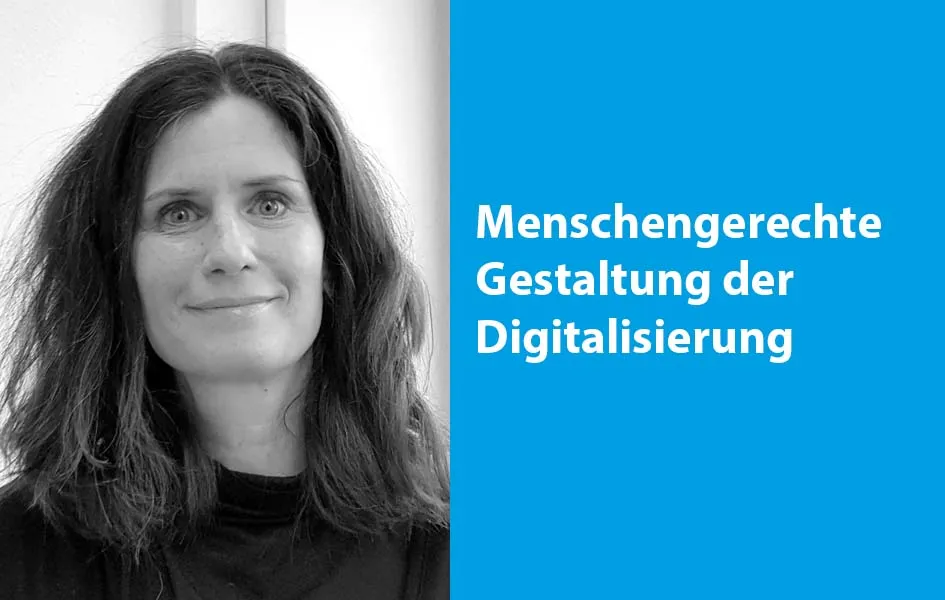
In the interview with Dr. Britta Hofmann, Head of Usability and User Experience Design at the Fraunhofer Institute for Applied Information Technology FIT
Fraunhofer FIT has over 35 years of experience in designing intelligent system solutions that integrate seamlessly into business processes in a human-centric way. Fraunhofer FIT is also a partner in digitalization, a contact point for Industry 4.0 projects, and brings the Internet of Things into industrial applications. The institute is also at the forefront when it comes to topics such as blockchain and energy efficiency. Now that the company will also be present at the Digital FUTUREcongress on November 5 at Messe Essen, we considered an interview with Dr. Britta Hofmann important.
DIGITAL FUTUREmag: When you look at new topics such as Industry 4.0, the Internet of Things, or blockchain, and realize that the transformation is in full swing, you could almost speak of a new era of tech infatuation. In your opinion, what are the “game changers” that will impact German SMEs and users in the coming years?
Dr. Britta Hofmann: You’ve already named the right “players” in digital change. As the Fraunhofer Digitalization Institute, we focus on connected, intelligent machines, deep learning, machine learning, automation, sensor technology, data transparency, and blockchain—all of which can be cited as decisive technical digitalization trends. With these technologies, we could produce more sustainably and design work in a more human-centric way. If we don’t act out of pure tech infatuation when introducing IT, but instead prioritize human and work-context-specific requirements, we could avoid the well-known productivity paradox of IT. This paradox states that productivity and working conditions worsen after the introduction of IT compared to before. Accordingly, the ultimate “game changer” would be the introduction of human-centered approaches when identifying suitable digitalization strategies. First, understand the problem and the business vision, and then the right digital solution idea will follow naturally.
DIGITAL FUTUREmag: Can you put the individual elements you mentioned into a timeline? Which technologies will arrive first, and which ones will we still have to wait a while for in day-to-day practice?
Dr. Britta Hofmann: In principle, all technologies will become reality relatively simultaneously, but the order will differ for each company. Depending on the company’s level of digitalization, networking will be the first step. Processes and their data must be consolidated. However, this is not about mere data collection. A human- or business-centered perspective is crucial here: Why am I collecting certain data? Where does automation make sense? Later, I can use technologies such as blockchain to replace certain processes or establish new business models. A topic that will certainly concern us more and more in the future is usability and cybersecurity. With increased networking and data exchange, such as data in the cloud, companies—and even entire countries—become more vulnerable. Just think of digital energy or supply chains: Ensuring resilience against attacks must be a top priority.
DIGITAL FUTUREmag: For the Fraunhofer FIT, human-centered development of innovative digitalization strategies is always a top priority. How do you ensure that people do not get left behind as new technologies emerge and, ultimately, that machines do not “take over”? Is that even desirable?
Dr. Britta Hofmann: Of course, machines should not take over. Machines should remain our servants, ideally as intelligent tools. With automation and Artificial Intelligence (AI), the key is a reasonable division of labor between humans and machines, which can be achieved through human-centered development approaches. A machine should handle tasks that are tedious, demanding, or dangerous—things we gladly delegate. Furthermore, machines should collect or analyze data that the human brain cannot process and prepare decisions accordingly—in the sense of Intelligence Augmentation (IA). The final decision should and must always rest with humans.
DIGITAL FUTUREmag: “User-friendliness” is legally integrated into occupational health and safety regulations. Could you outline the key elements for us?
Dr. Britta Hofmann: Employers are obligated by the Workplace Ordinance to ensure the usability of digital tools. They must ensure that interaction with IT systems is task-appropriate, self-explanatory, and tailored to the knowledge and experience of employees. Fraunhofer FIT creates expert assessments and optimizes digital tools in line with occupational health and safety requirements.
DIGITAL FUTUREmag: Could you share some insights into your daily work? Are there methodological approaches you use to develop technology?
Dr. Britta Hofmann: When we receive a digitalization assignment, we first analyze the requirements and business goals of our customers and user groups. To do this, we have a comprehensive set of methods—from in-depth interviews to workplace studies. Usability methods are employed alongside Design Thinking approaches when defining requirements, developing concepts or prototypes, or conducting evaluations. Additionally, we have a broad spectrum of programming languages, allowing us to integrate seamlessly into almost any technical environment.
DIGITAL FUTUREmag: The Fraunhofer FIT is among other things involved in digital networking. Why is this topic so particularly important?
Dr. Britta Hofmann: Networking is central to the digitalization of work because production processes or supply chains can be analyzed and optimized in their overall context through networking. Individual results would fall short. Fraunhofer FIT operates its own IoT platform called LinkSmart for networking. Thanks to data transparency, it enables, for example, the comparability of different production processes so that their effectiveness and efficiency can be increased. For example, the FIAT Panda is manufactured in Italy and Brazil – with identical process steps. If you look at a single process step, such as the installation of a door, you can compare the costs between the countries, identify which parameters make the difference, and optimize the production processes accordingly.
DIGITAL FUTUREmag: Thank you very much indeed for this exciting interview.