In the interview with Dr. Martin Schiele, Advisor, Speaker, Founder and CEO of AI-UI GmbH
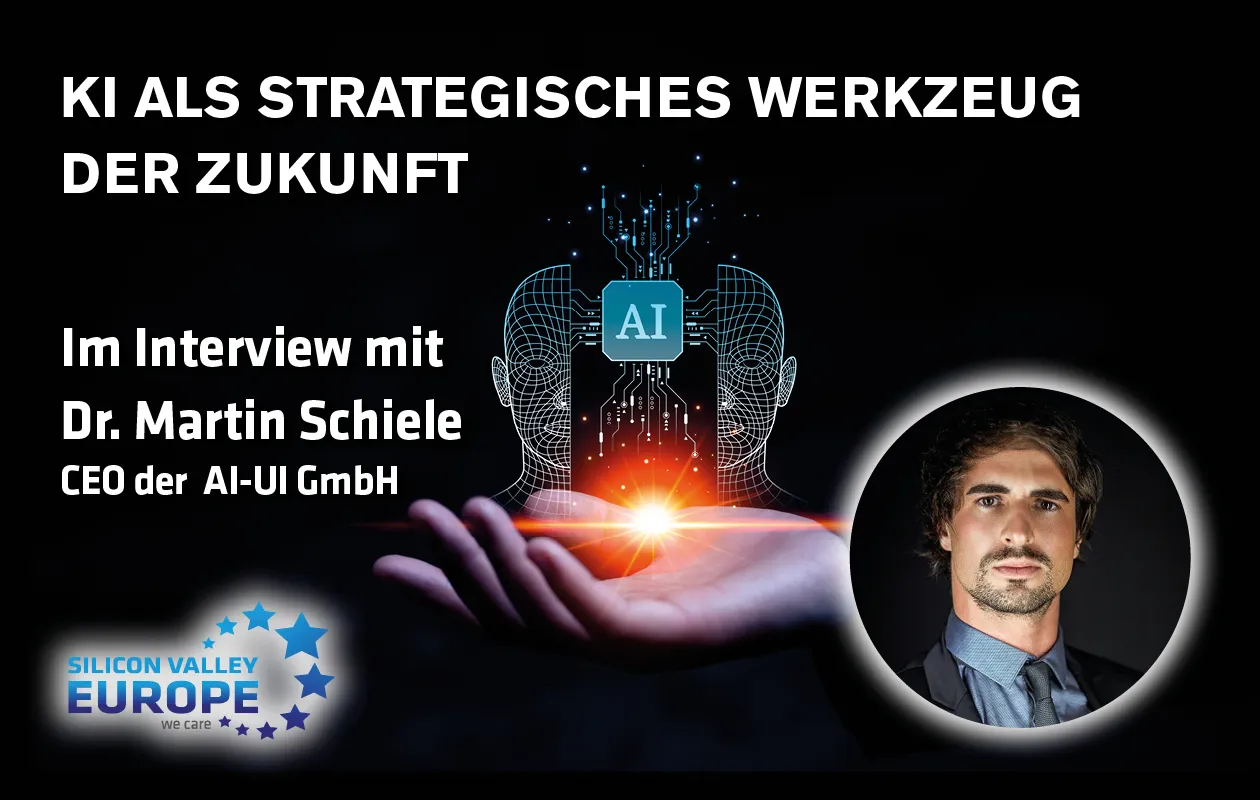
Artificial Intelligence is not just a technical buzzword, but a decisive driver of digital transformation. But how can companies use AI strategically to optimize processes, drive innovation, and secure long-term competitive advantages? We will explore these and other questions in our exclusive interview with Dr. Martin Schiele.
Dr. Schiele is founder and managing director of AI-UI GmbH, a leading AI company from Thuringia. Since 2021, he has been supporting companies from various industries – from industry to trade to research – in the secure and efficient implementation of AI solutions. His work has been recognized multiple times, including the title "Innovator of the Year" and the Thuringian Digital Award 2024.
In conversation with the Silicon Valley Europe community, Dr. Schiele provides valuable insights into current developments and trends in Artificial Intelligence. A particular focus is on the question: "Content Chaos or Control? AI as the Guardian of Our Digital Selves". He will explain how AI technologies can help protect our right to our own image on the internet and prevent abuse. He will also provide exciting insights into the future of work: What new job profiles are emerging thanks to AI? Which processes can be efficiently automated?
With his deep expertise and practical examples, Dr. Schiele is one of the most sought-after experts in his field. His presentations at renowned events such as Hannover Messe, KI Connect Karlsruhe, or the ERWICON Business Congress inspire a wide audience.
Get ready for an inspiring conversation with a true thought leader of the digital revolution.
Silicon Valley Europe: Dr. Schiele, what motivated you to found AI-UI GmbH, and what problem do you aim to solve with it?
Dr. Martin Schiele: At that time, there was no ChatGPT or comparable solutions making artificial intelligence accessible to everyone. It was important to us to give people without programming skills the opportunity to use AI simply and intuitively. This is exactly how the idea for AI-UI GmbH came about: to create a platform where AI-based applications can be assembled without code using a modular system. The name “AI-UI” reflects this approach – a user-friendly interface (UI) for artificial intelligence that enables everyone to benefit from this technology.
Silicon Valley Europe: Your AI solutions optimize processes in various industries. What technical challenges arise when integrating AI into existing IT infrastructures, particularly regarding data quality and interfaces?
Dr. Martin Schiele: It’s less about “problems” and more about challenges arising from the diversity of existing IT landscapes. Companies often use different software and hardware solutions with varying interfaces. When integrating AI, these must be individually adapted, similar to introducing an ERP system like SAP. Careful coordination is required to ensure that AI is seamlessly integrated into existing processes and can effectively work with available data sources.
Silicon Valley Europe: Which algorithms and architectures do you prefer to use to ensure both performance and security in AI implementation?
Dr. Martin Schiele: Currently, we primarily use large language models with multimodal capabilities – meaning they not only understand text but can also analyze images, perform OCR tasks (text recognition), and process audio. Examples include models from Mistral, Meta, and Alibaba.
These architectures offer high performance as they are specifically optimized for scalability and efficiency. At the same time, we place great emphasis on security by implementing mechanisms such as access controls, encryption, and secure API interfaces. We also prioritize data protection and compliance by offering on-premise or private cloud solutions depending on the use case to best protect sensitive data.
Silicon Valley Europe: In your keynote at the DIGITAL FUTUREcongress AI on 26.02.2025 you will speak about "Content Chaos or Control". How can AI help protect our digital selves?
Dr. Martin Schiele: The internet is growing rapidly, and the amount of content created is increasing daily. For individuals and businesses, it is impossible to manually monitor where and how their content is being used. This is exactly where AI can make a crucial contribution to protecting our digital selves.
AI-powered systems can systematically search the internet and check, for example, whether image rights have been violated. Modern models are capable of detecting similarities and manipulations in images and assessing whether a work actually originates from the author or is being used unlawfully.
Ultimately, the goal is to regain control over digital content with AI—through automated monitoring, rapid detection of abuse, and targeted protective measures.
Silicon Valley Europe: Your company supports industrial and commercial enterprises in automation. What role do reinforcement learning and other adaptive AI models play in optimizing manufacturing processes?
Dr. Martin Schiele: Reinforcement learning currently plays no role in our work, as it is an extremely complex method primarily suited for training language models. For most industrial companies, it is difficult to implement and requires significant human and technical resources to achieve usable results.
I wrote my doctoral thesis on this topic and applied reinforcement learning to machines. It became clear that while this method can be promising for highly specialized applications, it is often too complex for standard tasks in industrial automation. Instead, we focus on more robust and easier-to-implement AI models that integrate better into existing manufacturing processes and deliver added value more quickly.
Silicon Valley Europe: In the debate on AI ethics, transparency and explainability of models are often central issues. Do you work with Explainable AI (XAI) approaches to help your customers understand and accept AI decisions?
Dr. Martin Schiele: Explainable AI (XAI) does not play a central role in our current work. In the past, we have used XAI approaches in mechanical engineering to analyze which variables influence AI models and which have the greatest impact on the outcome.
For the models we currently use, such as in document processing, XAI is too complex and currently not relevant for our customers. Instead, the focus is on fast, efficient results and a high return on investment (ROI). In many use cases, additional explainability would only complicate implementation and usage unnecessarily.
Silicon Valley Europe: Secure processing of sensitive corporate data is essential. How does your company address challenges in data protection and GDPR-compliant AI applications?
Dr. Martin Schiele: Data protection and GDPR compliance are our top priorities. We are the only company that delivers AI entirely on-premises. This means we integrate systems like ChatGPT directly on the customer’s premises, either in their own cloud or—if desired—even in the company’s own server room.
This ensures the system is as secure as the customer’s existing IT infrastructure. All data remains entirely within their environment, with no external transmission or storage. This approach enables the highest security standards and complete control over sensitive corporate data—a decisive advantage for companies with strict data protection requirements.
Silicon Valley Europe: Scalability is a key factor for AI systems. What technological strategies do you use to efficiently adapt your AI models to different company sizes and use cases?
Dr. Martin Schiele: Scalability is a central issue for us – especially as a startup, we need to ensure that our AI systems can grow flexibly and efficiently. Our entire architecture is based on Docker and Microservices, which enables a modular and adaptable structure.
For our customers, this means maximum control: if more computing power is needed, all it takes is to integrate additional hardware – such as a GPU – into the existing system. Scaling then happens seamlessly, without complex reconfigurations. This allows companies of all sizes to use our AI solutions and expand them as needed without relying on external cloud services.
Silicon Valley Europe: In software development, generative AI models are increasingly being used. What opportunities and risks do you see in combining traditional software engineering approaches with AI-generated code components?
Dr. Martin Schiele: Generative AI models for software development offer both opportunities and challenges. In collaboration with other companies, we have gained two key insights:
Support for less experienced developers
AI can help new or less experienced programmers achieve good results more quickly. The broader the topic, the better AI performs. In general software development tasks, it can be used productively.Limitations in specialized problems
However, AI reaches its limits when dealing with highly specialized or very individual problems – in these cases, highly qualified developers remain essential to create precise, optimized, and sustainable solutions.
Currently, we therefore see generative AI as a valuable tool for increasing efficiency, but not as a replacement for experienced software engineers, particularly in highly complex areas.
Silicon Valley Europe: Thank you very much for this exciting insight into your work and your vision of future AI development, as well as what users should definitely pay attention to.