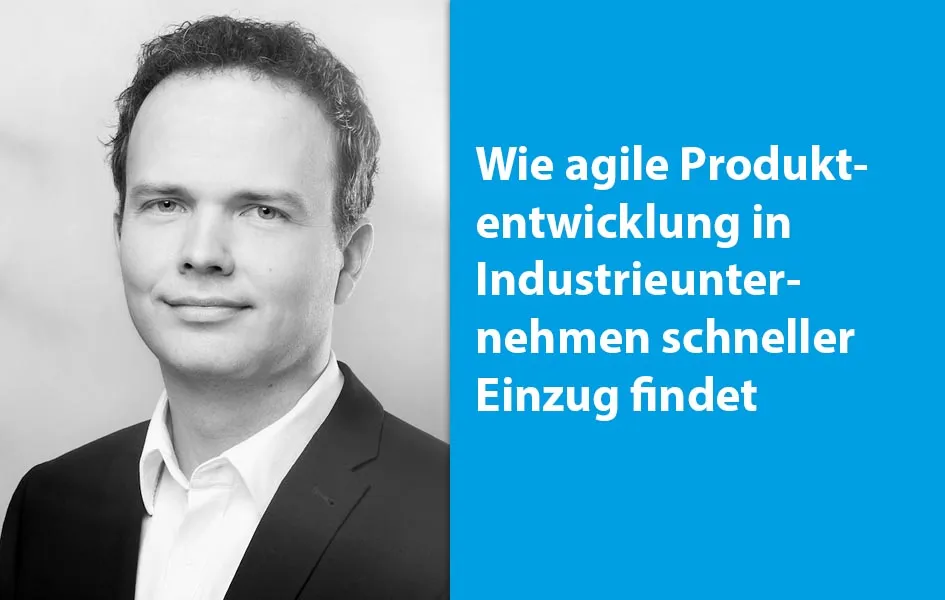
In the interview with Dr. Peter Stangner, Senior Manager at Continental Business Consulting (Continental AG)
Continental Business Consulting (CBC) is the management and business consulting arm of technology company Continental, one of the world's largest automotive suppliers, industrial specialists and tyre manufacturers. Since 2011, CBC has offered tailored solutions worldwide across the entire value chain. Key focus areas of its consulting services include new mobility solutions, development efficiency, digital transformation and Industry 4.0. CBC supports its customers in realigning business activities and organisational structures, optimising processes and implementing IT solutions. With its internationally experienced team, CBC meets the high demands of an in-house consultancy from the initial conceptual idea through to sustainable implementation. In an interview with Dr. Peter Stangner, Senior Manager at Continental Business Consulting, we discuss agile transformation, process excellence and functional safety.
DIGITAL FUTUREmag: Mr Dr. Stangner, Germany is one of the world’s strongest exporting nations. Our expertise in engineering plays a major role in this. The feeling is that we are currently losing ground here. Whether it’s artificial intelligence or mobility, in none of these areas are we still leading. How do you currently assess the engineering quality and performance of the German economy?
Peter Stangner: My impression is that German manufacturers are still at the technological forefront. Ultimately, it is the overall package of functionality, development time, cost and quality that will determine market success. I am convinced that Germany will continue to defend its market position in the premium segment in the future, provided we use the potential of new technologies wisely and purposefully. Digitalisation and artificial intelligence will not only change the German business location but, particularly in times of demographic change, will be essential to securing its future.
DIGITAL FUTUREmag: Your company has been successfully active in the field of engineering performance for many years. What problems or shortcomings do you most frequently encounter?
Peter Stangner: With our offerings for improved engineering performance management, I represent a very exciting area of Continental Business Consulting, which also includes our projects in the field of agile transformations. A classic challenge, for example, lies in the understanding and the associated expectations of the term “agility”. This can lead to methods that are actually intended to improve developers’ working environments being met with initial resistance. When introducing agile development methods and processes, it is therefore crucial to manage expectations effectively at all levels involved in order to achieve sustainable results.
DIGITAL FUTUREmag: Digitalization has a significant impact on the speed at which developments take place today. This requires companies to undergo transformation processes. How do you generally initiate your projects at CBC when it comes to agile or digital transformation?
Peter Stangner: Agile transformations can be started quite easily. Mostly, they are initiated by management. There are also very progressive software teams or development project managers who want to take new approaches on their own initiative. But regardless of who initiates the changes, the major risk is that the transformation stalls after some time. Sometimes it cannot unfold its full potential as quickly as initially hoped, and everyone reverts to “square one.” This must be prevented. That’s why, even in the concept phase, we start developing the big picture for the future, taking into account specific requirements. Especially in matrix organizations with various development teams, numerous projects, and multiple locations, it is important to clarify future planning methods, role responsibilities, the IT tools to be used, and the sustainable integration into the organization at an early stage.
DIGITAL FUTUREmag: To be at the top of the world, it is necessary to be a leader in your field. How do you ensure, as part of your consulting activities, that companies increasingly move toward process excellence?
Peter Stangner: Vehicle manufacturers expect Continental to meet an appropriate ASPICE level, which is an expression of process maturity in automotive software development. Additionally, high process maturity forms the basis for fewer iterations in software creation, which directly impacts development efficiency. The challenge, therefore, is not to motivate our clients to move toward process excellence. Rather, it is the consistent application of processes across many projects. For example, Chinese vehicle manufacturers expect very short development cycles. This time pressure is sometimes difficult to reconcile with the creation of all the work products defined in the process. To overcome such conflicting goals, it is necessary to establish genuine “ownership” of processes and the required work products within an organization to avoid bottlenecks in certain project phases. Through our support, we enable organizations to actually live their target processes and thus achieve project goals.
DIGITAL FUTUREmag: Reliability in processes as well as protection against cybercrime are of particular importance to companies today. What advice would you give companies to increase functional safety in particular?
Peter Stangner: Cyber Security and functional safety should be treated separately in discussions. In many companies, methods of safety analyses (FMEA, FTA, FMEDA) are often perceived as a kind of obligatory exercise in projects. However, those who use these methods early in the development process and combine them effectively can design their products to be much more robust at an early stage, thus avoiding high modification costs later on. In addition, companies should always be aware of the importance of these methods in order to avoid possible product liability risks later on. To gain the greatest benefit from functional safety methods, it is necessary to systematically set up the methods and consistently and efficiently integrate the various experts. Here, for example, we at CBC offer professional support with certified Functional Safety Professionals.
DIGITAL FUTUREmag: Many companies today are also looking for new business models and are thus trying to strengthen their market position. To what extent can digitalisation or software analytics contribute to this?
Peter Stangner: Digitalisation enables the development of new business fields and is currently challenging long-established business models, especially in the automotive sector. We use the topic of software analytics, however, in a different context. Together with a technology partner, we are currently focusing on so-called “SW Health Checks” with which we can identify future development risks in large software projects in an extremely transparent and precise manner. At Continental Business Consulting, we use this understanding to initiate improvement measures that have an immediate impact on the performance of the projects, so that we can ultimately strengthen the market position of our clients.
DIGITAL FUTUREmag: Thank you very much for your openness in the interview. That was a lot of fun. We wish you every success and hopefully a lot of attention at your appearance at the DIGITAL FUTUREcongress!