In the interview with Harald Meurer, recipient of the Federal Cross of Merit and winner of the Excellence Award Manager & Macher
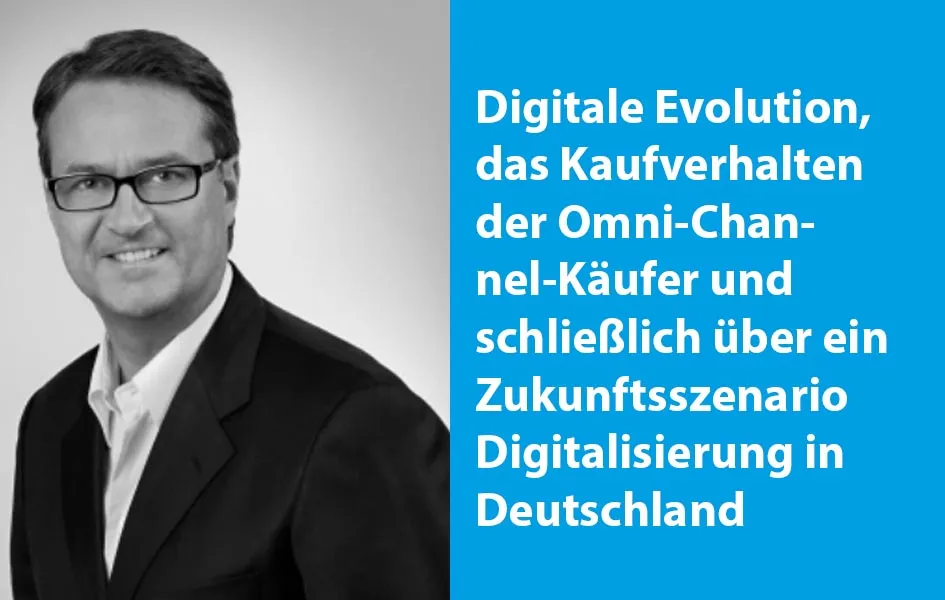
Since 1998, the team at AGIDOS has been helping companies shape their brand and use technologies effectively. In this interview, we speak with Harald Meurer, the digital mind behind AGIDOS, who was already honored with the Federal Cross of Merit as an internet pioneer and received the German Excellence Award in the category “Manager & Makers” in 2018.
As theme sponsors and experts on Stage 5 of the DIGITAL FUTUREcongress on November 8 at Messe Essen, we will discuss digital evolution, the purchasing behavior of omni-channel buyers, and finally a future scenario for digitalization in Germany.
DIGITAL FUTUREmag: First of all, we are of course interested in what exactly you received the Federal Cross of Merit for. How did that come about?
Harald Meurer: That was in 2012. The Federal Presidential Office called me and asked if I would accept the award. I don’t know exactly how it came about. The selection process can take up to a year and requires extensive research and many conversations with industry personalities. This is followed by a comprehensive report on the person and their work, and the Federal President personally decides whether the award should be given. In my case, I received it as an internet pioneer because I used digital technologies in a wide variety of industries very early on.
DIGITAL FUTUREmag: Customer expectations in the digital age are changing rapidly. How important do you think a holistic approach to digitalization is for companies?
Harald Meurer: Some companies still believe that digitalization means having a nice website as a standalone communication channel alongside traditional marketing. But we have moved beyond that stage for years now. Digitalization now affects all operational processes of a company. In my opinion, a company without a long-term and holistic strategy for digitalization across all areas of the business has no real chance of survival.
DIGITAL FUTUREmag: The term “digital evolution” is being used more and more often in this context. What does it mean?
Harald Meurer: In 1998, we were still talking about the digital revolution. From today’s perspective, the early approaches to digitalization were quite modest. However, these have developed rapidly over the last 20 years. At the time, it would have been hard to imagine ordering complex products like varifocal glasses, shoes, or plants over the internet. Today, that’s standard. Not only have technologies and ideas evolved, but consumer behavior has too – and in all areas. We are still far from the end. Evolution, however, does not only mean progress, but also selection and displacement. Technologies and concepts that seemed promising just 10-15 years ago no longer exist today. Companies from outside the industry now dominate markets that no one would have thought possible for an external provider to enter – and all thanks to digital concepts. Industry leaders that long resisted digitalization no longer exist today or have barely managed to turn things around. Digital evolution is like nature: pretty ruthless! It will only reward those who recognize the signs of the times early on.
DIGITAL FUTUREmag: Mr. Meurer, right now we can see a clear shift towards customer centricity in the consulting and IT market. What does this mean for companies in concrete terms?
Harald Meurer: This holistic approach is extremely complex and cannot be implemented just like that. Rather, changes are needed at all levels of a company. This raises the question of whether you even want to do this. Customer centricity as a concept is not new. The phrase “the customer is king” essentially expresses the same guiding idea. The new aspects are more about focusing on digitalization and the opportunities it offers to positively shape the customer journey or customer experience.
A company that operates in a customer-oriented way generates added value for the customer, which can take various forms – depending on where the customer is in the evaluation process. As a new customer, they will provide the company with initial data. As a returning customer, they will have already done so. The latter allows for an even more personal relationship between customer and company. With the help of big data, profiles can be created to positively influence customer relationships. However, the company must not lose sight of the fact that customer orientation must also be communicated transparently and effectively externally. Only when the convinced customer acts as a mouthpiece, singing the company’s praises and spreading its message, has the goal of customer centricity been achieved.
DIGITAL FUTUREmag: Today, customers buy products and services across all possible online and offline channels – not only in the B2C sector but increasingly also in the B2B sector. How can a company optimally adapt to the omni-channel buyer?
Harald Meurer: The problem in the B2B sector is the traditional sales channels to date: producer = importer or distributor, wholesale, retail = consumer. Everyone wants a piece of the pie. Digitalization, however, makes it easy for producers to approach consumers directly, cutting out intermediaries or simply offering lower prices. Especially providers from industries that no longer have these old distribution channels are the winners on the internet. Others shy away from this step because they don’t want to cannibalize their traditional sales channels. However, this consideration is simply wrong. Instead, new strategies are needed to integrate these sales channels into an online strategy. Doing one without abandoning the other. More and more customers come to us and have us develop and digitally implement precisely such new sales strategies. In my opinion, that’s where the future lies. If you ask me, classic wholesale simply won’t survive the digital evolution—it’s become superfluous.
DIGITAL FUTUREmag: This year, 2018, you were awarded the German Excellence Award in the “Manager & Mover” category. Of course, our congratulations on that! What sets you or AGIDOS apart?
Harald Meurer: Of course, I’m pleased about all the awards over the past 20 years, but I don’t take them too seriously. Maybe that’s because I’m a bit of a lateral thinker. Futurist Sven G. Janszky describes me in his bestseller “Rulebreaker – How People Think Whose Ideas Change the World” at least as such. Perhaps he’s right. I don’t go for well-trodden paths. Stagnation is regression, especially in the digital industry. The name AGIDOS isn’t a coincidence. We don’t just react to market developments—we help shape markets anew.
DIGITAL FUTUREmag: Your many years of experience give you the opportunity to outline a future digitalization scenario. Mr. Meurer, where is the journey headed?
Harald Meurer: Personally, I believe we are only at the beginning. What are 25 years of the internet? Terms like “Big Data, AI or Blockchain” are no longer visions. They are already all around us. Digitalisation will change the world, our actions, thinking and communication more than anything before. There will be many winners, but also many losers. Entire professional fields will disappear, new ones will emerge. This means: We are no longer talking about a revolution, but about a real evolution – and evolution is something the Neanderthals and dinosaurs famously did not survive. Those who fail to recognise the signs of the times will find themselves among the evolutionary losers.
What worries me even more is the development in Germany: We are currently in the bottom third in European comparison. None of the 20 largest digital companies are from Germany. But nine are already from China! China is pushing its digital companies with immense resources. It is already clear today that the USA will hardly have a chance against China in digitalisation worldwide. Meanwhile, Germany doesn’t even have a ministry for digitalisation, which is already standard in many other countries. That is tragic. Germany lives off the assets of its past. How long will that continue to work?
DIGITAL FUTUREmag: On 8 November at Messe Essen you are not only a topic patron and expert on Stage 5 and thus responsible for moderating the Innovation Stage, but you will also give a presentation yourself. What can visitors to the event look forward to?
Harald Meurer: I will talk about the opportunities of digitalisation in sales and retail, specifically in the symbiosis of online and offline. But not just theoretically, rather very practically. For this, I will bring a great real-life example that shows how rigid, conservative industries have found new sales channels – online and offline – with good ideas and technologies. Stay tuned!
DIGITAL FUTUREmag: We thank you for this extremely informative conversation and wish you every success at the event.
The interview was conducted by Michael Mattis, organiser of the DIGITAL FUTUREcongress