In the interview with Hartmut Becker, Head of Central Europe at Promethean GmbH
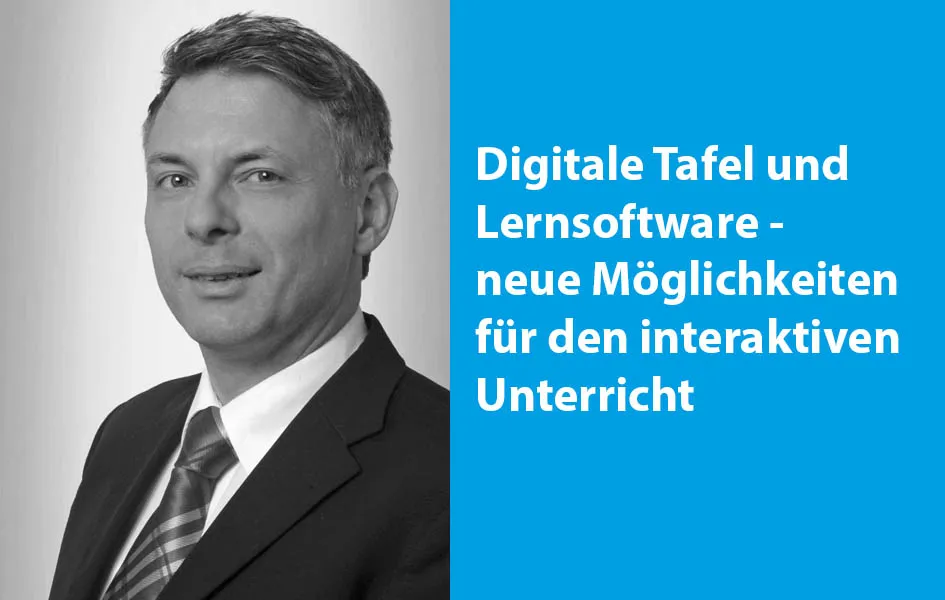
Promethean is a global leader in interactive teaching and learning technology, headquartered in Seattle, USA. For over 20 years, it has developed and distributed digital boards and classroom software for interactive teaching. The equipment for the German government's #DigitalPakt Schule initiative—a funding program of over €5 billion for schools—will promote the procurement of digital boards for interactive teaching over the coming years. Promethean develops exclusive interactive technology for the EdTech market. This is reason enough for us to speak today with Hartmut Becker, Head of Central Europe at Promethean GmbH in Essen.
DIGITAL FUTUREmag: The #DigitalPakt Schule aims to improve schools' equipment with digital technology. To provide the funds, even the Basic Law had to be amended. Will these tax funds merely purchase new gadgets for the smartphone generation, or will these technical devices also lead to improved learning outcomes?
Hartmut Becker: Acquiring digital skills is of crucial importance for every economy and society—this already applies today and is indispensable for the future. The world of work is changing rapidly due to digitalization, and students must be able to use digital media independently, reflectively, and responsibly. At the same time, equal opportunities for participation in digitalization must be ensured. The learning environment of schools must address this task in the 21st century. Using digital media requires their application, which leads to the long-overdue digital equipment of schools. This is where the #DigitalPakt Schule comes into play, enabling this nationwide. So, it's neither about toys nor improved learning outcomes, but about guiding and supporting our children in a digital world.
DIGITAL FUTUREmag: What devices and software do you offer, and how can they be integrated into modern pedagogical concepts?
Hartmut Becker: Promethean specializes in developing EdTech (Education Technology). Our product expertise lies in visualization—replacing the chalkboard with a digital board—and providing classroom software and applications developed with educators for pedagogical use.
The ActivPanel, a multi-touch flat-screen display, is not just a replacement for the analog board but serves as a technology hub in the classroom, enabling the integration of additional media into lessons. ActivInspire, our award-winning whiteboard software, provides the tools for educators to create creative, interactive whiteboard content. We offer school-appropriate licensing solutions without recurring costs and continuously expand the functionality of our applications with free upgrades. Apps, such as a whiteboard app, are developed in-house and made available as both online and offline applications. Just as diverse as media-pedagogical concepts exist, the ActivPanel can be used flexibly in lessons.
DIGITAL FUTUREmag: If digital whiteboards and learning software are used, it is conceivable that students' digital skills could surpass those of their teachers. Is teacher training a matter for the federal states, or does your company also offer services for teacher training?
Hartmut Becker: It goes without saying that the procurement of IT equipment for schools should be embedded in a comprehensive training and further education program for teachers, and this is taken into account during procurement. Initially, the federal states are responsible. For several years now, Promethean has been offering a free-of-charge multiplier program to train those responsible for teacher education and further training in the use of our solutions. In addition to training materials, the program includes free software licenses for participants. The program can be used by universities for the education of trainee teachers. We also regularly hold so-called teacher consultation hours where users can deepen their knowledge. Online tutorials are available 24/7, and German-speaking support provides assistance. Individual on-site training sessions can be arranged upon request, for which our well-trained network of specialist dealers is available.
DIGITAL FUTUREmag: Procuring the devices is not enough; it must also be ensured that they function as smoothly as possible. Who is responsible for maintenance and providing the technical prerequisites?
Hartmut Becker: Initially, the school authority or the school itself is responsible for the technical prerequisites. We or our specialist dealers are happy to provide advice. As far as installation and commissioning are concerned, our authorized specialist dealers are appropriately trained. In the rare event of a technical malfunction, we offer on-site service in Germany, depending on the device type, for up to 7 years. This means that not only our local specialist dealers with short distances are available to you, but we as the manufacturer are also at your disposal.
DIGITAL FUTUREmag: The private media consumption of young people is currently under criticism due to health risks. Your interactive multi-touch displays make the chalkboards of past generations of students look distinctly outdated. Brilliant image quality and impressive sound, however, can also lead to sensory overstimulation. How could this be counteracted?
Hartmut Becker: Several tens of thousands of ActivPanel are used worldwide in classrooms and educational institutions. The devices do not pose any health hazards, and we are not aware of any incidents attributable to overstimulation.
Just because digital whiteboards can offer an audiovisual, multimedia experience does not mean that every lesson turns into an overstimulating fireworks display.
Our evaluations show that the most common use is a structured whiteboard image and classic board writing—i.e., no moving images. Although a whiteboard is a frequently used tool in lessons, it is not in continuous use. Lessons also take place through project work, individual work, or group work “without” a whiteboard, and this is how it will remain in the future. Based on our findings, there is no need to establish a special code of conduct for the use of a multitouch display, i.e., the digital whiteboard.
DIGITAL FUTUREmag: The new learning tools are intended, among other things, to prepare students for working in the office of the future. Networking is a key term here. Interactive presentations and interactive meetings are part of the possibilities your products offer. What other opportunities do you see to promote teamwork?
Hartmut Becker: Indeed, we see it as a crucial contribution of schools to prepare children and young people for their professional future and to impart all the necessary skills. Our interactive teaching and learning tools offer multiple solutions for this. Whether through the integration of well-known presentation software or office programs, which, in combination with our annotation functions and remote PC control via mirroring and touch back, open up entirely new possibilities for lesson design. With our own software solutions, such as ClassFlow, we provide added value when using mobile devices in lessons and simultaneously support team or group work.
DIGITAL FUTUREmag: In your opinion, should primary school students already be introduced to the new technology, or should this only start in higher grade levels?
Hartmut Becker: Media education and media training are part of the curricula of the federal states across all school types, which includes primary schools, and it is difficult to convincingly implement digital media education in an analog way. A digital whiteboard, for example, serves as an interactive display, and there are excellent interactive whiteboard images, such as the Boardstories from Onilo or apps like the ANTON app—just a few examples for primary schools that children find extremely fun and motivating to learn. One must not forget that today's children grow up with media from the cradle and have a completely different "media biography" than 10 or 20 years ago. It is important to start guided, age-appropriate media education early on, particularly to raise awareness of the dangers—this is part of the educational mandate that schools have.