In the interview with Jens Büscher - Managing Director of AMAGNO GmbH & Co KG
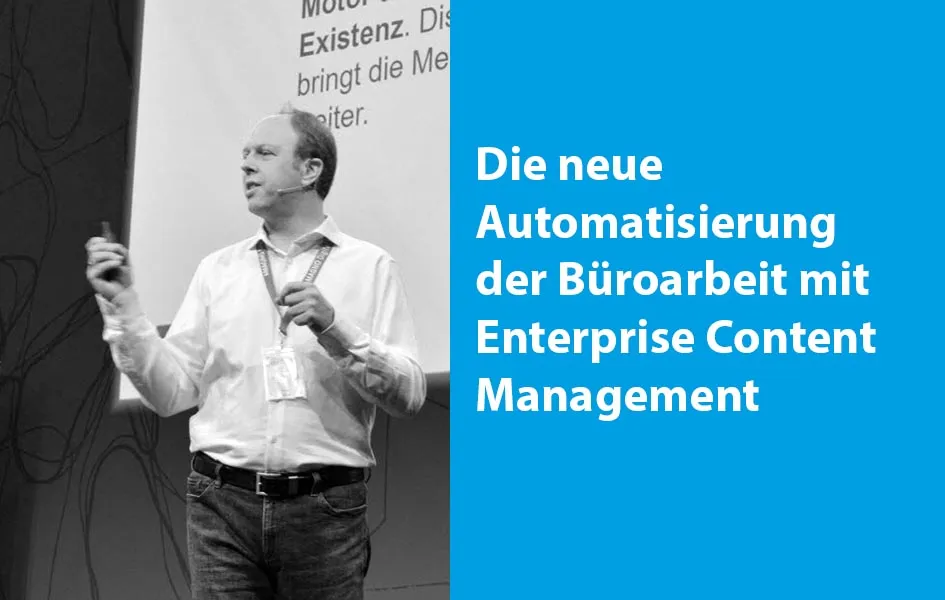
AMAGNO is redefining the Enterprise Content Management (ECM) market with many new approaches and, according to a 2018 Deloitte study, is one of the fastest-growing technology companies in Germany. Based in Oldenburg, Lower Saxony, the application can be operated either as an on-premise or cloud solution. Among its more than 360 customers are renowned medium-sized companies that may already be one step ahead of others with this solution. Reason enough for us to conduct an in-depth interview with Managing Director Jens Büscher about the automation of office work.
DIGITAL FUTUREmag: Mr. Büscher, let’s start by talking about the word disruption. What does disruption mean to you, and where do you see the greatest risks but also opportunities for German SMEs?
Jens Büscher: We live in an incredibly fast-paced time. A special time in which everything worldwide is being questioned for new business models that were previously considered established, proven, and traditional. We are also experiencing the “end of ownership” era. For this reason, all subscription and rental models are currently expanding. However, disruption is also the engine of our humanity. We will witness many fantastic innovations, but also the effects of disruption. The world of work will undergo profound changes in the coming years, including high unemployment. One reason for this is that most traditional companies considered—and still consider—themselves untouchable. A good example is the automotive industry. I see it as the duty of a modern managing director to regularly address the disruption of their own business model. Only then can we set the course for the future in good time before new competition does so. And only in this way can Germany, or even better, Europe, keep pace with a global market that is already thinking so radically. If we approach our business openly and disruptively, we have an excellent chance of keeping our country strong.
Entscheider kompakt: Document management or Enterprise Content Management is a topic already in use at many medium-sized companies and has enabled enormous savings there. What is new and extraordinary about your solution?
Jens Büscher: Our industry assumes that no more than 20% of SMEs are using such a solution. Almost all SMEs still rely on analog filing and workflows. Most companies are still unaware of the positive effects in cost savings, quality, efficiency and, above all, legal security. They are also still confronted with many solutions that do not motivate employees to use them. Previous solutions were too complex and too expensive. We wanted to do something about this and focused on the document itself. We aim to ensure that employees enjoy working with digital documents so much and feel the benefits that they no longer want to switch back to paper. In other words, personal motivation instead of obligation. This is why we developed the AMAGNO Living Documents™ technology. Every document, whether a file, scanned receipt or email, becomes interactive in AMAGNO. A simple double-click on any term, e.g. a customer number, triggers a search across millions of files and all texts in AMAGNO, and the results, including visual highlighting of the search hits, can be viewed within seconds. Employees can browse through documents just like on the internet. Paper cannot offer this added value, which is what makes AMAGNO so extraordinary.
DIGITAL FUTUREmag: In your business cloud solution, more than 20,000 users in Germany are now working with your solution. Has SMEs lost their fear of the cloud? What is your assessment here?
Jens Büscher: We and other market players have noticed a massive shift in purchasing behavior since last year, moving away from on-premise solutions towards the cloud. In our opinion, this is due to several factors: 1. Companies can no longer find qualified staff to administer their own servers. In addition, the costs of operating their own servers, including licenses, backups, security infrastructure, etc., are far too high. 2. The cloud is immediately available, the software is not functionally restricted, and it requires hardly any high initial investment. This allows workflows to be implemented and put into operation immediately. 3. Legal requirements have become stricter, and cloud providers meet these requirements.
DIGITAL FUTUREmag: Invoice processing is still a central issue for many companies today, as sensitive supplier data must be processed. What basic precautions should companies take when they first deal with document management systems and are looking for the right provider here?
Jens Büscher: The major added value in invoice receipt processing is primarily the performance and traceability through workflows. Solutions like AMAGNO automatically capture invoice data, reconcile it with external systems, route invoices without delay to decision-makers, and carry out posting. This represents a high degree of automation with significant time savings. Typically, an ECM system pays for itself in a very short time simply by adhering to discount deadlines. In principle, all providers can cover this. Ideally, companies should outline the workflow and have providers demonstrate the digital implementation. In the end, it comes down to an emotional decision (simplicity, user experience, usability). The cost question should not even be asked, because digitization in this area pays for itself very quickly in any case.
DIGITAL FUTUREmag: What three most important criteria would you name for the successful introduction of an ECM system?
Jens Büscher: The most important thing is that the customer can articulate what solution they expect and outline their processes. No provider can offer a successful solution if these basic pieces of information are missing. Providers and consultants are happy to help, but simply writing down the current process can already be a big help. Customers should also articulate their functional requirements. No provider can do everything – if they can, it may involve a great deal of additional effort. Therefore, prioritize the requirements (must-have now/later). Last but not least, customers should have their top solutions demonstrated live based on a small scenario. Do not make decisions based on PowerPoint or pure requirement lists. This is where most surprises lie in wait.
DIGITAL FUTUREmag: Thank you very much for the interview.