In the interview with Jens Keckstein
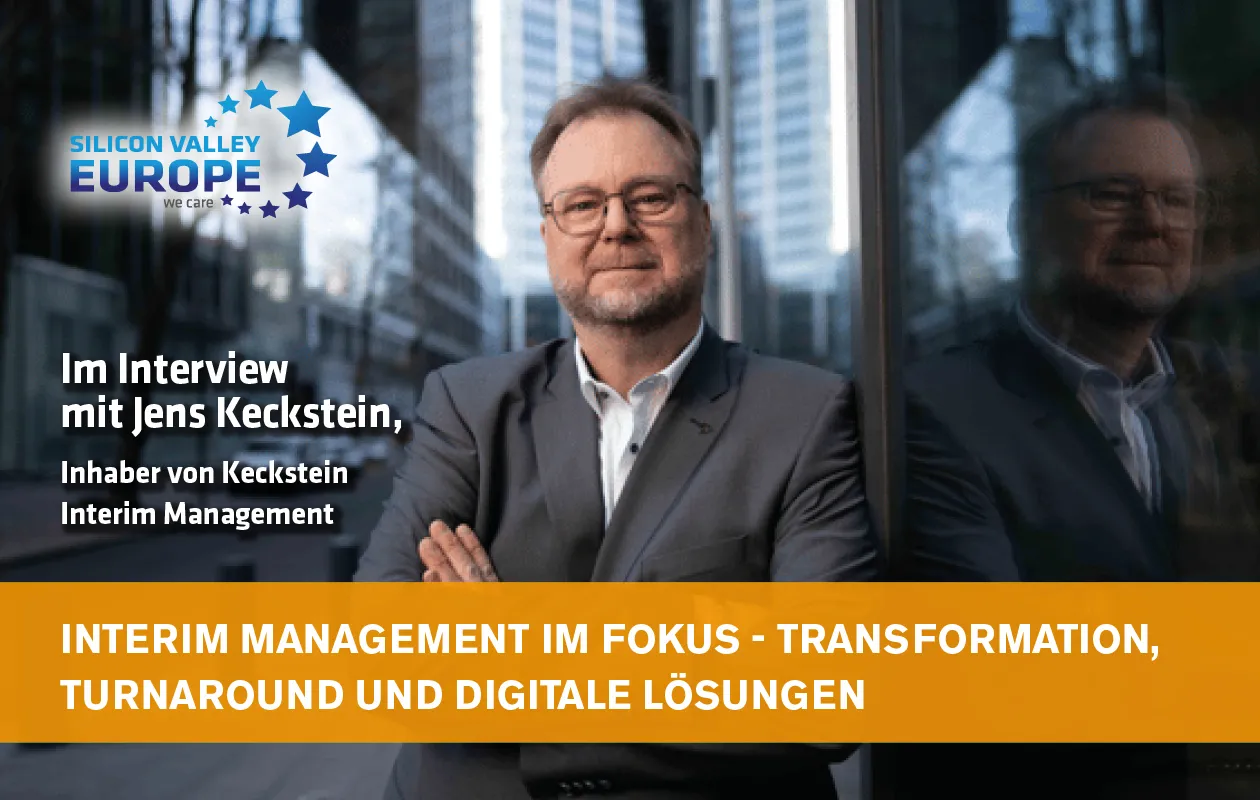
The challenges companies face today are diverse: globalization, digitalization, skilled labor shortages, and economic uncertainties are putting enormous pressure on executive floors. Strategic decisions must be made quickly, transformations implemented smoothly, and change processes designed sustainably. In this dynamic environment, interim management is becoming increasingly important. Jens Keckstein, experienced interim manager and consultant, knows how to support companies precisely at these critical moments—whether by taking on management positions, steering major reorganization projects, or managing critical transformations within companies.
In an interview with Silicon Valley Europe, Jens Keckstein sheds light on the growing pressure on executive floors and explains how companies can remain capable of action and implement decisions effectively despite complex conditions. Particularly in digital transformation, it becomes clear why external expertise is often the key to successfully transitioning processes, structures, and business models into the digital world. Practical insights into success strategies for turnaround and special projects demonstrate how companies can reposition themselves even in critical situations and emerge stronger from the crisis. Keckstein also highlights the importance of human leadership in times of change and how to engage, motivate, and lead people through transformation processes.
In addition to his analytical sharpness and operational implementation strength, Jens Keckstein brings a deep understanding of the needs of modern companies. His experience from assignments in the industries of production and logistics, pharmaceuticals, banking, and retail shows that interim management is not just a temporary solution but often a decisive success factor in today’s digital world. Experience an inspiring exchange with an expert who sees change as an opportunity and proactively supports companies in shaping transformation successfully. With certainty.
Silicon Valley Europe: Mr. Keckstein, interim management is becoming increasingly relevant in today’s corporate world. What makes this form of collaboration so valuable, especially in transformation and crisis situations?
Jens Keckstein: An interim manager is usually only brought into a company when it’s on fire. We interim managers like to use the phrase: only when the pain for the entrepreneur is big enough. Sometimes that’s a shame because you’re just the “firefighter” putting out the blaze. But just as the fire department not only fights fires but also provides preventive measures to ensure the next fire doesn’t break out, bringing in a thematically experienced interim manager is comparable. They bring value to the field they’re hired for. It’s far more advisable to bring an interim manager on board before smoke starts rising. Ultimately, it’s—just like preventive fire protection—cheaper than rebuilding what’s left after the fire.
Many entrepreneurs or decision-makers equate an interim manager with a management consultant. I encounter this repeatedly. Perhaps the most significant difference between the two is this: the interim manager implements. This is what the client should focus on. Of course, creating a concept is also part of an interim manager’s toolkit, similar to a consultant. After all, they are not hired for operational tasks. The areas of focus lie in conceptual, strategic, and future-oriented tasks. After that, it’s about providing “proof” that those famous PowerPoint slides are sound. Bringing the whole thing to life: for example, not just drawing the new organizational structure but actively implementing it. Actively managing the entire project. Defining future roles and responsibilities, developing the necessary standards. Involving the people affected by the project. Explaining, addressing fears and concerns, and engaging them.
Another aspect that makes working with an interim manager so valuable is our approach: we come to leave! Meaning, I know—and I want this myself—I am only in the company for a certain period. Ideally, until the task has been fully implemented. Then I leave again! Of course, I’m also happy about interesting follow-up assignments if it suits both parties. But I’m not sawing off the chair I’m sitting on, nor do I need to position myself against others internally. As an interim manager, I see tasks more rationally. I can ask my questions, highlight my observations more directly and openly than an internal employee—even to the entrepreneur. There are no reservations, nor any ambitions to build a career there. It’s all about solutions. That’s what makes me freer!
Silicon Valley Europe: How do you, as an interim manager, manage to quickly familiarize yourself with complex corporate structures and deliver immediate added value?
Jens Keckstein: First, I always stay within my area of expertise for the tasks I take on. This makes it easier to get into the subject matter over the course of my professional experience. Apart from that, companies function similarly at their core. Sure, there are differences based on company size, industry, and whether they operate locally, nationally, or internationally. But as long as a company has to operate in an economically viable way, there are factual limits. This makes it—up to a point—easier to grasp structures and processes. That’s how I can deliver faster added value.
But, you’re right: it is a challenge to familiarize yourself with the company, its environment, and its organization. As an interim manager, you’re internally observed to see whether you’re delivering the value for which you were hired—not just by management but also by your “direct colleagues.”
On the other hand, I have a clear task and a clear focus on what I need to address. All other aspects that may seem relevant to an internal employee are initially secondary. Here, it’s about filtering.
At the same time, the actual task needs to be analyzed, evaluated, prioritized, and broken down into manageable chunks. My approach to this: identify what can be done “now” and what can be addressed “later.”
In total, I have learned to identify and tackle quick wins. The fact that I have no history with the company works in my favor here. I am “unblemished,” can openly question things, and get to work on them. These are usually long-standing operational grievances. As I said, I don’t want to build a career internally!
Silicon Valley Europe: What particular challenges do you currently see for executive floors, especially in times of economic uncertainty and digital transformation?
Jens Keckstein: It’s not just about digital transformation or economic uncertainty. On February 23, we had the opportunity to cast our vote on economic uncertainty. We can only address that to a limited extent at the business level.
As far as digital transformation is concerned, I advocate not viewing the topic as too technical! The technology, the router, the server, the cloud—all of that accounts for 30% of the challenges of digitalization. That can be solved relatively quickly.
It’s the integration of digitalization into day-to-day work that makes companies sweat. Internal business processes need to be adapted. Work content will shift internally. The organizational structure needs to be adjusted to the circumstances. It’s worth considering whether departments (silos) should be reorganized into value streams | business processes. That would also bring about a rethink in hierarchies. Along with secondary aspects such as work distribution, roles & responsibilities, employee management, works council involvement, employee development paths—all of these topics should be put to the test. Not to be forgotten: the customer interface, which needs to be served in a process-oriented way in the back office.
Since the end of the coronavirus pandemic—and the return to everyday life—I have noticed a clear shift in mindset in executive floors. Whether the “old” business model still works with the new customs needs to be questioned. It’s not just about the supposed pressure to accept remote work. Often, digitalization in executive floors is only thought of in terms of the customer: “You have to serve them this way now because that’s what the spirit of the times demands.” What is frequently neglected is that internal structures need to mirror this in kind—if only to ensure customer satisfaction.
Silicon Valley Europe: You have accompanied numerous turnaround projects. In your opinion, what are the key strategies for successfully managing such processes?
Jens Keckstein: Why a company is where it is today has many causes. To focus on just one would be too simplistic. A key success factor in moving forward is for management | the entrepreneur | and the shareholders to recognize that they are part of the cause! They are a key part of the whole. All too often, people in this position believe that the issues only affect operational levels, or even sales, but not themselves. That is a misjudgment. This group of people is part of the problem, part of the change, part of the solution. They not only need to participate—they need to lead by example. As mentioned, the COVID-19 pandemic has prompted a clear shift in thinking, particularly due to the economic pressure it created, showing that a company cannot be run by KPIs alone.
Silicon Valley Europe: In the field of Industry 4.0, the focus is on transferring processes and structures into the digital world. How do you approach such projects, and what mistakes should companies absolutely avoid?
Jens Keckstein: The term “Industry 4.0” is now outdated. It has been replaced by terms like digitalization and, above all, AI. In my view, the focus is still too much on the technical aspect. That is important and relevant. However, someone also needs to understand, operate, and master the technology. We have now reached “Industry 5.0.” A concept that emphasizes the collaboration between humans and machines—not just in production. It goes beyond the pure efficiency gains of Industry 4.0 and highlights the importance of sustainability, personalization, and empowering people in the workplace. What downstream requirements arise from the fact that our printer now 3D prints? Which requirements are eliminated, and what new skills do I need?
Silicon Valley Europe: What role does interim management play specifically in digital transformation? Can you give an example where your work was decisive?
Jens Keckstein: A key factor in interim management is the repetition factor. I have been working in my field for years. Of course, with all its facets, but always thematically focused.
It certainly happens that I do not have in-depth knowledge of a specific operational production process or detailed expertise in a particular administrative procedure. But I don’t need to! Perhaps up to a certain point, at which I then familiarize myself with it. My role is conceptual and overarching. I reorganize. If I were to constantly focus only on the current state (IST), I would quickly become blind to the bigger picture. That must not happen! I bring the right people on board for the specialized knowledge. Employees who are positively inclined toward change. Who would have liked to make those changes themselves. The driving force is often missing, partly due to a lack of reputation, partly due to a lack of hierarchical opportunities. But the will is there.
My recent work had a significant impact at a medium-sized company (approx. 450 employees) near Dresden. The task within the digitalization program was to coordinate individual projects so that they could go live simultaneously, as one could not function without the other: introduction of a procurement platform, digitized supplier management, and the downstream processes of invoice receipt with approval and release procedures. This included, among other things, selecting suppliers, developing user stories, managing the proof of concept, deriving decisions, and overseeing the implementation. As you can see, the topic is more extensive than initially thought. The challenge is to implement purely technical aspects into the existing organization—and, conversely, to adapt the organization and internal processes to the new technical conditions.
Silicon Valley Europe: Changes are often associated with uncertainties for employees. How do you manage to motivate and involve people in transformation projects?
Jens Keckstein: The key term here is “co-creation.” Actively involving internal employees in the process of idea generation, problem-solving, and developing new products, services, or processes. It’s a collaborative approach aimed at leveraging the knowledge and creativity of your own workforce to drive innovation or improve internal workflows and workplace culture. Modern companies increasingly rely on this active involvement. Even if it may seem daunting or slightly chaotic at first glance, by utilizing diverse perspectives, collective knowledge, and employee creativity, companies can develop solutions, adapt processes, and respond to changes. Additionally, it typically has positive effects on improving workplace culture, focusing on a sense of community and making employees at all hierarchical levels stakeholders in the process.
Silicon Valley Europe: You describe yourself as a doer who gets things done. What leadership principles guide your work?
Jens Keckstein: Quite simply: openness, honesty, and appreciation. No hidden agendas, no double standards. Leading by example and starting with yourself. Of course, there are business decisions that don’t need to be announced immediately or company-wide. In my experience, most employees can accept and live with any decision made by management, even if it’s personally unfavorable, as long as it’s explained in content and justified factually. Explain—include—communicate. However, the ultimate decision-making authority remains with the entrepreneur.
Silicon Valley Europe: You’ve worked with companies across various industries. Is there a project that was particularly challenging for you and why?
Jens Keckstein: I can’t quite put it that way. Projects in large companies are particularly challenging. At some point, you run up against guidelines from “headquarters” or “global”. You have to find your place there. Explore the limits of what’s feasible and try to stretch them as far as possible in your favor. It becomes more specific when management believes the issue doesn’t concern them, that it’s something for “the employees”. I had a mandate at an eastern German site of an international logistics corporation. The task was to develop leadership skills to motivate and involve employees at each hierarchical level. Another aspect was reducing absenteeism, especially among warehouse employees. How do you get employees to show up for work willingly? Certainly not by decree! Involvement – inclusion – setting incentives. Those “down below” are (rightly) of the opinion that changes, incentives, “that has to come from above”. The site management initially delegated that “motivation should be created at the lower (leadership) levels”. At the start, the site management believed the challenges for the change lay everywhere except with them. Getting them to realize that it involves all levels, that roles, tasks, responsibilities, and areas of accountability start right “at the top”, was a challenge. We ultimately succeeded in creating this understanding, but it took a few attempts.
Silicon Valley Europe: What should companies definitely consider when engaging an interim manager, in your view?
Jens Keckstein: Immediate effectiveness: no long onboarding – bring structure to the situation straight away.
Independent & neutral perspective: clear decisions without operational blindness or corporate political dependencies.
Expertise, experience & cross-industry knowledge. This allows best practice approaches to be incorporated.
Very important: hands-on mentality & implementation skills – the interim shouldn’t be too good for operational activities or operational discussions.
Strategy alone isn’t enough – implementation is the task!
The interim manager is a flexible & cost-efficient solution: predictable costs, no long-term fixed costs, scalability as needed.Silicon Valley Europe: Thank you for this exciting conversation and insight into your approach.