In the interview with Karl Heinz Mosbach, Managing Director of ELO Digital Office GmbH.
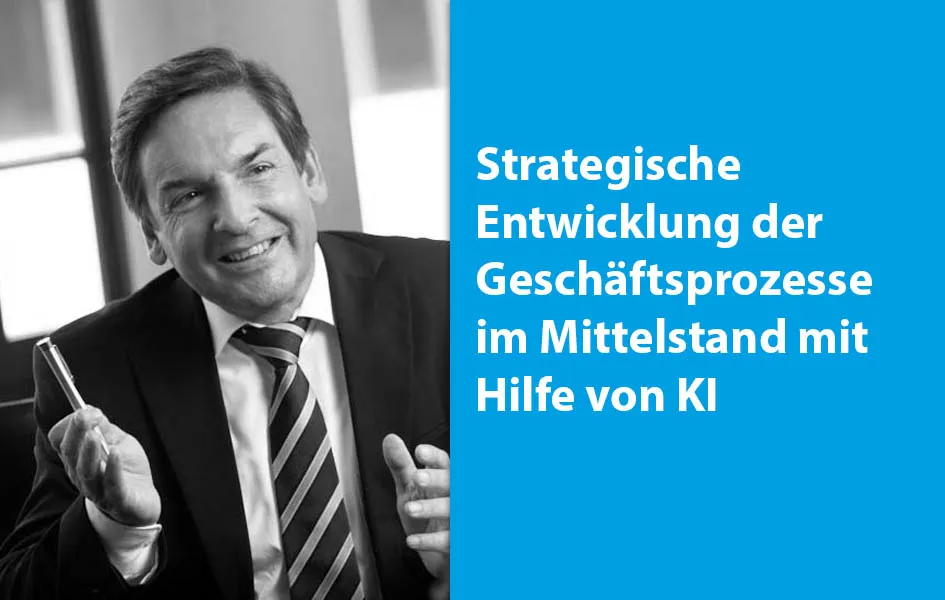
ELO Digital Office GmbH is one of the leading manufacturers of systems for Enterprise Content Management (ECM). The Stuttgart-based company develops digital business process solutions for all industries and departments, as well as for companies of any size. ELO Digital Office has been active in the market for over 20 years and is increasingly focusing on the topics of artificial intelligence (AI) and the impact of AI on digital business processes, particularly in the field of Enterprise Content Management. In an interview with Karl Heinz Mosbach, Managing Director of ELO Digital Office GmbH, we discuss today the benefits of using artificial intelligence in SMEs.
DIGITAL FUTUREmag: Mr. Mosbach, your company has been successfully active in the SME sector for many years, enabling companies to digitalize and significantly accelerate their business processes. In your opinion, why is AI – artificial intelligence – now a game-changer and therefore so important for the future?
Karl Heinz Mosbach: To begin with, I would like to put the term “artificial intelligence” into perspective. Many people instinctively associate artificial intelligence with independently thinking machines. However, we are still light years away from such scenarios. Instead, the first step is to develop intelligent solutions that – focused on a specific task – relieve people of manual, often mundane work. While many IT solutions in the past offered little user comfort and functionality, this has changed significantly in recent years thanks to increasingly powerful systems. High computing power, vast storage capacities and ever-faster networking have created a new basis for developing more powerful and intelligent systems today. AI technologies open up a new level of supporting people in business processes. This will bring about a similar transformation in the coming years as we know from the industrial revolution. Despite increasing complexity, many things will become simpler. Therefore, this can be seen as an important change for a successful future.
DIGITAL FUTUREmag: What specific benefits does artificial intelligence offer companies?
Karl Heinz Mosbach: Above all, companies can focus on their core processes. Tedious administrative processes, which we still have in abundance in all areas today, will be reduced to a minimum. This will not happen overnight, but the path to it is already mapped out by companies' and administrations' digitalization efforts. In addition to increasing efficiency, AI and increasingly intelligent processes will primarily save costs. In many areas, new business models will also emerge that we do not yet think of today and that will be made possible with the support of AI technology.
DIGITAL FUTUREmag: Could you perhaps give us a few examples of how AI is used in the finance department?
Karl Heinz Mosbach: Especially in the financial sector, where large quantities of data, fixed processes and assignments are traditionally used, there is great potential for successfully implementing AI technologies. Take, for example, supplier invoices, which are still printed out in the millions, sent by post and laboriously entered manually in accounting departments in many companies. A process that can already be excellently automated today using an intelligent system such as our ELO DocXtractor (https://www.elo.com/de-de/produkte/elo-module-und-schnittstellen/elo-docxtractor.html). The good thing about these systems is that they constantly improve during the processing stage, as they learn and thus continuously reduce the proportion of manual interventions – where the system is not entirely certain. Using this example, it is easy to see the difference between manually processing thousands of invoices or having a highly intelligent system component handle them in the shortest possible time.
DIGITAL FUTUREmag: That sounds very exciting. Are there other areas in the company that are interesting for the use of AI?
Karl Heinz Mosbach: Essentially, it is the areas of the company where increasingly intelligent system solutions can be used in the future. Take the HR department, for example, where we support companies in personnel recruitment with solutions such as our Business Solution ELO HR Recruiting. In the future, there will also be intelligent assistants that automatically analyse cover letters, certificates, qualifications, etc., prepare them graphically and, based on this, compile a performance profile of the best applicants. This significantly simplifies the laborious analysis of each application and its comparison with others. In the future, AI and intelligent systems will relieve people of laborious manual work in all areas.
DIGITAL FUTUREmag: Although AI is currently on everyone’s lips, I believe that introducing and dealing with such technologies is still new territory for many. What is your recommendation for medium-sized top decision-makers who want to seriously address this topic?
Karl Heinz Mosbach: First of all, you should be open to such new technologies. AI and intelligent systems are not voodoo magic, but rather methods and logics that process information and data. Just as we use machines and production systems to avoid manual work, computer support or complete automation will increasingly be used in business processes, especially for laborious, partly mindless work steps. Every company and every administration has countless examples that need optimisation. Ultimately, it always comes down to increasing performance, saving costs and working more efficiently. Those who stand still and do nothing run the risk of falling behind.
DIGITAL FUTUREmag: What specific tips can you give to SMEs, particularly those in the upper mid-market segment?
Karl Heinz Mosbach: Digitalization, automation, and process optimization are continuous processes. SMEs in particular should not try to tackle everything at once. Prioritizing the areas that are most important to the business is advisable. It is also crucial to involve employees from the outset to prevent reservations and concerns from arising in the first place. In most cases, this approach adds momentum, as employees recognize the benefits and claim the progress as their own achievement.
DIGITAL FUTUREmag: Even though the issue of the General Data Protection Regulation (GDPR) has somewhat lost its urgency and the feared wave of warnings has not materialized, the topic remains of utmost importance. How can data security and, in particular, data protection be ensured in the age of AI? Is there a direct connection here?
Karl Heinz Mosbach: Indeed, data protection has gained critical importance due to the increasing digitalization of our lives. Nothing is perfect from the start. Nevertheless, the EU GDPR provides a solid foundation that offers greater security for everyone. It is therefore not surprising that California recently adopted similar strict data protection regulations based on many of its principles. For me, there is also a direct connection to AI. Most data protection incidents are caused by human error or negligence. I am confident that the future will bring increasingly intelligent solutions that will help people comply with data protection and security requirements.
DIGITAL FUTUREmag: Thank you very much for this interview on such a current topic. All that remains is for me to wish you every success at the next Digital FUTUREcongress and to look forward to seeing how many decision-makers you can inspire on the topic of AI.