In the interview with Klaus Beck-Dede, CEO of iDocpro.de GmbH
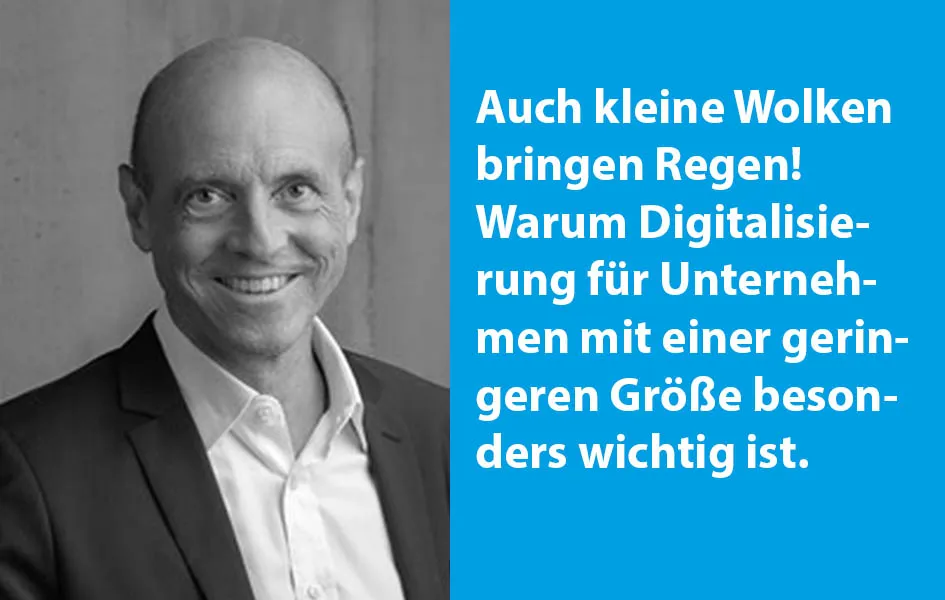
iDocpro from Neu-Isenburg near Frankfurt has developed a solution that enables even small companies with 50 or fewer employees to easily leverage digitalization. iDocpro invites service providers, craftsmen and industrial companies to improve their processes and measurably increase their efficiency. With the slogan “Fast, paperless and efficient,” iDocpro promotes complete digital data collection. Today, we talk to Klaus Beck-Dede, CEO of iDocpro.de GmbH, about simple ways even smaller companies can benefit from digitalization.
DIGITAL FUTUREmag: Small and medium-sized enterprises often fear high effort and therefore refrain from the opportunities digitalization offers. Why should SMEs open up to this topic?
Klaus Beck-Dede: When advising companies with 1 to around 100 employees, we have found that the right form of digitalization can unlock great potential. Efficiency gains, which can be a major advantage especially in times of skilled labor shortages. Achieving higher sales and thus profits with the same number of employees or simply having less stress and more free time as an entrepreneur are goals that can be very well achieved through digitalization.
DIGITAL FUTUREmag: What problems and hurdles should SMEs be particularly prepared for when deciding to digitalize their company?
Klaus Beck-Dede: Many companies have a strong trust-based relationship with their long-standing IT service provider, who has supplied them well with hardware, service and standard software. However, these providers often reach their limits when it comes to digitalization because process optimization and the design of efficient holistic solutions are not part of their core competence. The biggest challenge for SMEs is therefore to find the right partner for digitalization. As a “layperson” in a very opaque market, this is more than difficult. There are only a few IT companies, whether software, consulting or service providers, that refuse a request when approached by customers. It is therefore up to the companies to recognize which provider really offers good solutions or is able to do so. In addition, many companies are not aware that digitalization means further expanding the strengths they have built up in the past through digitalization. The use of standard software, as may be common in your industry and used by competitors, may work for administration, but cannot be a solution for digitally supporting core processes. With standard software, you as a company are always only as good as your competitors.
DIGITAL FUTUREmag: Decision-makers in SMEs are often deterred by the presumed or real complexity of processes and applications. Your company advertises that your solutions can be used even without IT knowledge. How should this be understood?
Klaus Beck-Dede: Good solutions are never complicated. Complexity is always a sign that processes and relationships have not been fully thought through and insufficiently analyzed. As experts in digitalization, we guide our customers and develop, either workshop-based or agile—as it is so nicely called today—the requirements for the processes and the necessary information flows. Of course, we also take a close look at how companies currently operate.
Based on this knowledge, we propose to our customers how we would design the future solution. This is exactly where the functional performance of the iDocpro solution helps us. iDocpro already includes a very wide range of functionality. We can not only explain the process to our customers theoretically. We directly show our customers how the process looks when implemented with iDocpro. This is only feasible for us because iDocpro, as a highly flexible system, is designed to be configured flexibly for the most diverse customer requirements. Just as a CNC machine can produce different sheet metal or wooden elements, the iDocpro solution is designed to create and manage individual data objects. Thanks to this tangibility, our customers can immediately use, understand, and evaluate the configured solution. This flexibility allows us to quickly and easily implement any change requests that may arise or adjustments needed due to additional insights. Step by step, we work with the customer to continuously improve and fine-tune the configuration to meet specific requirements and needs.
Entscheider kompakt: In smaller companies, field service often plays a central role. How can your solutions contribute to greater efficiency here?
Klaus Beck-Dede: We don’t talk about field service but about on-site deployment to differentiate where the work is performed. An in-house solution for offices, warehouses, or production can use different options than a solution for on-site use deployed elsewhere. iDocpro offers a solution component with the iDocpro Digital On-Site Deployment System that allows on-site deployment to be fully digitized. We can capture any information digitally using the iDocproApp and store it in the iDocproPortal for further processing. This information can be directly imported into the database, used to generate documents, statistics, or evaluations, trigger (subsequent) process chains, or simply sent as a letter or email. The data collection can include images, dates, times, geodata, text, numbers, and signatures. At the same time, the iDocproApp can provide users with information such as images, videos, PDFs, text, or selection data for data collection. Another major benefit is the offline capability of the iDocproApp. All configuration data, selection data, images, etc., are regularly updated in the background. Data collection can be performed at any time, online or offline. If there is no connection, the data is sent later accordingly.
DIGITAL FUTUREmag: Your solutions are cloud-based. Do you often encounter reservations regarding security on this topic?
Klaus Beck-Dede: Indeed, there are often reservations here, but they are gradually diminishing. We always ask our interested parties whether an external connection to the company’s data is necessary. As soon as customers confirm this, it is naturally very easy to demonstrate to them that a professional cloud solution, managed by specialists, is far more secure than external access to their own company servers, whether organized by in-house employees or an external IT service partner. Customers quickly understand that external threats today are very complex and new threats emerge time and again. A professional cloud service provider has dedicated specialists who deal with these issues daily and can respond immediately to current threats. This focus and sophisticated knowledge is usually lacking in the IT service providers of our customers, which allows us to clearly demonstrate the security benefits of our solution.
DIGITAL FUTUREmag: Today, we are already talking about the post-digital era. If digitalization continues to develop at such a rapid pace, what could this mean for smaller companies?
Klaus Beck-Dede: Digitalization is developing rapidly, that’s correct. However, no one can yet predict exactly how and in which industries the changes already visible will have a long-term impact. What is clear, however, is that we are moving towards a data-driven future. AI systems (artificial intelligence) help companies improve and leverage the knowledge embedded in data. Smaller companies are clearly at a disadvantage here, as their smaller size means they generate less data. Moreover, developing and using such AI systems involves significant costs. iDocpro already has corresponding concepts and mechanisms in place or in the pipeline. We already store all data collected from customers in a data pool, separated by customer. Our customers can already use this data today or begin doing so at the appropriate time. At the right moment, we will offer our customers not only our Business Intelligence component but also an AI component for data analysis that can utilize all the data collected by the customer in iDocpro.
In the long term, no company will be able to do without data-driven process design and optimization. It is therefore important for all companies to prepare as well as possible today. But this shouldn’t be cause for concern. In my presentation at the DIGITAL FUTUREcongress on February 18, 2020, at 2:40 PM, I will show with three examples how small companies can overtake large competitors through digitalization.
The interview was conducted by Erika Alkemper-Heinrich