In the interview with Malte Redmann, Co-Founder of 2WORK
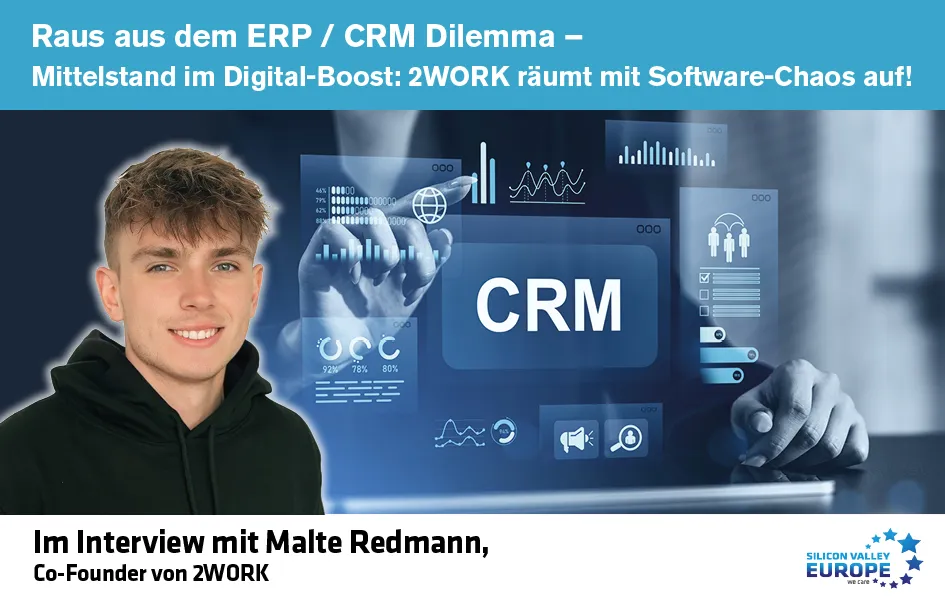
Many medium-sized companies still struggle with a software dilemma: either ERP, CRM and HRM systems are overloaded, unwieldy and require extensive consulting – or they are so heavily stripped down that important requirements are left unaddressed. Often, this results in an expensive patchwork of individual solutions that entails high license costs, duplicate data maintenance and unnecessary administrative effort. 2WORK GmbH from Flensburg aims to change exactly that and relies on a lean, practical cloud platform that combines the best of ERP, CRM and HRM systems and controls the entire business process – from the first lead to the final invoice, including personnel management and service.
In the current interview with Malte Redmann, Co-Founder of 2WORK, we discuss the success factors and pitfalls in digitalization in the SME sector, the advantages of a central system compared to isolated solutions, and the paradigm shift that many SMEs still have ahead of them. Malte Redmann also provides insights into 2WORK’s AI implementations and explains how the “AI-first strategy” shapes future product development. Another key topic is digital sovereignty – and why hosting on German infrastructure is not only a security factor in times of global uncertainty, but also a strategic advantage.
Look forward to clear words, practical insights and bold visions in this Silicon Valley Europe interview.
Silicon Valley Europe: Mr. Redmann, many SMEs still operate without a comprehensive ERP or CRM solution. In your experience, what is the reason for this – and what typical obstacles prevent them from taking the plunge?
Malte Redmann: The main problem is overwhelming complexity. Many SMEs are faced with a tangle of overly complex systems, high consulting costs and a flood of individual solutions. Often, various tools have been cobbled together somehow – the result: high license costs, duplicate data maintenance and inefficient processes. The initial step often fails due to a lack of orientation, fear of high investments and the dread of failing in the digitalization process. This is exactly where we come in with 2WORK: we reduce complexity and create a clear, practical solution for SMEs.
Silicon Valley Europe: If an SME takes the plunge: what are the most common stumbling blocks when introducing integrated business software – and how can companies successfully overcome them?
Malte Redmann: A common stumbling block is the lack of preparation in data migration or clear process definition. Many companies also underestimate the cultural change that digitalization entails. At 2WORK, we offer a standardized onboarding process with clear roadmaps and training programs. Our customers benefit from a straightforward start from day one, without months of workshops or external consultants.
Silicon Valley Europe: You consciously opt for an all-in-one system at 2WORK instead of multiple individual tools. What are the decisive advantages of this approach for companies compared to standalone solutions?
Malte Redmann: Standalone solutions create data silos, high coordination efforts, and unnecessary friction losses. To connect these systems, companies often resort to expensive individual interfaces or must rely on limited interfaces provided by the software vendor—both of which incur additional costs. Our all-in-one platform solves this exact problem: it combines BRM (CRM), project management, accounting, sales, and HR in a single system with one interface. The result is not only significant efficiency gains but also substantial cost advantages. Most SaaS providers lure SMEs with an affordable base price, but the software only covers the bare minimum. The magic word is often “module expansion,” which means many SMEs quickly end up paying triple-digit amounts per user per month to cover all their processes. We want to counter this trend with 2WORK and include all our modules in the basic package—no extensions, no add-ons. We also adopt an all-in-one pricing model.
Silicon Valley Europe: Many ERP and CRM systems feel bloated and confusing. How do you manage at 2WORK to keep the focus on core processes while still covering all essential functions?
Malte Redmann: The secret lies in the principle of “progressive disclosure.” Users always see only what they need at that moment. The interface remains clean, yet the depth is still there. We align with the central business process “Order to Build to Cash to Operate” and develop functions along this path that make daily work smarter, not more complicated. Our software is a fluid construct that allows users to independently visualize the entire process from lead to outgoing invoice, as well as the connections between individual process steps.
Silicon Valley Europe: You have already integrated AI features into 2WORK. Can you give specific examples of how artificial intelligence is already supporting your customers' daily work?
Malte Redmann: One example is our intelligent relationship mapping: all you need to do is enter the company name, and the AI automatically fills in the remaining data such as associated individuals, addresses, general company information, etc. The days of manual relationship mapping are over! In the near future, we will also roll out features such as AI document recognition and AI-assisted automation of standard processes. For our customers, this means: fewer clicks, less routine – more time for what really matters.
Silicon Valley Europe: You are pursuing an “AI-first strategy.” What does this mean in concrete terms for the further development of your platform – and how will AI be integrated even more deeply into your solutions in the future?
Malte Redmann: Our AI-first strategy means: artificial intelligence is not an add-on; it is an integral part of our product development. Every new feature is reviewed to determine whether and how it can be made smarter, faster, or more efficient through AI. We believe that, in particular, small companies can gain a competitive advantage through AI that was previously reserved for large corporations. In addition, we are working with Viakom GmbH to develop a shared LLM integrated into the digitally sovereign workspace “cloud.desk” (an alternative to Google Workspace and Microsoft Office), of which 2WORK will also become an integral part. The use of an AI that is already pre-contextualized in business software takes automation possibilities to a whole new level!
Silicon Valley Europe: A key USP of 2WORK is hosting on German infrastructure. Why do you place such great importance on digital sovereignty – and how do your customers respond to this issue?
Malte Redmann: Trust is the be-all and end-all, especially when it comes to business software. Our customers want to know where their data is stored and that it is secure. Hosting in Germany, GDPR compliance, and a support team that speaks German and is locally accessible create this trust. For us, this is not just a security aspect, but a clear strategic advantage in competition with international providers, especially in uncertain times when global developments by actors such as Trump or Musk further increase the need for reliability.
Silicon Valley Europe: In conclusion: If you had to give SMEs three quick tips for successfully digitalizing their business processes, what would they be?
Malte Redmann:
Dare to simplify: Say goodbye to the patchwork. Focus on fewer tools and more integrated processes.
Involve employees early on: Digitalization is a change process. Bring your teams on board early, communicate openly, and offer training. User acceptance is crucial for the success of any software implementation.
Rely on digitally sovereign cloud solutions: The cloud enables flexible, location-independent work and rapid scaling. But not all clouds are the same: Those who prioritize digital sovereignty retain full control over company and customer data, independent of US providers or global crises.
Silicon Valley Europe: The interview is encouraging and shows a practical way to move away from the ERP/CRM dilemma. Great stuff and thank you very much for your time.