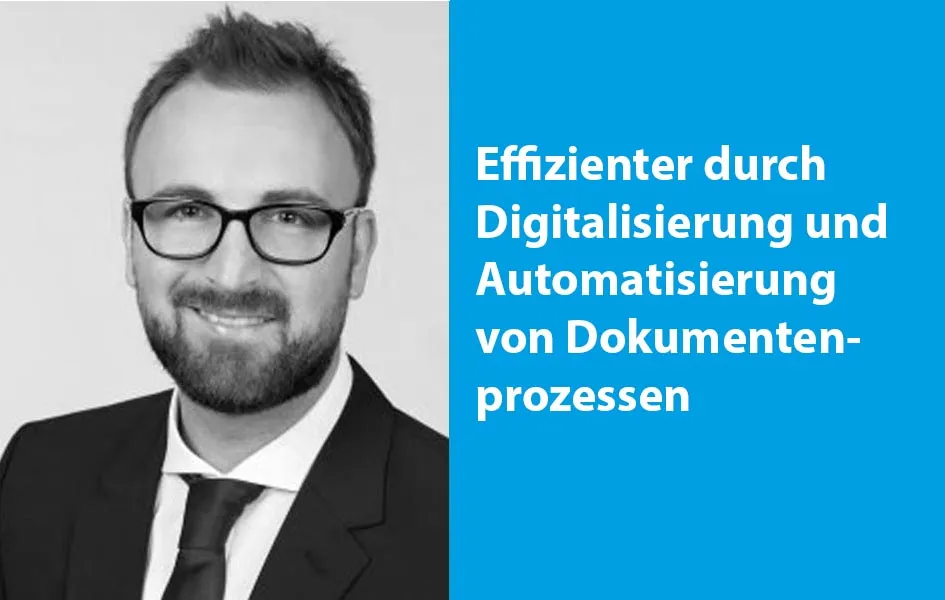
In the interview with Martin Fecker, Managing Director of HABEL GmbH & Co. KG
Since 1991, HABEL has been one of the leading software companies for document management and enterprise content management. With over 1,800 national and international customers, the company can demonstrate valuable references. As a highly specialized project partner with high technical expertise and many years of experience, HABEL has developed many industry-specific document management solutions in recent years. With its solutions, the company enables the archiving and automation of documents through workflow tools.
In an interview with Martin Fecker, Managing Director of HABEL GmbH & Co. KG, we talk today about optimal processes in SMEs, efficient digitalization, and the automation of documents.
DIGITAL FUTUREmag: For many years, the paperless office was considered a vision of the future. In reality, more mail is being sent today than ever before. How does that fit together?
Martin Fecker: I think we need to differentiate here. In fact, parcel shipping volumes have increased significantly. The reasons for this include, among other things, consumer purchasing behavior, which has been driving strong growth in online shops for years. Letter mail, on the other hand, has been declining in recent years. However, this also clearly shows that there are alternatives to letter mail that companies are indeed using. Unfortunately, there is still a lot of potential, especially for the postal service. In particular, the sending of invoices by e-mail is gaining momentum, and with the E-Invoicing Act, EU Directive 2014/55/EU will be transposed into national law as of April 2019. This means that authorities will gradually have to switch to e-invoicing. It starts with federal ministries and constitutional bodies, and a year later for all other federal public contractors. This also makes companies sit up and take notice. Especially if they are affected as contractors. At the latest then, it will become an issue within the company.
DIGITAL FUTUREmag: In many areas, e-mails with attachments have replaced postal mail. Can e-mails in this form be archived today in such a way that they can be stored in a structured manner alongside regular business mail?
Martin Fecker: First of all, it must be said that companies are legally obliged by regulations and laws such as the GoBD to store received e-mails with attachments, especially invoices, in compliance with the law. As a DMS manufacturer, we will always meet these requirements and offer our customers solutions. A digital archive offers particular added value in that it can store different types of documents in a structured manner. This means that automatic customer, order or project files can be created as desired. To create this added value, you should understand the customer and their previous processes. Which brings us to process consulting. This involves analyzing processes and transforming them into digital structures in the best possible way. The goal is always to minimize the previous effort.
DIGITAL FUTUREmag: Where exactly does the scanning of documents begin so that all documents are actually available digitally?
Martin Fecker: Documents can enter a company in a wide variety of forms. Among other things, they may still arrive in paper form. It’s not possible to give a blanket rule of thumb here. Experience shows that it depends on the customer and their existing document processes, as well as how extensively they want to digitalize those processes. In principle, documents should be digitalized as early as possible in the process—especially if approval processes are to be digitally mapped using a workflow tool like the one from HABEL.
DIGITAL FUTUREmag: Can images or drawings be archived to the same extent?
Martin Fecker: Of course, images and drawings can also be archived and assigned to one or more processes. Ultimately, this works the same way as with any other type of document.
DIGITAL FUTUREmag: Archiving and storing documents is all well and good. But the question is: how quickly can the documents be found?
Martin Fecker: With a document management system, one of the major advantages is the ability to find documents. In this case, documents are available across departments and locations, depending on the user’s authorization. Through digital document processes and interfaces with leading third-party systems in the company such as ERP or merchandise management, documents are automatically tagged with the correct keywords upon archiving. This means the document you’re looking for is only a few clicks away.
DIGITAL FUTUREmag: Does finding documents require a specific nomenclature or table of contents? How do you support users in this regard?
Martin Fecker: Of course, it makes sense to define and structure document types in the storage system. We go through this step with the customer at the start of the project. This makes it easier for employees to find the right documents in their daily work. However, we moved away from fixed document structures very early on. This is certainly a difference compared to other systems. We don’t think in terms of fixed tables of contents or nomenclature where employees have to store their documents. These are often difficult to change later on. Instead, we rely on database structures that allow employees to create their own structure. We believe that each department views the company-wide documents through a different lens. For example, a project manager may prioritize the project number first in their structure, while purchasing prioritizes the order number. This individuality can be a factor in the acceptance of a DMS within the company.
DIGITAL FUTUREmag: On your website, you can read a lot about automatic document processes and workflows. What does this mean and what are the advantages?
Martin Fecker: Ultimately, it's about highly automating document processes. This starts with the classification and extraction of documents to route them to the correct processing workflow, right up to so-called "dark posting," using invoice processing as an example. Incoming invoices undergo an automatic check here. If the criteria match after comparison with other sources, they are automatically posted. No employee support is required. Ultimately, the goal is always to shorten processing times and minimize error rates.
DIGITAL FUTUREmag: Especially in the SME sector, I believe there is potential for savings here. What would your recommendation be for a first 3-point plan?
Martin Fecker: We agree with this assessment. The SME sector still has the advantage that organizational structures can respond more flexibly and dynamically to changes. Actually, an advantage for digitalization. On the other hand, complex document processes have not only grown over the years but the effort required for individual processes has also increased. Our first recommendation to companies is therefore: Involve the right employees in the project from the very beginning. The success of a document management system stands or falls with employee acceptance. Get an overview of your document processes. The deeper you understand your processes, the easier it will be to digitally transform and optimize them. That would be my second recommendation. Use a cost-benefit analysis to examine the factors of time, cost, and quality to find out what added value a document management system will provide for you. Earlier, we talked about the degree of digitalization for document processes. Often, companies do not go far enough for the savings potential to be significantly noticeable, and then regret that the investment and effort were too high.
DIGITAL FUTUREmag: Thank you very much for the interview. We are already looking forward to your presentation on November 8 at the Digital FUTUREcongress at Messe Essen.