In the interview with Martin Meise, Head of Sales at REWOO Software GmbH
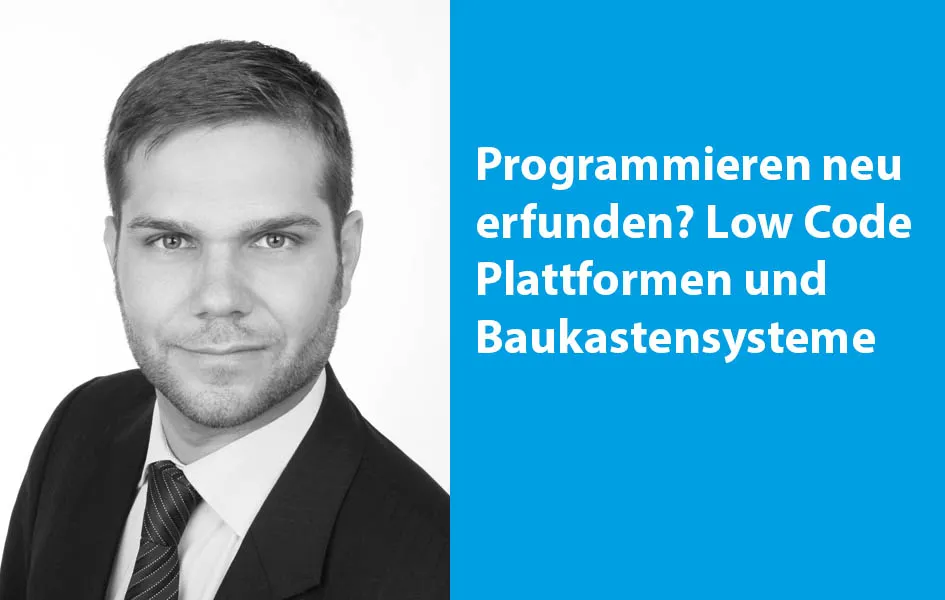
REWOO Software GmbH offers a highly customizable software solution through its modular system REWOO Scope, which maps processes in the business environment exactly as they occur at the customer's end. REWOO will also be represented with its innovative solutions at this year's Essener DIGITAL FUTUREcongress in November 2019. In an interview with Martin Meise, Head of Sales, we will discuss the new trend of Low Code and future prospects today.
DIGITAL FUTUREmag: Mr. Meise, it's great that you are represented again this year at the DIGITAL FUTUREcongress in Essen. What news are you presenting?
Martin Meise: Thank you very much. We are very pleased to be taking part again this year. For us, the DIGITAL FUTUREcongress has become a fixed date in our calendar. In addition to our new solutions such as a CRM module, we are presenting new core features that make the use of our software even more effective. We have significantly expanded many functionalities. From now on, each digital signature will be accompanied by the corresponding time and date stamp. New interfaces to other solutions such as Datev or Lexware make the range of applications even broader. Bulk actions such as signatures via list views enable multiple requests to be answered simultaneously. As always, our modular system REWOO Scope is at the forefront, with which we can create customer-specific solutions in no time at all.
DIGITAL FUTUREmag: Customer-specific solutions are a good keyword. For some time now, a new trend in the industry has been making the rounds: low-code platforms. Can you briefly explain this to us and our readers?
Martin Meise: The trend can best be explained by putting ourselves in the perspective of a user: I have an acute problem and need a quick, well-functioning solution. However, this solution must fit my company, both financially and in terms of processes. Until now, a standard software for the corresponding needs was often adapted and integrated by development, i.e. by changing the source code. This involves a large amount of project management, e.g. for creating the requirements specification, and high costs for development services.
A low-code platform allows me to establish my own processes in a short time through graphical applications or to optimize existing solutions. Providers of this concept enable users to implement their own ideas and requirements within the software using simple means. No programming expert is required for this. The skills needed to implement this can be learned quickly by almost anyone.
As a customer, I save myself the lengthy coordination with the software developers on the one hand. On the other hand, the development time and thus the costs are reduced enormously.
DIGITAL FUTUREmag: What other advantages are there compared to conventional standard software?
Martin Meise: The low-code approach opens up completely new ways of thinking for us. While most standard software is limited to specific industries and types of companies, low-code providers think in different dimensions – the application areas. It doesn’t matter much whether your company comes from the pharmaceutical industry or from skilled trades – every company needs well-thought-out processes. In many processes, there are intersections that are surprisingly large. This means we can also learn from leading companies in other industries.
We also utilise these intersections – for example, when creating our best-practice solutions in our modular system concept.
DIGITAL FUTUREmag: The term “modular system” comes up quite often in our conversations about REWOO. How does your modular system differ from a low-code platform?
Martin Meise: We offer more than low-code platform providers do. The basic idea is the same: we want to help customers create a meaningful and stable digital solution using simple tools. The creation process must be simple and easy to understand. Above all, however, it should be quick and available with manageable effort.
The challenge lies in balancing user-friendliness and complexity: the easier a solution can be created using graphical tools, the less complex it can be.
A two-stage approval process with integrated triggering of a status email is easy to map. However, if you add substitution rules for absences or automatic assignments of amounts to specific cost centres, the structure becomes significantly more difficult and is hardly manageable on its own.
While most low-code platforms are therefore more suitable for smaller individual solutions, our REWOO Scope modular system allows the creation of entire business suites, right up to a holistic end-to-end corporate application. In doing so, we support our customers in every necessary detail and draw on our many years of experience. We often use our countless best-practice solutions as a starting point and optimise them together with the customer according to their requirements – so we rarely start from “scratch”. This approach makes implementation even more efficient and cost-effective. By now, we have developed a best-practice solution for almost every requirement that the customer can use as a template – from A like employee file to Z like central project management.
DIGITAL FUTUREmag: Mr Meise, thank you very much for the interview. We are already very excited about your trade fair appearance and wish you every success.
Martin Meise: Thank you very much. We are already looking forward to the DIGITAL FUTUREcongress and the many visitors.