In the interview with Marvin Mueller from the Lernfabrik CiP | Center für industrielle Produktivität
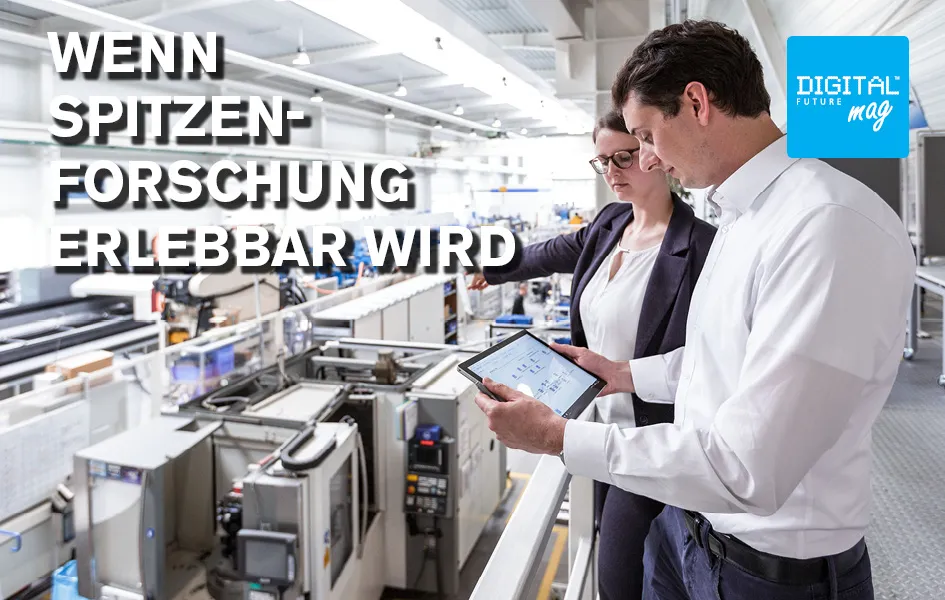
The Institute for Production Management, Technology and Machine Tools (PTW) at TU Darmstadt has stood for industry-oriented top research in the field of production engineering for more than 120 years. At PTW, the focus of this research is on the machining of metallic materials, additive manufacturing, the design of machine tools, energy-efficient production and production organization. Today, we speak with Marvin Mueller about an innovative subfield of PTW, the training and further education center “Process Learning Factory CiP”. This core element of the Mittelstand 4.0-Kompetenzzentrum Darmstadt offers production-oriented companies excellent conditions for professional exchange as well as the opportunity to initiate implementation and research projects between SMEs and the university.
DIGITAL FUTUREmag: Mr. Mueller, the CiP learning factory was founded back in 2007. What was the original approach of the “Center for Industrial Productivity”?
Marvin Mueller: The impetus came from the realization that while our students are very well trained in many technical subjects, they are not taught the real processes of a production operation. This led to the concept of the learning factory: a real production environment with machining, logistics and assembly, operated for education and training purposes. In the course of implementation, the partner model for companies emerged. In a three-year contract model, companies can train their employees with us – initially in classic Lean topics.
DIGITAL FUTUREmag: In 2016, the Process Learning Factory was expanded. What challenges led to the expansion?
Marvin Mueller: The CiP was not well enough positioned for two defining trends: digitalization and individualization. Originally, we only produced eight very similar variants of a pneumatic cylinder with balanced demand in the learning factory. However, this no longer reflected the profile of our partners, as the customer-specific share of production increased. In the classic Lean environment, the topic of digitalization was also not represented in a contemporary way, and production order control was paper-based. We took these challenges as an opportunity and demonstrated how an existing, lean production environment can be technically and organizationally converted to digitally supported, customer-specific production. Plans are currently underway for an additional, new hall – the FlowFactory – directly in front of the existing learning factory. In this hall, the value stream will be completely rethought with regard to customer individuality and digitalization.
DIGITAL FUTUREmag: What thematic focuses are you currently setting with the Process Learning Factory?
Marvin Mueller: Over the years, the focus has continuously shifted in line with current trends in production and production research. Currently, the emphasis is on value stream design, artificial intelligence and (digital) shopfloor management. We have consistently been leaders in learning factory research, i.e. the question of how a learning factory should be designed to optimally impart skills.
DIGITAL FUTUREmag: What can I imagine under digital shopfloor management and from which production size does such technology make sense?
Marvin Mueller: Shopfloor management (SFM) is a leadership approach that has been widely used in workshop environments for decades. Developed at Toyota, it first became established in Germany in the 1990s in the automotive industry and later in other areas of manufacturing. Its strength lies in creating transparency through key figures and sustainably solving identified problems. This not only optimises the production area, but also increases employees' ability to solve problems more independently and effectively. It is implemented through daily, short meetings at the shopfloor board, which visualises the current state of production and ongoing problems. This is where digitalisation comes into play. Updating the key figures involves a lot of manual effort, even though many of the data used now come from digital systems. At the same time, a further strength of SFM is continuous communication and escalation of problems across different areas of the company. Without digital measures and problem management, this quickly leads to paper chaos, redundant information on different boards and inadequate tracking of still active measures. The improvement and simplification of transparency and communication through SFM already supports the continuous development of several production teams from around 100 employees.
DIGITAL FUTUREmag: What role do assistance systems play in this?
Marvin Mueller: So far, I have only mentioned the advantages of digital SFM that simplify existing analog workflows. However, if the data on key figures, problems, causes and measures is available digitally, completely new functions are possible that support staff in their work. This ranges from anomaly detection in processes to supporting moderators during meetings and evaluating problem data using natural language processing.
DIGITAL FUTUREmag: Natural Language Processing (NLP) attempts to capture natural language and process it using rules and algorithms. Can you give us an example of how this technology could be used at machine tools?
Marvin Mueller: When dealing with a machine tool, for example, failures or quality issues occur time and again. These are discussed and resolved – namely by people communicating in natural language. This creates several valuable use cases for NLP, which I prepare for companies in my team in the transfer project TexPrax (https://texprax.de) and explain in free workshops. This includes, for instance, the detection of relevant data in chats to structure problem-solving processes, document clustering to identify the most common topics, and recommendation systems to disseminate and consolidate knowledge. Chats are also often established as the simplest means of communication in production, albeit on private devices. The coronavirus pandemic certainly intensified this trend. As a result, company-specific knowledge about problems, causes, and measures is stored on non-company servers and is no longer usable. In the learning factory, we demonstrate a chat solution that, while meeting data protection and security requirements, stores the problem-relevant data from a chat in the problem database of the SFM. This ensures that operational know-how is not lost and that problems find their way into the structured process of the SFM.
The problem database can now be used to identify the most common problems in the area directly from the free-text data. Clustering the most common word combinations makes this faster, easier, and more accurate than manually assigning problems to predefined categories. To consolidate the knowledge developed in problem-solving, recommendation systems can finally be added that, when a new deviation is entered, are already able to recommend similar cases and their solution approaches. This technology can either be integrated into the input mask of the digital SFM or the recommendation system can respond to questions in the chat to be even closer to employees. For all use cases, production- and area-specific preparation of the text data is necessary to correctly process the many abbreviations and special terms.
DIGITAL FUTUREmag: Thank you for the clear example. Let’s now perhaps take a closer look at the target group you want to reach with the CiP process learning factory. Who exactly is your core clientele, and how is learning conducted here?
Marvin Mueller: The target group for our classic Lean training are companies that (still) do not have internal Lean teams or want to accelerate an already started transformation process. Here, we take on the further training of employees and support individual on-site projects to accompany the Lean transformation. Many of our partners are custom manufacturers. Serial production is not necessary to work with us to transform production.
DIGITAL FUTUREmag: What can people who participate in your work and learning groups take away after completing a training course?
Marvin Mueller: What sets us apart is not only our ability to impart theoretical knowledge but also to provide practical tasks in a realistic environment. By applying skills in an unfamiliar—but authentic and manageable—work environment, competencies and self-confidence are strengthened to independently apply what has been learned in one's own professional field. In terms of content, we cover a wide range of Lean and digitalization topics.
DIGITAL FUTUREmag: How can medium-sized companies from the manufacturing sector get in touch with you, and which projects would be beneficial for both sides?
Marvin Mueller: At www.prozesslernfabrik.de, the CiP is introduced once again. Currently, we are looking for partners for our advanced training program. This isn’t always the case, as we only accept as many partners as can fit into our workshops and research groups. Additionally, companies (especially SMEs) often participate in our research projects. When it comes to forward-looking issues, we are always open to new concepts or initiatives. Furthermore, commissioned research for specific company-specific tasks within the scope of a project can be very fruitful for both sides if it aligns with our thematic focus.
DIGITAL FUTUREmag: If you could make one wish regarding the CiP Process Learning Factory, what would it be?
Marvin Mueller: Currently, our wish is for the pandemic to end so we can resume our usual operations in the halls. In the meantime, we have offered online training, but given our profile and the strength of the learning factory in building competencies through hands-on experience, it’s particularly painful that the hall doors have remained closed for so long. For the future, I hope we can further expand our digitalization topics in our workshop curriculum and become as well-known and successful in this area as we already are in the Lean sector.
DIGITAL FUTUREmag: We wish you every success with that! Thank you for the conversation and the exciting insights.