In the interview with Mathias Pröhl, Managing Director of bellmatec GmbH & Co. KG
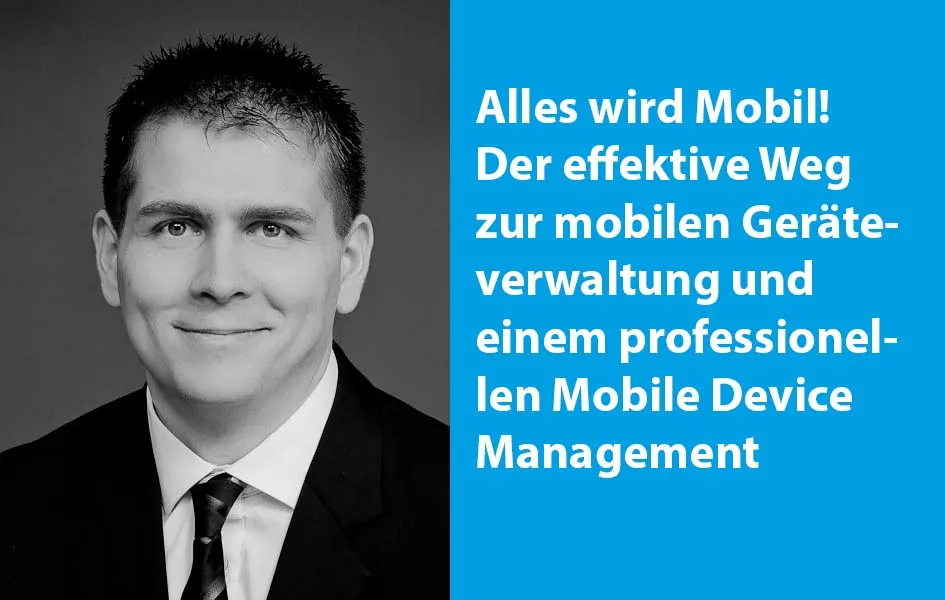
Agility and mobility are on everyone's lips. The young and innovative team at bellmatec GmbH & Co. KG has set itself the goal of realizing mobile productivity for companies. The mission is to establish smartphones and tablets as a valid replacement for laptops, thus enabling mobile employees to enjoy a new form of freedom. To achieve this goal, the company supports medium-sized decision-makers in planning and implementing the new mobile digitalization. In the interview, we learn a lot about Mobile Device Management
Mobile productivity and security for mobile end devices.
DIGITAL FUTUREmag: Mr. Pröhl, for IT managers, a large number of mobile devices brings with it its own challenges. Which are usually the biggest?
Mathias Pröhl:
With a well-planned and implemented mobile strategy, the sheer number of devices is a solvable challenge. However, the challenge grows with the number of different platforms used in the company.
If a homogeneous device landscape is in use, the number of devices actually no longer plays a role. This scenario also offers major advantages in maintaining operations. If all devices behave the same way, this reduces the effort required to introduce new applications or maintain support cycles.
However, if a heterogeneous device landscape with different devices from different manufacturers is to be operated, this will greatly increase the effort.
DIGITAL FUTUREmag: The goal of integrating mobile end devices into company processes is often linked to the goal of increasing productivity. Where do you see the greatest opportunities here?
Mathias Pröhl:
Smartphones and tablets have the advantage of providing location-independent access to information. In our view, this makes them particularly interesting for employees who primarily retrieve information rather than produce it themselves.
Field sales staff in particular can benefit from the devices. But service staff who move around within their own company can also optimize their work processes.
Processes that require access to business applications and may be paper-based are particularly interesting. We have had very good experiences with projects involving mobile expense reports or applications for time recording.
But special company applications that have previously only been used on laptops and desktop PCs can also be optimized for mobile use.
DIGITAL FUTUREmag: How do you or the companies deal with the fact that employees often want to use private devices in a company context?
Mathias Pröhl:
When implementing a Bring-Your-Own-Device strategy, two questions need to be clarified: How can the devices be integrated into operational processes? How can we ensure that sensitive company data on the private device is secure?
Especially in the German-speaking market, BYOD use is currently more the exception than the rule. Instead, the option of allowing company devices to be used for private purposes is much more common. This means the company chooses the platform, and the number of different manufacturers can be limited, which greatly benefits smooth operations.
The separation of professional and private data is technically feasible on all platforms. However, with BYOD use, employees must be engaged and informed about what information the company is allowed to see on their device. There is often a great deal of mistrust here, which further impedes the use of private devices in a corporate context.
DIGITAL FUTUREmag: This naturally leads us to the question of security for mobile devices. After all, mobile devices offer many gateways for spam, right up to malware. What specific solution approach do you propose?
Mathias Pröhl:
Even the selection of the right mobile device represents a first solution approach. Both Google and Apple regularly provide updates to close security gaps. However, many manufacturers do not implement these updates for all of their own devices. Consumer devices in particular are often only supported with updates for a limited period. After this time, there are no official security updates anymore.
We fundamentally believe that employees should not be forgotten when developing a mobile strategy. It would be easy at this point to say that device usage should simply be restricted until security is optimal. But no employee wants to work with such restrictive devices. Conversely, this can even mean that the user looks for new ways that ultimately offer even more gateways.
Our solution approaches are therefore the selection of the right mobile device and educating employees through training.
DIGITAL FUTUREmag: Smartphones and tablets are offered and used on different operating systems, iOS and Android. Can you make a recommendation here? Which systems do you think are better suited for business use?
Mathias Pröhl:
We recommend Apple’s iOS devices for use in companies, because Apple provides the answers to two very crucial questions: – how can large numbers of devices be deployed without high administrative effort, and how can paid applications be delivered to the devices.
The first question is optimally answered by the Device Enrollment Program. Here, devices can be issued to users completely without any administrative intervention. The question of application provisioning is addressed by the Volume Purchase Program, which allows applications to be deployed quickly and without bureaucratic hassle.
DIGITAL FUTUREmag: Could you perhaps outline the first three steps for decision-makers who are just starting to explore the topic of professional Mobile Device Management?
Mathias Pröhl:
First and foremost, we recommend assessing business processes through targeted consulting.
1. Determine which business processes and requirements in your company are to be met by using mobile devices. These requirements should be defined by the specialist departments. Also involve the works council or HR departments. Consulting can also be helpful here.
2. Choose whether a BYOD strategy makes sense for your company or if you want to provide company devices.
3. Select a mobile platform (Android or iOS) to be used.
And as a final point: Plan with pilot projects. User experience plays a crucial role and has a major impact on the success or failure of your mobile project.
DIGITAL FUTUREmag: Thank you very much for this conversation.