In the interview with Oliver Th. Fritz, Managing Director of SOTEC GmbH
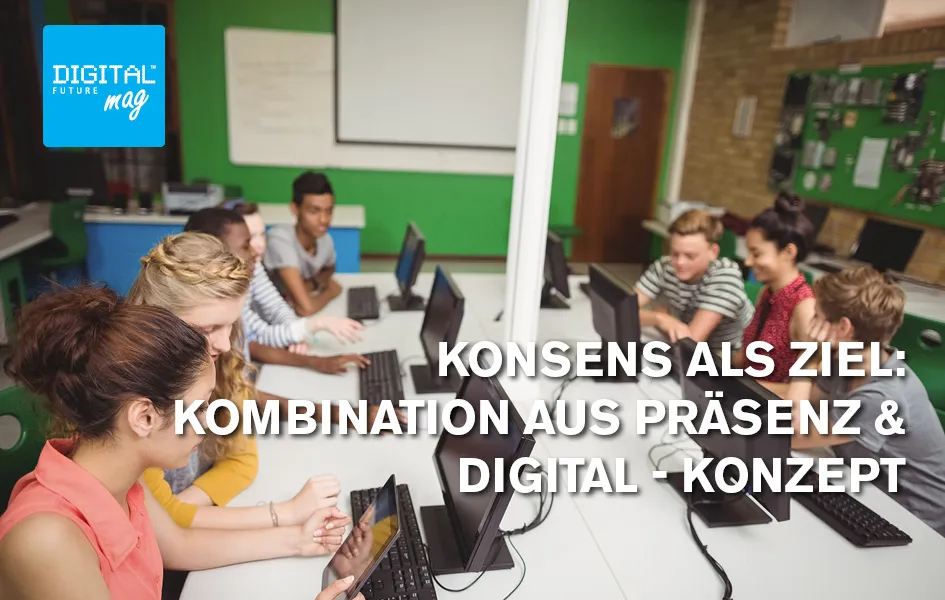
Since Oliver Th. Fritz took over the company in February 2017, a lot has happened. The SOTEC GmbH IT systems house, which has been successful for 50 years now, operates in the Rhine-Neckar metropolitan region as an independent manufacturer and owner-managed company covering the entire IT lifecycle. In recent years, the company has expanded into additional business areas and now offers a broad portfolio of services: from the setup of IT infrastructures, the management of output systems, IT solutions & services, to comprehensive support for schools. In an interview with Oliver Th. Fritz, Managing Director of SOTEC GmbH, we discuss digital learning, political failures, the definition of a standard in hardware in connection with funding approvals, and the opportunities and risks that social disparities can bring if the wrong priorities are set. We also learn about a best-practice example from the municipality of Laudenbach.
Oliver Th. Fritz: The "DigitalPakt Schule" funding program, launched on 17 May 2019 following a constitutional amendment on 15 March 2019, has since been increased to 7 billion euros to cover key areas such as teacher equipment and maintenance of the IT infrastructures already set up and yet to be established. There are several reasons why only around 1.4 billion euros have been drawn down so far. The first major reason is the lack of support in developing the relevant concepts for setting up school-specific IT infrastructures. You know, I always compare this to a four-year-old child who is given 500 euros by its parents for the weekly shopping, with the instruction, “now go and do the shopping nicely.” Both the child and the school authorities are and have been completely overwhelmed by this! When the school authorities then drew up the media development plan required to approve the allocated funding, there were no application forms available from the responsible authority, particularly in the initial phase and for a certain period afterwards. You have to let that sink in! This is digital Germany! The second main reason is the still inadequate training of our teachers in handling digital media, i.e. so-called media literacy. I am not even considering the lack of availability of digitised schoolbooks here. This is another aspect of why we are not making consistent progress in Germany on this issue. Our student teachers are left to their own devices when it comes to the school-based application of digital media in their training. The curriculum does not include a semester, let alone a seminar, that covers this topic. What the future teachers are supposed to teach children about digital media is largely down to their own initiative. How are they supposed to teach children something that is withheld from them? This is incomprehensible. DIGITAL FUTUREmag: It seems that schools are keen to return to 100% face-to-face teaching as quickly as possible. To what extent are the benefits of digital learning being wasted here? What would your suggestion be for a successful combination of face-to-face and digital teaching? Oliver Th. Fritz: There is no one-size-fits-all solution for a successful combination of face-to-face and digital teaching. Certainly, learning content delivered in person can be effectively repeated and consolidated digitally. However, you need to take into account the different requirements of our school systems. Simply saying that we will now do 80% face-to-face and 20% digital teaching, following the old Pareto principle, is too simplistic. In my view, this requires much more consideration. However, I lack the pedagogical training to give a specific answer. I come at this more from a common-sense and parental perspective, having supported our two sons through distance, alternating and face-to-face learning during the pandemic weeks. Nevertheless, it would be fatal if we did not now seize the opportunities that have emerged in this area from the pandemic and develop concepts that specifically aim to combine face-to-face and digital teaching. SOTEC has the necessary expertise and knowledge of what needs to be done to achieve this. What we would then “only” need are people who can implement and apply it in everyday school life. DIGITAL FUTUREmag: You have already mentioned this. For you, the opportunities clearly outweigh the risks. At the same time, you also see the risksone of the social inequalities when families are unable to support their children with digital learning. What strategy would you suggest? Oliver Th. Fritz: Another question, Mr. Mattis, that is quite complex! You know, to answer this question, I would essentially have to be among the consultants commissioned externally by the German government last year, 2020, who collectively cashed in 435 million euros in fees. But as you can see, even these ladies and gentlemen have no strategy to propose. At least, to my knowledge, nothing usable has been published that goes beyond commonplace wisdom. Yet you ask me what I would suggest: That would bring us back to the topic of organizing education and its delivery nationwide. Every schoolchild in Germany should have uniform technical equipment. To use this nationwide requires comprehensive availability of 5G technology. And here we encounter another challenge that Germany has simply slept through. Long story short, so many parameters are involved in this process and influence it that, in my opinion, we cannot avoid central coordination that must be equipped with the appropriate competencies. I had expected that the State Minister for Digital Affairs in the Federal Chancellery, Ms. Dorothee Bär, would seize the opportunity and take charge of the matter. Even though her ministry has no or only a limited budget, she could have made an impact with ideas and strategies. But apart from a few tweets on her Twitter channel, nothing has happened. Too bad… DIGITAL FUTUREmag: Previously, you told us about a best practice from the municipality of Laudenbach. What exactly is it about and what was implemented here? Oliver Th. Fritz: Thank you for asking. The municipality of Laudenbach approached us in its role as the school authority and asked for our support under the DigitalPakt Schule funding program. The municipality was facing exactly the challenges described in the previous statements: How do I develop a media development plan (MEP)? What form do I use to apply for funding, and what is funded? How do I get Wi-Fi in my school? Who sets up the devices for me and provides training on how to use them, and who maintains them? How do we teach the children, with what educational offerings? And so on. Since SOTEC, as described in the first answer, has been dealing with the digital future for some time, we were able to position ourselves as a competent partner for the municipality with our knowledge and expertise in this area. After a kick-off meeting with all stakeholders, including the mayor, we established a roadmap, which we have been following to this day. With our help, the MEP has been created and submitted. The funding has been applied for with the correct forms. The children and teachers have been equipped with hardware. The classrooms have been equipped with digital presentation media. In the regularly held status meetings, open questions and points are discussed and resolved. This exemplary approach quickly became known in the surrounding municipalities, so that we are now incorporating the successful approach from the municipality of Laudenbach, along with the experiences gained there, into new projects just as successfully. In this way, we are contributing to making the world more digital! DIGITAL FUTUREmag: That sounds very good. Thank you very much for the insight into your expertise, the clear words, targeted solutions, and sharing your suggestions for a digitally competent school landscape.
DIGITAL FUTUREmag: Mr. Fritz, when you took over the company four years ago, what vision did you have for a successful IT system house, and which of your key ideas have you already implemented?
Oliver Th. Fritz: My vision before the takeover was actually quite simple. On the one hand, I wanted to preserve the “old.” You know that this year we are celebrating the company’s 50th anniversary, so the former owners did a lot right in terms of business development and preservation. After all, anyone who knows a little about it knows that the IT market in which we operate is like a shark tank, and many market players have not survived this long. Many have come and gone quickly. SOTEC is still here, stronger than ever. On the other hand, as is natural, there were one or two dusty corners that needed to be shaken up. It was therefore obvious to align SOTEC as an IT system house for the digital future under our motto “Listen – Think – Solve.” Especially since we are in the midst of the fourth industrial revolution, it was my ambition to guide SOTEC through this era—for our existing and future customers. Specifically, we have modernized and future-proofed our internal collaboration. Incidentally, this has helped us a great deal: at the start of the first lockdown in March 2020, we were able to switch to home office work immediately and without complications. We now use VOIP for calls. No matter where my employees are, they are always reachable under their direct extensions for our customers. Our servers have also been technically upgraded to the latest technology. These are just a few examples that demonstrate how stringently I have implemented these changes.
DIGITAL FUTUREmag: The pandemic has clearly shown the deficits in our schools’ digitalization. You yourself have school-age children. What bothered you the most, and where do you currently see the greatest need for action?
Oliver Th. Fritz: Wow, that’s a complex question. The answer might be even more so. You have to know that I volunteer as chairman of the parents’ council at a high school in beautiful Upper Bavaria. This gave—and still gives—me a “direct” insight into the numerous letters from the Bavarian Ministry of Culture during the pandemic, thanks to our close contact with the school management. These letters clearly showed—and still show—that there was and is no strategy for the different in-person, distance, and hybrid teaching formats during the pandemic. Why do I say “still”? We are starting the second summer holidays of the pandemic these days. There is a great—and likely—fear that no clear, uniform digital concept for potential distance learning will be developed in the six weeks. From conversations with parent representatives throughout the Federal Republic, I can say: this applies nationwide! Don’t get me wrong, I am a convinced federalist. Nevertheless, in my view, there are areas in politics that urgently need nationwide uniform leadership. This includes the education system, as well as the healthcare system. As long as we have 16 state premiers in the state ministries of education, none of whom are able to coordinate with each other, Germany and Europe will continue to lag behind in digital school teaching concepts.
DIGITAL FUTUREmag: The federal government has allocated a large 5-billion-euro budget for the digitalization of our schools as part of the digitalization initiative. However, if you look at the funds actually drawn down in theLooking at individual federal states in more detail, you can see that in some cases only a fraction of the available budgets is being used. What do you think is the reason?