In the interview with Sikko Hühsam
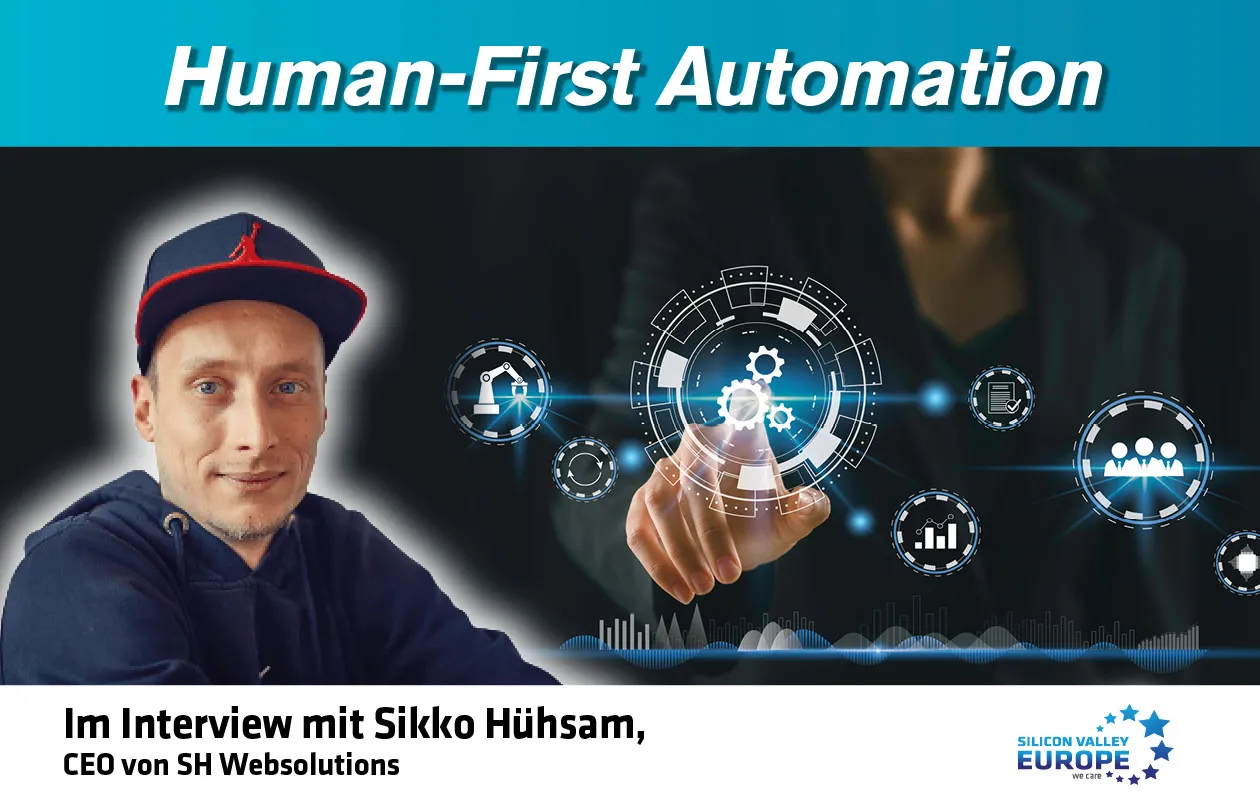
In an era when companies are hastily implementing AI tools yet still facing “automated chaos,” Silicon Valley Europe speaks with someone who has witnessed this problem up close for years: Sikko Hühsam. The consultant, developer – and unusually, someone with gallery experience – blends art, empathy, and technology into a radically new approach: Human-First Automation.
What sets him apart? He grew up between canvases, not server racks. There, he learned how to read emotions and build systems that truly resonate with people. Today, he translates this skill into the business world – proving that digitalization only works when people are at the center. His approach delivers measurable results: fewer errors, less friction, up to 60% less workload, and, above all, teams that can finally breathe easy again.
In the interview, we discuss the most common cause of failed automation projects (“tools over strategy”), the difference between efficient and fulfilling, Dual-ROI – the equal focus on business impact and human impact – and why automation often only succeeds when it is approached like a work of art: holistic, empathetic, and aesthetically refined.
For anyone who wants to know why “AI-First” is often the wrong approach, how process design can account for emotions, how co-creation drives real acceptance, and why sustainable digitalization begins with culture – this interview will be an eye-opener.
Silicon Valley Europe speaks with a thought leader who helps companies shift from “Tuesday hamster-wheel” to everyday flow state – and shows how technology can become human again.
Silicon Valley Europe: You say many companies automate their chaotic processes first – and end up with “automated chaos.” Why does this happen so often?
Sikko Hühsam: This stems from a fundamental misjudgment: many believe technology will solve their problems. But automation only amplifies what’s already there. If a process is inefficient or unclear, automation makes the chaos faster and more expensive. The issue usually starts with the wrong sequence: companies jump straight to tools without understanding WHAT exactly needs automating and WHY the current process isn’t working.
That’s why our approach is different: first, we transparently analyze the structures, identify bottlenecks, optimize together with the teams – and only THEN do we automate.
Silicon Valley Europe: Your approach is called Human-First Automation. What does that mean exactly?
Sikko Hühsam: Human-First Automation means radically putting the people who have to work with the systems at the center of every decision. Not the technology. 70% of all automation projects fail not because of the technology, but because of the people. Our approach turns that completely around:
Phase 1 starts with human-centered process intelligence. We conduct in-depth stakeholder interviews and create emotion mapping – where do frustrations arise? How do teams feel about their work?
Phase 2 is cooperative optimization. Teams become co-designers of their ideal workflows. This creates ownership – people accept and love what they have helped shape.
Phase 3 develops the automation roadmap – but every technology decision is evaluated based on dual ROI criteria: business impact AND human impact.
The result: 85% of our customer teams report improved work quality.
Silicon Valley Europe: You originally come from the art world. How does this background shape your view of technology?
Sikko Hühsam: I grew up in the art gallery Thomas Hühsam – over 20 years between artists and people searching for emotional resonance. That was my school for empathy, aesthetics, and the understanding that systems must not only function but also resonate emotionally.
In the art gallery, I learned three defining things. First, that aesthetics is always also function: If something doesn’t look beautiful, it won’t be loved – and what isn’t loved won’t truly be used. Second, I learned to read people. This form of emotional intelligence is missing in many technical projects. While IT experts often ask, “What features do you need?”, I’m more interested in: “What frustrates you? Where do you lose energy?” And finally, I understood the importance of holism. You can’t simply introduce a tool in isolation; it must align with culture, people, and existing processes.
This combination – 20 years in an art gallery plus IT expertise – leads to solutions that are not only functional but also aesthetically and emotionally well-considered.
Silicon Valley Europe: You speak of the “aesthetic imperative.” Why is aesthetics a success factor?
Sikko Hühsam: Because people are not rational machines. You can have the technically best system – if it feels "wrong" to use, it will be bypassed.
The aesthetic imperative means: What is not beautiful is not loved. Aesthetics is not decoration – it is user experience. And user experience determines acceptance.
We see this measurably in our projects: Teams that describe their systems as "beautiful" and "intuitive" use them 3-5 times more frequently than teams with functionally identical but unaesthetic solutions.
It’s about flow-state design – systems that feel so natural that people enter a state of productive focus: information exactly where it’s needed, intuitive behavior, minimal cognitive load, clear visual hierarchies. 85% of our customers report noticeably improved work quality. This doesn’t come from more features – it comes from more beautiful, human-friendly systems.
Silicon Valley Europe: What do you mean by Dual-ROI?
Sikko Hühsam: Dual-ROI is the core of our philosophy. Success has two equally important dimensions:
Business ROI: Increased efficiency, cost savings, time gains, error reduction.
Human ROI: Employee satisfaction, energy levels after work, frequency of flow states, creative freedom, work-life balance.
Why is Dual-ROI important? Because both reinforce each other. Satisfied, energized people are more productive people. Teams that love their systems work more efficiently, innovatively, and stay with the company longer.
With Dual-ROI, we ask for every decision: How much time/cost does this save? AND: How does this improve work quality? Only if both answers are positive do we implement it.
The numbers: 60% reduction in workload, 40% fewer errors – BUT ALSO: 85% of teams report improved work quality, measurably more flow-state experiences, 20-35% less stress.
Long-term, this is also economically smart. Companies with high Human ROI have lower turnover, higher innovation power, and better employer reputation.
Silicon Valley Europe: How do you get people out of tool fatigue?
Sikko Hühsam: Tool fatigue is justified. Most teams have already experienced several "revolutionary" systems that ultimately only meant more work.
My answer is radically honest: I understand this fatigue and promise nothing I cannot deliver.
I believe it is important to truly listen. The central question is not "What does the company need?" but "What frustrates you?" "What would really make your workday better?"
Second, we should strengthen co-creation instead of imposing solutions. Teams design their own solutions. In workshops, we jointly develop the target processes.
Additionally, quick wins are needed for immediate trust. We deliver initial improvements within 2-4 weeks, without new tools, simply through process optimization.
And furthermore, we need evolution rather than revolution. Gradual integration with fallback options and time to learn.
My goal is not only to make a dual ROI measurable for customers. But also to show them: Hey, you’re saving 10 hours here, which means you can go home earlier.
Silicon Valley Europe: What changes through co-creation?
Sikko Hühsam: Co-creation actually changes everything—really everything. It’s not just about better results; it’s about a completely different attitude toward change. The biggest difference is that people are no longer treated as objects of transformation but as subjects, as true designers. And that makes an incredible impact.
What I keep experiencing is that acceptance skyrockets. Instead of the usual ‘This system is annoying,’ I suddenly hear ‘This is our system.’ And that’s exactly what leads to better solutions because employees know their processes much better than any external consultant ever could.
What’s also fascinating is that resistance no longer blocks progress but instead releases energy. Those who were initially the most critical often become the most engaged co-designers. And within the team, a learning culture emerges that didn’t exist before—people start systematically reflecting on their work and improving it.
And when this process really gets going, something I like to call a ‘flow-state workflow’ emerges: Teams intuitively optimize for productivity and satisfaction. It no longer feels like change management but like genuine progress.
But the most impressive part is the long-term effect: Co-creation has an impact far beyond a single project. Companies tell me that willingness to change increases, and teams suddenly come up with new ideas proactively. That’s how an innovation culture emerges—from the bottom up, not dictated from above.”
Sikko Hühsam: We systematically optimize on multiple levels simultaneously.
To do this, we use these 5 main levers:
Lever 1: Eliminating duplicate work (20-30% savings). In most companies, data is entered multiple times and copied between systems.
Lever 2: Intelligent automation of routines (15-25% savings). We identify high-frequency, low-complexity tasks.
Lever 3: Process redesign before automation (10-20% savings). Processes are often historically grown and full of inefficiencies.
Lever 4: Error prevention instead of error correction (5-15% savings). The 40% reduction in errors comes through intelligent design: validation during input, drop-down menus instead of free text entry.
Lever 5: Information accessibility (10-15% savings). 15-20% of working time is spent searching for information.
The combination is key: These levers reinforce each other.
Silicon Valley Europe: Why do you focus on “process before AI”?
Sikko Hühsam: I’m a big fan of AI. But – AI without clear processes is like a Ferrari without a road. Impressive, but useless. 85% of AI projects will fail. Not because of poor technology, but because of missing foundations. AI is an amplifier – it makes what’s there faster and more efficient. If your processes are chaotic, AI will only give you faster chaos.
Our philosophy is very simple and has 4 stages:
Stage 1: Process intelligence. First, understand WHAT is actually happening.
Stage 2: Process optimization. Improve the process BEFORE automating it.
Level 3: Automation. Only then automate – using classic tools.
Level 4: AI integration. Only at the very end – when the foundation is in place – use AI strategically.
When processes are clear and optimized, data is structured, and teams are ready – THEN AI can create enormous added value: intelligent pattern recognition, predictive analytics, complex decision support.
AI on a solid foundation is brilliant. AI on chaos is money burning.
Silicon Valley Europe: How do you ensure that AI integration is ethically responsible?
Sikko Hühsam: We stand at a crossroads: AI can either be a tool for human flourishing – or an instrument for surveillance and dehumanization.
To address this, I have developed my 5-Principles Framework, which brings clarity to everyone:
Principle 1: Transparency is non-negotiable. Everyone must understand: WHAT is the AI doing? HOW is it making decisions?
Principle 2: Empower people, don’t replace them. AI is a tool for augmentation, not substitution.
Principle 3: Bias awareness and active correction. Data audits, diverse training sets, continuous review.
Principle 4: Clear data protection and security standards. Privacy by Design, Security First.
Principle 5: Continuous quality control and human oversight.
The vision: AI as a co-pilot for humans, not as an autopilot replacing humans. Technology should help us make better decisions, work more productively, and live more fulfilling lives.
Silicon Valley Europe: What makes SMEs particularly suitable for your approach?
Sikko Hühsam: SMEs and family businesses are the ideal playground for Human-First Automation.
The advantages:
Short decision-making paths: In SMEs, you speak with the managing director, make decisions, and implement them. Faster iteration, flexible responses, more action.
People know each other personally: The boss knows their team. Emotions are visible, frustration is communicated directly, and co-creation works better.
Value orientation: Family businesses think across generations. This long-term perspective aligns with our sustainable transformation philosophy.
Tangible impact: When we save an SME 15 hours per week and reduce errors by 40%, everyone feels it. Immediately.
Flexibility and pragmatism: SMEs need practical solutions that work. This fits with our iterative, evolutionary approach.
Silicon Valley Europe: What distinguishes sustainable digitalisation from quick-fix projects?
Sikko Hühsam: The difference is like building a house versus pitching a tent.
Quick fixes are characterised by: tool-first instead of problem-first, instant expectations, technology without people, and isolated solutions.
My framework for sustainable digitalisation:
Foundation over façade: clear processes BEFORE automation, structured data BEFORE AI.
Evolution over revolution: gradual introduction, continuous learning.
Empowering people instead of steamrolling them: co-creation instead of imposition.
Systems thinking instead of point solutions: holistic consideration.
Dual ROI instead of just business ROI: business impact AND human impact.
The long-term perspective: Year 1: Initial investment higher. Year 2: ROI becomes positive, quick-fix has already failed. Year 5: Transformed company vs. tool graveyard.
The uncomfortable truth: Sustainable digitalisation costs more time, money, and patience. But it is the ONLY approach that truly works.
Silicon Valley Europe: Why is continuous support after implementation crucial?
Sikko Hühsam: Because the go-live is not the end – it is the beginning of the actual transformation.
Most digitalization projects fail within 3-6 months after implementation. The system works technically but is not adopted.
The 5 critical challenges after go-live:
The "honeymoon-to-reality" transition: Initial excitement for the first 2 weeks, followed by frustration. Without support, teams end up resigning.
Unforeseen edge cases: Reality is more complex than standard scenarios. With support, we adapt the system to real requirements.
Varying learning curves: Without continuous support, frustration builds among slower learners, while faster learners become impatient.
Process adjustments: Only in daily use does it become clear what was overlooked during planning.
Fluctuating motivation: After the initial hype comes the "valley of tears" – where old routines seem tempting.
The measurable differences: Without support: 40-60% usage rate after 6 months. With support: 85-95% usage rate.
Silicon Valley Europe: What drives you personally?
Sikko Hühsam: The certainty that there are millions of people suffering every day under systems not made for them. I don’t want to live in a world where people are too exhausted for their children in the evenings. My mission: I want to prove – concretely, measurably, project by project – that it can be different. That digitalization can empower people. That automation can create freedom.
Twenty years in the art gallery have shown me: beauty, aesthetics, emotion – these are THE factors that determine whether something is loved or merely tolerated.
How I want to make digitalization more human:
Through concrete examples – every successful human-first project is a beacon.
Through honest conversations – I will continue to say loudly: "AI-first without process-first is nonsense."
Through education and awareness – many companies don’t know that there’s a better way.
Through a strong network – if 100 people adopt the human-first approach, the impact multiplies.
My vision for Germany: In 5 years, I want "human-first automation" to be the standard. For companies to naturally ask: "How will the people working with this system be affected?"
I want Dual-ROI – business success AND human impact – to become the new normal.
Germany stands at a crossroads. We can choose technology at any cost – or take a different path: German engineering meets human values. Precision AND empathy. Innovation AND sustainability.
I believe in the second path. And I work every day to make it a reality.
What gets me out of bed in the morning: the certainty that with every project, I can make a small part of this world a better place.
This is not just business to me. It is a calling.
My promise: I will never prioritize efficiency over humanity. I will never stop believing that technology with soul is possible.
Let’s work together to make digitalization in Germany more human. Project by project. Company by company. Person by person.
Silicon Valley Europe: Thank you, Sikko, for the open conversation and the inspiring insights into your Human-First Automation philosophy.