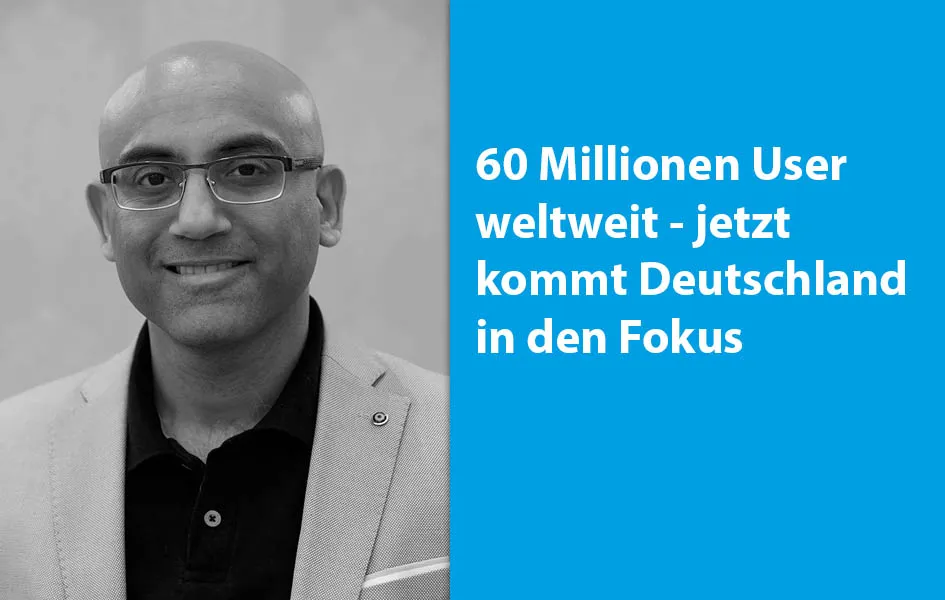
In the interview with Sridhar Iyengar, European Managing Director at Zoho.
With more than 45 apps in nearly every major business category, including sales, marketing, customer support, accounting and back-office operations, as well as a range of , Zoho Corporation is one of the world’s most productive software companies.
Zoho is privately held, profitable and employs more than 9,000 people. Zoho is a global company with offices around the world. Zoho’s European headquarters is in Utrecht, Netherlands. In addition to Zoho GmbH in Germany, the company also has offices in France, the UK, the US, India, Japan, China, Singapore, Mexico, Australia and the United Arab Emirates. Zoho operates its own data centers around the world and has two data centers in the European region, in Amsterdam and Dublin, that meet the latest security and privacy standards.
Zoho places a high value on user privacy and has no advertising in its apps and services, including its free products. More than 60 million users worldwide, in hundreds of thousands of businesses, now use the more than 45 different applications. Reason enough for us to learn more about Zoho’s Germany strategy with the successful software provider. In the interview, we speak with Sridhar Iyengar, European Managing Director at Zoho, about digitalization, the importance of privacy for Zoho, long-term business commitments, a unique approach to customer focus and the latest cloud technology.
DIGITAL FUTUREmag: Mr. Iyengar, Zoho is already very successful around the globe. What prompted the company to now push its market presence in Germany more aggressively?
Sridhar Iyengar: This is a natural development, as we have had customers in Germany for a very long time. Our partner ecosystem in Germany is also quite strong. With a local office in Germany, we can now be closer to our customers and partners. Germany as an economy has also grown over the years. Last year was tough for many major economies and many lives were lost to the pandemic. Last year, we also saw how our products were used by our customers in Germany – whether to meet the challenges of remote work or to address concerns about privacy abuse. We believe that Zoho, with its deep expertise in technology and our stance on data protection, has the opportunity to add value to the business ecosystem in Germany – an opportunity to raise awareness and help companies transition to digital tools in an affordable and secure way. This requires a lot of groundwork and our local presence will support this effort.
DIGITAL FUTUREmag: Germany is known for its strong SME sector. Why should German SMEs in particular take a closer look at Zoho’s products and use them to drive digitalization?
Sridhar Iyengar: I am aware that we are not yet a well-known company in Germany. However, our current customer base in Germany, consisting of thousands of SMEs, gives us the confidence to expand. The German SME sector is known for its efficiency and superior engineering, but in terms of digital transformation, it has so far been one of the more cautious users. Now is the time to think long-term about how to build a resilient technology infrastructure. Some key factors required for this transformation are ease of use, a wide range of customization options, strong data protection policies, and long-term price stability. Zoho as a company and Zoho's software suite are built on these pillars. Zoho's cloud offerings are available in various options: companies can purchase software for a specific requirement, such as event management, invoicing, inventory management, CRM, or email marketing, or they can purchase functional suites that bundle several related products into an attractive, integrated package. Furthermore, they have the unique opportunity to bring their entire company to the cloud with Zoho One. We will present Zoho One at the global Digital Future Congress, and you can experience live how more than 40 applications work seamlessly together to bring an entire company to the cloud. Since affordability is one of Zoho's pillars, we have also kept the prices quite aggressive: it costs €1 per day per employee to use Zoho One.
DIGITAL FUTUREmag: In press releases and on the website, you can repeatedly read that Zoho places special emphasis on data protection and data security for users. Could you tell us a little more about Zoho's strategy and the importance of privacy?
Sridhar Iyengar: Data protection has been the cornerstone of our company from the very beginning. This year, we are celebrating our 25th anniversary, and since the first year, we have offered free versions of our software—but never used customer data to finance our company. The widespread capitalism has made some of the most well-known tech giants the richest companies in the world. This profit-driven approach has driven Big Tech to collect data on a large scale. The better the data, the higher the profits. When we founded Zoho, we wanted to offer our customers the best possible solution—not only in terms of functionality but also to ensure that their privacy is always safe and secure. In 2019, we removed all third-party tracking software from our websites and applications and closed loopholes to improve data protection for our customers. To ensure that our internal processes also adhere to good data protection practices, we have our software and processes audited by recognized global companies. Last year, Zoho was included in the list of the very few companies with ISO 27701 certification. In recent months, we have raised awareness of data protection in various countries. We will continue our efforts to raise awareness among German companies as well.
DIGITAL FUTUREmag: Last September, Zoho announced plans to offer an extensive industry-wide suite of business software applications. Under the name “Zoho Workplace,” a software platform is to be created that combines tools for collaboration, productivity, and communication. How far along are you with the rollout, and when will this suite be available for use in Germany?
Sridhar Iyengar: Zoho Workplace has been around for a while. Last year, we refined many of the finer details, added more automation and intelligence. Since its release, Zoho Workplace has become the most comprehensive productivity, collaboration, and communication suite in the industry. It is already available in Germany, and we have several companies in Germany using the product. We’ve seen multiple companies migrate from Google to Zoho Workplace, primarily due to questionable privacy policies and frequent price increases. To sustain this migration trend from competitors, we’ve also built an easy migration path from both Office 365 and Google Workspace.
DIGITAL FUTUREmag: Zoho is not only very successful but also reportedly quite profitable. Overall, how would you describe your customer relationships, and what is most important to you in a customer relationship?
Sridhar Iyengar: Our company and some of the early visions of our CEO, Sridhar Vembu, were inspired by Japanese and German companies. From the beginning, the focus was on two things: taking a long-term approach to building expertise and making it extremely easy for customers to purchase and leave. We’ve never taken on debt, we’ve been careful with money, and we’ve chosen early on to reinvest profits back into the company to build products, support local communities wherever we operate, and expand customer support. This has helped us to this day. Even now, we don’t lock customers into endless contracts or penalize them for voluntary exits. In the past, we haven’t run many large-scale marketing campaigns but instead focused on creating training materials to help customers use our products independently. In Germany, we’ve started doing this as well, with our colleagues regularly hosting German-language webinars either about the product or inviting experts to discuss technology trends. This will continue to be our focus.
DIGITAL FUTUREmag: Cloud technology is on the rise not only in Germany but worldwide. Hardly any company today doesn’t use cloud services. What makes the Zoho Cloud infrastructure you offer so special?
Sridhar Iyengar: The Zoho Cloud infrastructure is built on several strong pillars:
1. Proprietary technology stack for building expertise and seamless integration
2. Continuous development and refinement
3. Data privacy and security as the cornerstone of research and development
Each of these pillars has its own advantages. Owning the stack and hosting applications in our own data centers helps us gain the expertise needed to fine-tune the software according to changing requirements. It enables us to develop new applications or features that integrate directly rather than serving as mere stopgap solutions. Additionally, we can pass on optimized costs by not hosting on hyperscalers. As consolidation sweeps the industry, we see providers rushing to acquire companies to complete the process. Often, these acquisitions fail to deliver on the promises originally made to customers because the platforms cannot be seamlessly integrated. Zoho has taken a more patient approach, building from the ground up, which sets our products apart from those that have been acquired and pieced together.
DIGITAL FUTUREmag: At the upcoming DIGITAL FUTUREcongress, Mr. Eric Mandel will deliver a keynote. What will the general content of his presentation be?
Sridhar Iyengar: At the event, we will address some of the challenges faced by German SMEs today on their digital journey. We will also have a virtual booth to show guests live how Zoho One can provide immense added value in building a resilient business.
DIGITAL FUTUREmag: Thank you very much for this exciting interview