In the interview with Stefan Schumacher from PBSGEO GmbH
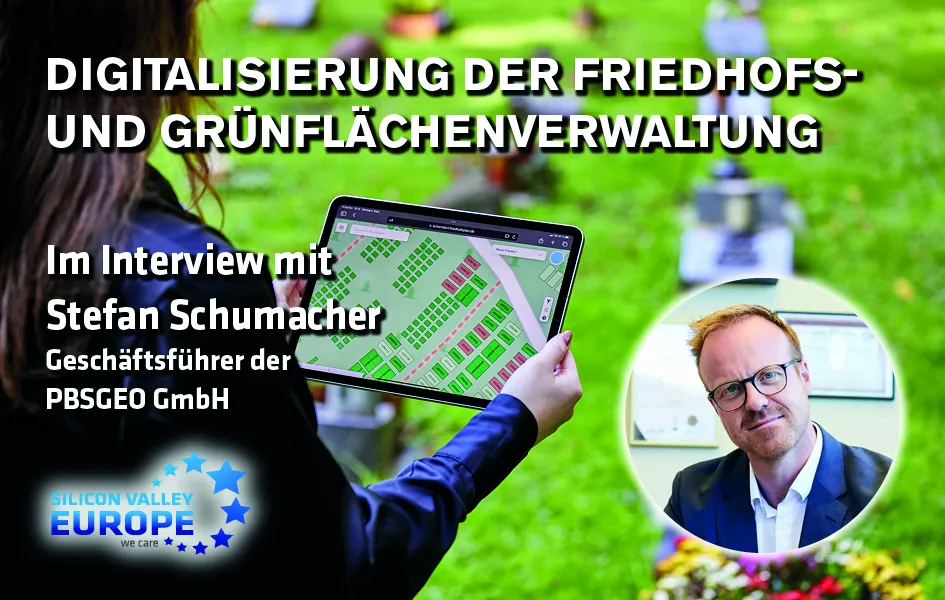
In this interview, we speak with Stefan Schumacher, founder and managing director of PBSGEO GmbH from Cologne, about an important topic: the digitalization of cemetery and green space management. The company was founded in 2011 by Mr. Schumacher after he had worked for several years in his father’s engineering office. Today, PBSGEO is one of the leading providers in the industry for digital management of cemeteries and public green spaces.
PBSGEO GmbH has made a name for itself with the development of innovative geodata solutions for public administration. In 2013, a special commission led the company in a new direction: the development of a digital mapping solution for cemetery data. This resulted in the “pg_friedhof” product family – today’s most powerful cemetery cadastre on the German-speaking market.
In addition to cemetery digitalization, PBSGEO has also launched solutions for tree and green space management. These applications are compatible with all common operating systems and end devices and help administrations manage areas and infrastructure efficiently and sustainably. Stefan Schumacher, who completed his engineering studies in Wuppertal and Madrid, provides insights in the interview into the development of his company, the opportunities of digitalization in the municipal sector, and the growing importance of geo-software solutions.
The following interview is intended to showcase the vision and future plans of PBSGEO GmbH and provide an overview of how innovative solutions can contribute to the digitalization of cemetery and green space management.
Silicon Valley Europe: Mr. Schumacher, you founded PBSGEO GmbH in 2011 and developed the first desktop application for cemetery plans. What was your vision at the time?
Stefan Schumacher: That is correct, PBSGEO was founded in 2011. However, we only started with our first desktop application in the field of cemetery digitalization in 2013. An administration we had already been working with at the time asked us whether we could develop a digital solution for their cemetery. We initially approached the idea with no vision at all, but found the field very interesting. What is particularly exciting is that we initially thought it was just a small product. In the meantime, however, a complete ecosystem has grown out of it.
Silicon Valley Europe: What challenges have you faced when introducing your digital products, and how did you overcome them?
Stefan Schumacher: We have faced many challenges. With each major customer, the level of difficulty increased, as the scope and performance of our application were repeatedly put to the test. We constantly had to make improvements. Today, I find it fascinating to look back over the years and see the development steps that have been taken throughout this time. I am amazed at how many significant developments we have been able to achieve in just the last year alone.
Silicon Valley Europe: From the very beginning, PBSGEO has relied on open-source software. Why did you choose this approach, and what advantages does it offer for your customers?
Stefan Schumacher: I have always had a soft spot for Linux and open-source software in general, so for me it was only logical to directly rely on the open-source GIS Quantum GIS. At the beginning, we occasionally had greater difficulties placing the software with customers, as they repeatedly had reservations about using the software. Today, this is no longer an issue. QGIS is one of the most popular open-source GIS systems in the German-speaking world. The major advantage for our customers is that they receive highly powerful software at a low financial cost.
Silicon Valley Europe: Your company today offers a comprehensive product family for the digital management of cemeteries, green spaces, and trees. How do your digital solutions impact the daily work of municipalities and public administrations?
Stefan Schumacher: We are in direct exchange with our customers and are delighted by the significant benefits for cemetery administrations and public green space management. Often, it’s a struggle to find the best idea and approach, which challenges us. However, we are very pleased to create innovative solutions and, as a result, receive a large number of very positive responses about us and our entire product family.
Silicon Valley Europe: As digital solutions become more widespread, the importance of data security and data protection is also growing. How do you ensure that sensitive data, such as that from cemeteries, is managed securely?
Stefan Schumacher: Of course, we have intensively addressed the topic of data security and data protection, especially when customers rely on hosting and cloud solutions. Data protection plays a crucial role in this context. Our solutions can be deployed either on-premise or in the cloud. To guarantee data security, we have had our hosting infrastructure audited. Additionally, we rely on modern encryption and authentication technologies.
Silicon Valley Europe: Customer requirements and technological progress are constantly evolving. How does PBSGEO remain innovative in this rapidly changing market?
Stefan Schumacher: We are continuously working on improving our application. I would say that we have far more ideas than we have capacity, and we won’t run out of ideas in the coming years. We believe that stagnation in development means regression. For example, we are interested in the topic of artificial intelligence, even in cemetery management. The focus is particularly on analyzing large volumes of data according to very specific criteria. We have, for instance, an application that uses AI to process cemeteries in terms of cultural history. This makes it possible to generate texts about famous deceased individuals and even communicate with or through the deceased. This application could help make cemeteries more appealing as cultural spaces for tourists.
Silicon Valley Europe: You are currently expanding your solutions internationally. What are the particular challenges in internationalization?
Stefan Schumacher: The challenge in internationalization is first and foremost building trust. It is important to convey that a company coming from the other side of the world can solve problems locally. Furthermore, while many processes are similar, they are not 100% identical, so software adjustments are required. In South America, for example, we often encounter privately organized cemeteries. These naturally have different requirements than the municipal and church-run facilities we encounter in European markets.
Silicon Valley Europe: To conclude: What recommendations would you give to administrations facing the challenge of digitalizing their cemeteries?
Stefan Schumacher: There is a very simple piece of advice for all cemetery administrations considering digitalization: Do it! Digitalization can increase flexibility and improve communication. Anyone can access the data and communicate via the application at any time using any device—within the administration as well as with external organizations such as construction yards, cemetery gardeners, or funeral directors. It’s also about creating better decision-making bases. Digital methods allow for the analysis and processing of much larger data volumes. Finally, the topic of efficiency gains should not be overlooked. How many hours do you think a cemetery administration can save each month through digitalization? Based on our experience and surveys we have conducted, we can tell you that there is significant savings potential.
Silicon Valley Europe: Thank you for this exciting insight.