In the interview with Thomas Kübler - myview systems GmbH
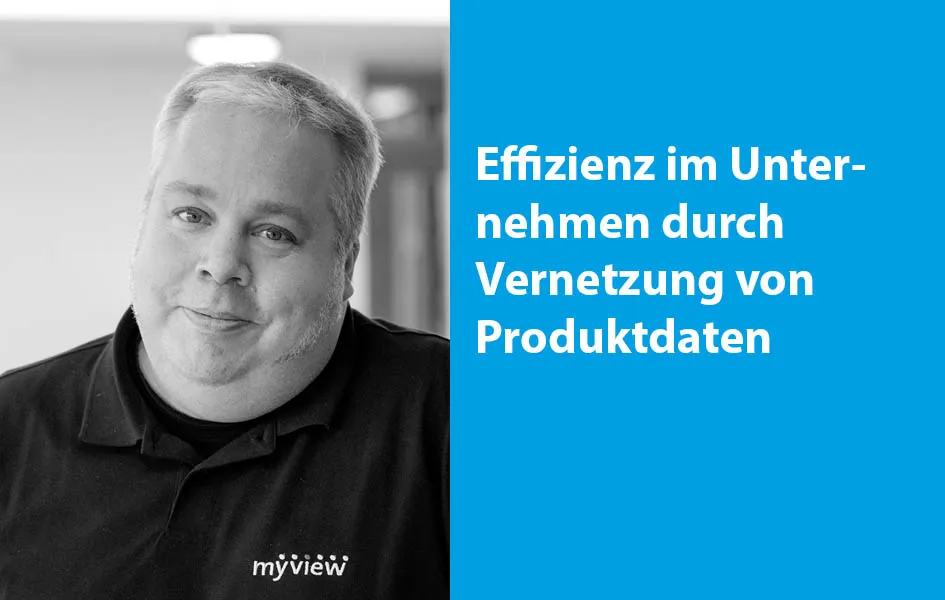
myview develops platforms for organizing product and company data with the aim of increasing the efficiency of information provision in companies. To this end, the company has developed its own software tools to implement the digital transformation of marketing and sales processes in companies. In an interview with Thomas Kübler, we focus in particular on PIM systems for technically sophisticated products, an API-first platform for the consistent provision of structured data, and what it means to set up a Digital Enterprise strategy.
DIGITAL FUTUREmag: Sales is the spearhead of the company. Why are PIM systems or Product Information Management applications so crucial for sales?
Thomas Kübler:
The ability to quickly search product data on-site at the customer's premises, as well as in channels such as eShops or eCommerce, gives salespeople the opportunity to respond quickly to customer requirements. Our systems also enable intelligent product searches. The basis for all these processes is complete, quality-checked product information. To achieve this goal, PIM systems are an essential component. They integrate, maintain, and release data. Companies that strategically pursue the topic of "sales enablement" are demonstrably more successful in their sales processes.
DIGITAL FUTUREmag: You mention that this can be a significant advantage, especially for technically sophisticated systems or devices. Why is that?
Thomas Kübler:
Technically sophisticated products involve a large number of product attributes to manage. These attributes are essential for customers when selecting products and must therefore be published across various channels. Efficient handling of this multitude of information is a key feature of our system. It enables users to quickly isolate and maintain data. A single product can easily have several hundred attributes, all of which are relevant for individual publishing channels.
DIGITAL FUTUREmag: Do other areas of the company also benefit from PIM systems?
Thomas Kübler:
Absolutely. A PIM system is a company-wide software, similar to an ERP system. In different departments of a company, there are always those who provide data to the system and those who query data from it. Engineering or product development provides technical information about individual items, and the person at the service hotline can query this information using a quick search interface and pass it on to the customer. So, it's not just the classic marketing channels that benefit from our systems.
DIGITAL FUTUREmag: What exactly is an API-first platform, and what does it have to do with the consistent provision of structured data?
Thomas Kübler:
An API-first platform is a platform that provides a simple, universally usable interface to the information it manages. It offers any applications the ability to use this interface and thus easily and consistently distribute the information.
DIGITAL FUTUREmag: You frequently speak with decision-makers and managing directors of medium-sized companies. In your opinion, what is the best strategy for permanently establishing a true digital enterprise strategy within a company?
Thomas Kübler:
I believe the most important thing is not to follow the motto “We’ve always done it this way,” but instead—just like in product development—to always keep an eye on the market and new opportunities, and to reflect on which developments are relevant to your company’s success. The ease with which we handle connected data in our private lives can largely be applied to the management of product data and sales activities. If I continue to think exclusively in traditional categories, such as “main catalog, flyer, online catalog,” I will likely be less visible in the coming years, as my customers are using entirely different media to find out about products. The networking of data and sales channels will, in my view, increase significantly and challenge existing distribution channels.
DIGITAL FUTUREmag: What mistakes do you think companies often make when they resist this issue?
Thomas Kübler:
As I’ve already described, when customer behavior changes fundamentally—which is often associated with increasing digitalization—and I dismiss it as just a phenomenon, the company risks losing touch with the market and its customers. I think there is a great opportunity right now to adapt business models or established processes, unlock new potential, and gain a competitive advantage.
DIGITAL FUTUREmag: You often mention digitalization through the networking of product data here. What exactly is meant by this?
Thomas Kübler:
A major problem for many companies is often not that they lack the necessary information about their products, storage locations, customers, etc., but rather that they have no way of connecting this information. I thus create data silos that each serve a specific application but operate independently of one another. Interfaces between the silos often exist only in a very rudimentary form. Our approach here is to break down these silos and introduce a data layer into the company that enables any application to query all data via a single interface. A simple example would be an application for field sales staff that allows them to easily determine which products a customer has already purchased, and then, in addition to the pure article number from the order history, immediately have access to all product information. This makes it extremely easy to present upselling or cross-selling offers during the sales conversation.
The simplest example of networking different silos is the connection of PIM systems with a DAM system. Having all documents and images, i.e., assets, available for an article number is still by no means a given today.
DIGITAL FUTUREmag: You will be represented with your company at the upcoming Digital FUTUREcongress. What will visitors learn about at your trade fair stand?
Thomas Kübler:
Over the past 10 years, PIM providers have focused on developing tools to manage the flood of data and its maintenance. The next step is to integrate the aforementioned use cases and internal business processes seamlessly and effectively. We have some interesting ideas to share with you at our stand, including not only the aforementioned xom platform and its capabilities, but also the concept of integrating data maintenance tools even more closely into company workflows to speed up processes and thus deliver high-quality product information.
DIGITAL FUTUREmag: That sounds very exciting. We look forward to a fantastic event with you on November 5 in Essen. Thank you for the interview.