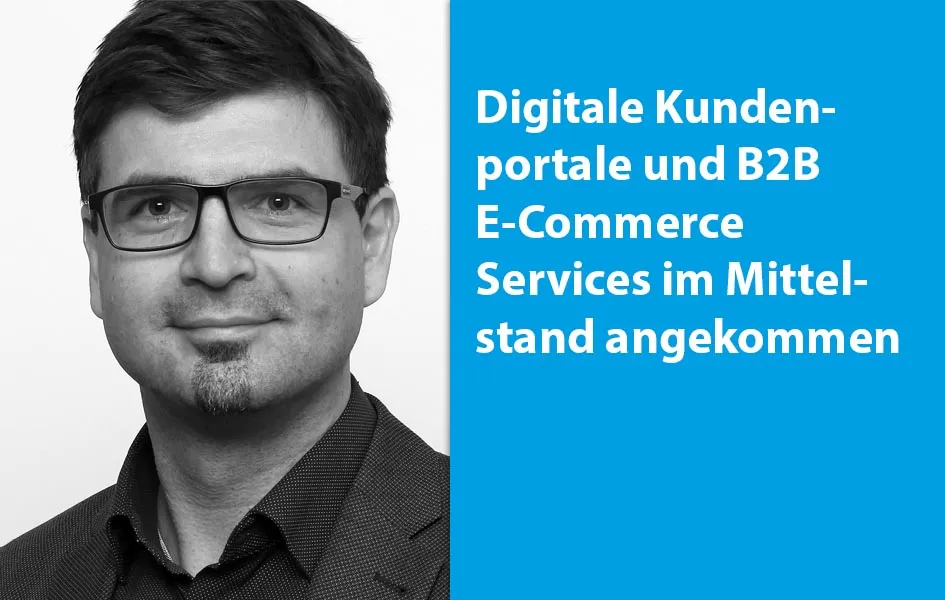
In the interview with Tobias Giese - Global VP Digital Solution at Intershop Communications AG
As an e-commerce pioneer, Intershop Communications AG, based in Jena, has been setting benchmarks in innovation and software development for digital commerce for over 27 years. It advises and supports companies in their digital transformation of trade relations to digitalize sales, marketing, and service processes. Independent analysts regularly rank the company as a market leader, particularly in the areas of B2B solutions and service portfolios. Globally, the company serves more than 300 customers across all industries, including many renowned companies from the German SME sector.
Tobias Giese has been with Intershop Communications AG since 2004 and early on found his passion in implementing e-commerce software in direct customer relationships within global project contexts in areas such as retail, manufacturing, automotive, or telecommunications. Developing, presenting, and discussing a customized solution architecture and the resulting changes to the business model are key focal points in his current role as Global VP Digital Solutions. In today’s interview, we discuss digital customer portals, B2B e-services, After-Sales Service 4.0, and personalization in marketing.
DIGITAL FUTUREmag: E-commerce is no longer just a topic in the B2C sector but is increasingly taking hold in the SME B2B space. Companies that are too slow or simply forget to view the internet as a sales channel will fall behind in the long run. In your opinion, what is the biggest obstacle for decision-makers to engage intensively with this topic?
Tobias Giese: Today, B2B companies still generate most of their revenue in the offline sector. The processes that have developed over the years work. Revenue streams are not declining, and products can still be sold as they have been for many years. Decision-makers are confronted with their numbers, and as long as these are stable or increasing, they can (but shouldn’t) lean back, postpone, ignore, or delay innovations and changes. Yet this period of prosperity should actually be used for investments!
DIGITAL FUTUREmag: Many companies therefore see more risks and dangers than opportunities in e-commerce? How do you respond to that?
Tobias Giese: Whoever sees too many risks in e-commerce has not yet recognized the advantages for their own company. There is no need to build large IT teams anymore. Cloud solutions take over responsibility for data security and optimal architecture. The risks of an investment pale in comparison to losing customers if they are not placed at the center of all sales activities. And a customer portal is exactly that. Here, the customer gains self-determination, efficiency, and loyalty to the manufacturer, while the latter gains the potential to establish new sales channels with minimal effort, for example in after-sales. A customer portal covers the entire customer lifecycle of your customer. From onboarding to automated ordering of consumables and spare parts, even after years.
DIGITAL FUTUREmag: How can I imagine the entire topic of B2B e-commerce services for a medium-sized company? Which products are suitable and are there any that are not?
Tobias Giese: The easiest way to start is with consumables. How great would it be if the customer didn’t have to call daily or send a fax every three days? Individually configured order templates or subscriptions are standard in digital B2B today. The next step would be spare parts for the machines in use. Manufacturers know the intervals at which wear parts need to be replaced or know every screw and nut that is installed. A dedicated online shop allows customers to accurately determine what they need and when—or proactively informs them before a part fails. This reduces inventory costs and downtime. Of course, you can also sell entire complex machines online, but this requires many small steps and accumulated experience in operating a digital sales channel. The ultimate discipline is linking products with services—such as booking a maintenance appointment.
DIGITAL FUTUREmag: For many entrepreneurs, their website is already their digital portal. What distinguishes a website from a digital customer portal?
Tobias Giese: A website is customer outreach from the inside out; a customer portal is the opposite. A website may offer initial products as a general list with order numbers, without considering customer segments or framework agreements. A good B2B shop can already handle this. Here, the product groups offered are displayed according to relevance, making operation faster. A digital customer portal, on the other hand, revolves solely around the customer themselves. After logging in, they only see products and services that suit them. Additionally, there are pre-configured reorders, subscriptions, or direct contact to contract workshops.
DIGITAL FUTUREmag: There is a lot of money at stake in the service sector, and today customers expect 100% secure service with high reliability and speed. What does a cloud-based After Sales Service 4.0 solution offer?
Tobias Giese: A cloud-based after-sales solution is primarily available immediately and at all times. It is scalable and highly performant. The corresponding cloud provider ensures security. Experts handle hacker attacks or peak loads. Manufacturers and retailers can focus on innovation without having to find and hire an IT team to manage the infrastructure and its security. Consider the shortage of skilled workers, onboarding time, and team building. Thanks to a cloud solution, you can implement your business plan immediately. Topics such as rolling out to another country or introducing a new product group can be implemented immediately without major technical investment.
DIGITAL FUTUREmag: Please tell us the 3 most important steps for optimally introducing a functional customer portal for a “beginner” in this area.
Tobias Giese: A beginner in the field of customer portals should already be familiar with well-founded digital sales processes, i.e., operate an online shop with initial personalization, for example, via customer-segment-specific product catalogs and prices. For these individuals, I recommend identifying the top 5 use cases of their customers as precisely as possible. Surveys, whether in interviews or online questionnaires, are suitable for this. Or also in personal meetings with customers. I also recommend taking a closer look at a few key customers separately. Alternatively or additionally, you can also examine the top 10 customers and analyze their needs in detail—depending on whether you have many customers who perform similar tasks or a few who realize heterogeneous business scenarios.
#2 Implement use cases
Based on these 5 use cases, you should determine which products are suitable for the customer portal, which functions are needed, and which services should be offered to fulfill these top 5 use cases. An example: The customer wants to order consumables that they regularly use quickly and efficiently: In this case, a one-page checkout with a subscription functionality would be configured to prepare the customer’s relevant products for recurring orders, thus supporting fast conversion from the manufacturer/retailer’s perspective and efficient ordering from the customer’s perspective.
#3: Gather feedback and optimize
This is followed by another evaluation phase. Now it’s about finding out how the provided functions are used and whether they actually serve the use case. An example: You can accompany a customer for a day during their work. As the operator of the customer portal, you know all the tricks and functions and can recommend to the customer how to use the portal more fully and efficiently, or even jointly develop or plan extensions on-site. Once the top 5 use cases are running stably, you move on to the next five, and so on. This way, higher customer satisfaction is achieved iteratively, which should also be reflected in the previously defined KPIs.
DIGITAL FUTUREmag: Lastly, perhaps one more question about the increasingly growing personalization in marketing. Do you see limits to personalization here? Where, in your opinion, is the line crossed?
Tobias Giese: B2B online shops are only at the beginning of in-depth personalization today. A customer portal will herald the next evolutionary stage in customer communication and personalization – so-called individualization. Of course, you also need to have trust and demand it from the customer if you want to establish a customer portal. If I register a machine online, I shouldn’t have to worry that something untoward will happen with the information. But it’s simply the next step, the digital mapping of a process that is already commonplace. For me, personalization in a professional environment knows no bounds. I focus on the advantages: if the salesperson is automatically informed about the successful registration of the machine they sold, they can use the opportunity to call to offer congratulations and trigger a discount code for the first order of consumables! That’s customer loyalty. And in the future, this will be achieved primarily through individualized digital sales.
DIGITAL FUTUREmag: Entscheider kompakt thanks you for this truly fascinating interview and we wish you every success at the Digital FUTUREcongress in Frankfurt …