Interview with Dr. Andreas Kohne and Nils Brechbühler
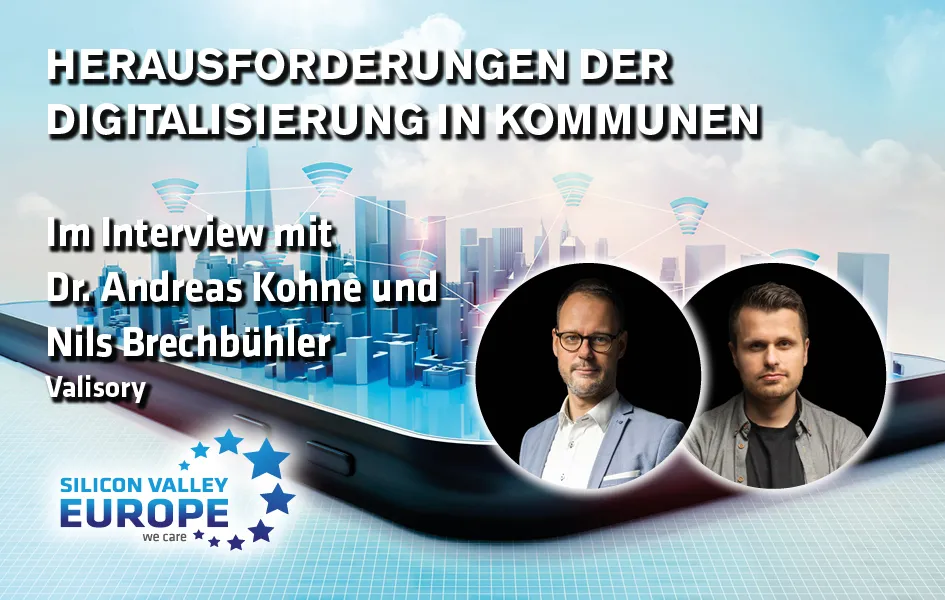
In an exclusive interview with Silicon Valley Europe, Dr. Andreas Kohne and Nils Brechbühler discuss the biggest hurdles municipalities face in digitalization. Key topics include the misconceptions about digitalization as an IT project, selecting the right technologies, and engaging employees. Both experts highlight the opportunities and risks of digital transformation and explain how targeted implementation not only modernizes municipalities but also makes them more efficient and citizen-friendly. An exciting exchange about the future of digital administration!
What do you see as the biggest challenges municipalities currently face in digitalization?
Dr. Andreas Kohne: Digitalization is often seen as a pure IT project. Frequently, processes are simply digitized without first making them fit for it. Additionally, those most affected by digitalization are often forgotten: the employees. Changes often lead to uncertainties and must therefore be explained and made understandable.
Nils Brechbühler: Then there’s the uncertainty in selecting and implementing the right technologies—there are often so many options that it’s difficult to find the solutions that best fit the respective municipality. Because alongside technical and financial considerations, legal and data protection requirements must also be taken into account. And implementation is by no means just about installing an IT solution.
Why are municipalities focusing on digitalization in the first place?
Nils Brechbühler: In principle, the digitalization of public administration is driven significantly by corresponding legislation. Additionally, digital solutions offer municipalities numerous advantages. When implemented correctly, digitalization relieves employees, for example through automation or improved information quality. It also enhances the traceability of processes and collaboration within the municipality.
How can municipalities be supported in overcoming the challenges of digitalization?
Dr. Andreas Kohne: In addition to financial prerequisites and legal, organizational, and technical frameworks, municipalities need a competent partner. This partner must support them with experience and pragmatism, explain concepts and technologies, and jointly overcome emerging hurdles. They need a partner who not only develops strategies but also implements them.
What risks arise if digitalization projects are not implemented in a targeted manner?
Dr. Andreas Kohne: High, unnecessary costs can arise and requirements may remain unfulfilled if technologies are not selected in a traceable and needs-based manner. If digital solutions do not fit established processes, inefficiencies occur, errors arise, or the processes simply do not work with this digital solution.
Furthermore, changes always lead to uncertainty and employees often experience worries and fears. The solution here is to explain and clearly communicate the "why." It can also be sensible or even necessary to actively involve employees in the change process.
Based on your experience, what steps should municipalities take to successfully launch digitalization projects?
Nils Brechbühler: At the beginning, the municipality should conduct a comprehensive and realistic potential analysis. This will help identify the greatest opportunities and opportunities for small, quick successes ("quick wins"). The municipality should then focus on these first. In addition, employees should be involved early and regularly trained. This requires a change and communication plan tailored to the specific municipality.
Which technologies or tools have proven to be particularly effective for municipalities in your projects?
Nils Brechbühler: This naturally depends on the initial situation of the municipality as well as the planned goal. We see that there is a lot of potential in three areas in particular.
Many municipalities are faced with the question of how they can digitally capture, process, and provide their employees' knowledge so that, for example, onboarding can be carried out as effectively as possible in the event of a staff change.
In addition, many municipalities are concerned with the topic of digital communication and collaboration. This goes far beyond classic email. We are talking about communication platforms such as Microsoft Teams, the use of cloud computing, or even real-time collaborative document editing.
Dr. Andreas Kohne: Finally, artificial intelligence is also an interesting and important topic for municipalities. The fact that municipal processes are based on data and information and the nature of the activities offer great potential for simplifying work and automating processes. Something that is becoming increasingly relevant in the context of staff shortages.