Kurt Birtel reveals in the interview how he identifies vulnerabilities in companies and optimizes them using the TOC method.
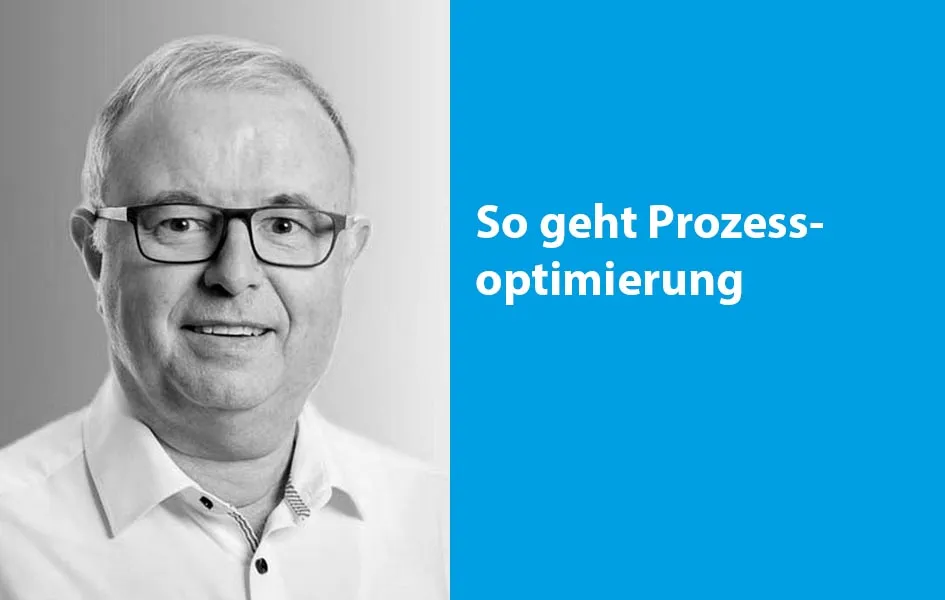
Process optimization – everyone has heard of it, many have tried it, and only a few have implemented it. Streamlined and efficient workflows, no waiting times, and quick coordination loops are on every business owner’s agenda sooner or later, especially when initial processes start to falter. But why do so few managing directors use strategic measures to boost productivity in their companies? The question on everyone’s lips: Where do you even start? Kurt Birtel has had a keen eye for the big picture since 2009 and is convinced: “I am certain that in 9 out of 10 companies, efficiency gains in production and administration can be increased by up to 50%!”
We wanted to take a closer look at the colorful world of diverse methods and invited the business consultant for an interview. Below, he reveals which methods he particularly recommends for SMEs and why they promise success even in turbulent times.
DIGITAL FUTUREmag: Mr. Birtel, you have been working as a business consultant for X years. Which companies do you primarily work with?
Since I started my own business, I have been very successful across almost all industries throughout Germany. Thanks to authorization in several small and medium-sized enterprise funding programs, SMEs are among my preferred clients, as I can bring in subsidies with a funding rate of 50 to 100%. However, very large corporations with up to $17 billion in revenue and 40,000 employees are also part of my client base.
DIGITAL FUTUREmag: You are known as the “Bottleneck Whisperer.” How did you come by this name?
There are only a few experts in Germany who successfully specialize in the Theory of Constraints. A major business magazine that recently reported on my work and my extraordinary successes is to thank for this name, which I am very proud of.
DIGITAL FUTUREmag: What is your specific goal? What do you want to achieve with companies? How do you go about it?
The goal of every company is to “make money.” Some are convinced that “bringing value to the customer” is the top priority. That is true, but I am convinced that only by making money can I bring value to the customer. So what holds entrepreneurs back? All kinds of bottlenecks – in other words, limitations that prevent us from achieving our goal of “making money.” We know several types of limitations:
1. Physical limitations – if we lack a drill, we can’t drill more holes
2. Psychological limitations – we’ve always done it this way, it has to be this way ...
3. Political limitations – working time models, break regulations, laws, etc.
Often, in initial meetings with customers, I hear the question: And how do I make money now? This question is justified, because I can only make money if I differentiate myself from my competitors. In addition to quality and costs, fast and reliable delivery is one of the decisive factors. And there we are already at the actual topic… I take the liberty of asking you a counter-question: How often do you order from the online retailer Amazon? I am sure, at least once. And why? Because you placed the order at 11 p.m. in the evening and the postman rings at your door at 11 a.m. the next morning. So why should we do without in our business lives what we have grown so fond of in our private lives?
DIGITAL FUTUREmag: That sounds plausible. How can companies counteract such bottlenecks?
It’s quite simple: by asking yourself what today’s customer expects from a company: small delivery quantities, in high variance and very short delivery times. And that’s exactly what I support my customers with. As part of my work, I focus on the TOC method (Theory of Constraints) and work with companies to find the “limiting factor”, which we call the bottleneck, that is responsible for us not achieving more sales, more profit, shorter delivery times, etc. I explain this to my customers using the example of an hourglass, because it’s clear here that there is only one point responsible for what comes out at the end. I orient myself on the 5 focusing steps of TOC.
1. Identify the bottleneck
2. Exploit the bottleneck
3. Subordinate everything else to the bottleneck
4. Elevate the bottleneck
5. Avoid inertia and always start again at 1.
For each of these steps, I have extremely powerful special tools and unique selling points, such as the Flow Analyzer. Together with my customer, I fly over their own process landscape like in a helicopter and see how the individual production orders move through the process chain. But I also quickly identify where material flow congestion and bottlenecks occur. Just like on the motorway, right in front of the bottlenecks!
DIGITAL FUTUREmag: An exciting theory. How do you implement this in practice? And what can SMEs expect from your method?
In a value stream analysis, where I take a close look at the entire customer-to-customer process, I don’t focus exclusively on operational processes but also on administrative workflows. You know this from a crime thriller, where the crime scene investigators arrive at the scene and place numbered tags on individual items. At point (1) there’s a knife, at point (2) an overturned wine glass, and at point (3) the body lies. In a similar way, I mark any irregularities and potential areas for improvement, as well as the main bottleneck along the entire value stream. Together with the customer’s “in-the-know” experts, I then define a range of measures, which are subsequently prioritized using a very specific method. Which measures have the greatest leverage in achieving my goals? If I were to have too many measures implemented at the same time, these “in-the-know” experts would become the bottleneck themselves, as they are involved in every project and, due to numerous meetings, no longer have time for implementation. You see, I like to use vivid imagery… ;)
DIGITAL FUTUREmag: Mr. Birtel, in conversations with our partners and customers, we often hear that projects fail due to a lack of concrete implementation. In your opinion, what causes projects to fail?
In Germany, we don’t suffer from a lack of ideas but from a lack of implementation. I experienced this very clearly during a project on a chicken farm. We had agreed to repair the fence together. When I visited the customer again weeks later and asked whether everything had been implemented, I was told, “We haven’t had time to fix the fence yet—we had to catch the chickens every day!” The day-to-day business quickly catches up with customers again. Most companies try to implement too many projects at the same time and ultimately achieve what? Almost nothing.
DIGITAL FUTUREmag: What was your most exciting experience in connection with your work?
At the end of 2018, I visited many of the leading technology companies and startups in Silicon Valley together with 50 entrepreneurs. It’s both impressive and alarming how disruptive innovations can change the world in the shortest possible time. In 1900, the main street in New York was dominated by horse-drawn carriages, and just 13 years later, they were replaced by cars. Not one of the former carriage builders went on to build cars. In 2007, Apple swept former market leaders for mobile phones, Nokia and Siemens, off the market overnight with the new iPhone. And here too, none of the former mobile phone manufacturers went on to produce smartphones.
On the return trip, I read the book “The Everything Store,” which describes how Jeff Bezos conceived and grew Amazon to become the world’s richest man. He says literally, “Without TOC and Six Sigma, we wouldn’t have made it!” The book “The Goal” changed my life in the late 1990s and is still the most widely read business book in the world.
Using the techniques of TOC and Six Sigma:
• I reduce my customers' lead and delivery times by up to 90%
• Increase throughput (productivity) by 20 to 50%
• Simultaneously reduce error costs by up to -70%
But without TOC and Six Sigma, I wouldn't have been able to do this either!
DIGITAL FUTUREmag: We are currently in an unprecedented situation that many people perceive as a bottleneck. What is your advice on how to deal with it?
We compare every company and every system to a chain. Everyone knows that a chain is only as strong as its weakest link, and every chain definitely has one. At the moment, most companies will find this comparison incomprehensible—unless they are producing face masks or toilet paper. We distinguish between two types of bottlenecks: internal and external. While most companies have struggled with internal bottlenecks over the past 10 years, the bottleneck is now clearly in the market. The lack of orders in the market is limiting our ability to generate more revenue and higher profits.Just as in the skilled trades, good weather is the time to repair your roof. Many companies have been spoiled by success for years and have neglected the continuous improvement process. The flood lifts all boats. Many have relied on the fact that competitors couldn’t deliver any faster either. This is going to change. The Corona pandemic has driven more digitalization processes in a few weeks than ever before. In recent weeks, there have been no alternatives to home office and video conferences. The pressure to optimize processes has now become so great that the conversation is no longer about when, but only about how.
DIGITAL FUTUREmag: In your view, what is the most common reason for flawed process design in SMEs? Where do you most frequently identify gaps?
The bottlenecks I mentioned earlier, which exist between people’s ears, are, in my view, the most common reason for suboptimal processes. Hastily digitalized poor processes remain poor processes. Especially in SMEs, dealing with ERP systems and a lack of in-house IT expertise is one of the biggest bottlenecks. From my work with Six Sigma, my second area of expertise, I’ve learned that you can only improve what you can measure. Until now, many companies have used key performance indicators exclusively to promote and monitor “local optimization.” Procurement must buy cheaply, and in production, machines must always be running—only then do we make money! But again, it’s the chain that teaches us that the overall optimum is not the sum of individual optima. In my work, I examine all existing KPIs and place the greatest emphasis on those that people focus on and that contribute to the company’s overall optimum. “Tell me how you measure me, and I’ll tell you how I’ll behave!”
DIGITAL FUTUREmag: A brief look into the future: What do you wish for German SMEs?
I would like to quote the BVMW’s figures here:
• SMEs are the engine of Germany’s economy and employment.
• They are the driving force behind innovation and a strong partner for large companies worldwide.
• 99% of SMEs consist of small and medium-sized enterprises (SMEs).
• They provide more than half of all jobs.
I wish German SMEs to regain their position at the global forefront with many disruptive innovations, particularly in areas such as alternative vehicle drive concepts and digitalisation, and to avoid the fate of carriage builders and mobile phone manufacturers. This can only succeed if policymakers create the right incentives and guardrails, and if the global economy recovers quickly from the COVID-19 pandemic.
-------------
Kurt Birtel is 63 years old and has held various leadership positions in industry for over 30 years. As an expert in the Theory of Constraints (TOC) and Six Sigma, he switched to self-employment in 2009 and now advises companies across almost all sectors throughout Germany. Whether it’s identifying the causes of bottlenecks, increasing productivity, or minimising quality defects: Kurt Birtel supports companies in implementing solutions and makes change processes tangible.
Contact:
Birtel Consulting
Zum Alten Kanal 20
66424 Homburg Saar
Mobile: 0176 2400 30 40
Email: kurt@birtel.de
Web: https://birtel.website/