Why Virtual Reality can be an alternative to standard web conferencing – in an interview with Burkhard Panier, CEO of Virtual Reality-Trainings
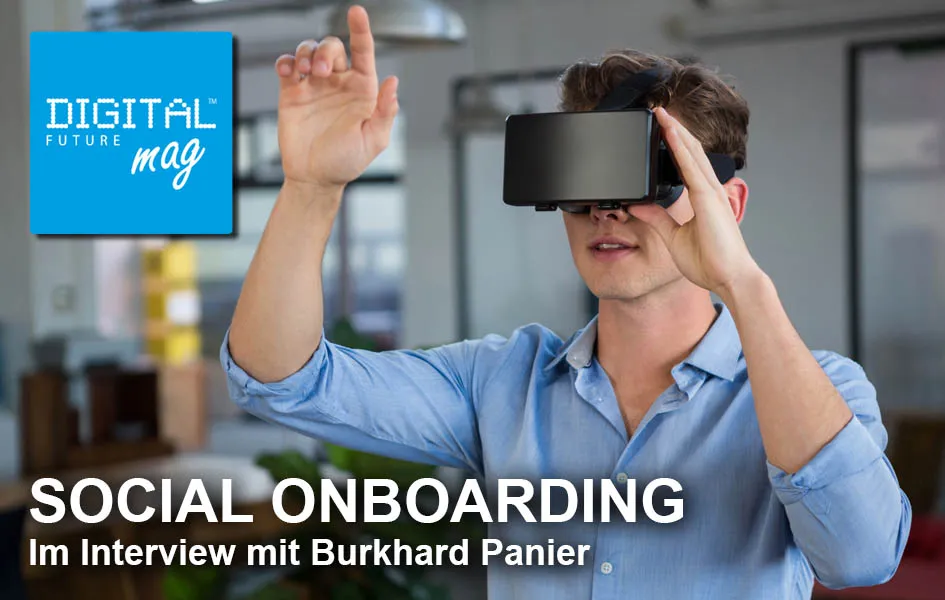
Even in times of coronavirus, SMEs and large corporations are hiring new employees. Preparing them for the post-pandemic era is a real challenge. Currently, the global situation requires us to maintain physical “distance”, but at the same time we need to communicate with others to keep our businesses running. Accordingly, providers of meeting software and e-learning solutions are currently experiencing enormous growth. Today, we will discuss the role that Virtual Reality (VR), Mixed Reality (MR) and Augmented Reality (AR) can play in this context and how they can simplify social onboarding in companies in an interview with Burkhard Panier, CEO of Virtual Reality-Trainings. He has been intensively involved in this field for many years, gives lectures and has numerous publications to his name.
DIGITAL FUTUREmag: First of all, we would like to clarify the terminology. What are the differences between Virtual Reality (VR), Mixed Reality (MR) and Augmented Reality (AR)?
Burkhard Panier: O.k., very gladly. So, one by one. Virtual Reality (VR) means: I see nothing of reality, everything I see is “100% virtual” and generated by the computer. Mixed Reality (MR): I see reality and partially computer-generated elements (overlaid) and Augmented Reality (AR): The human and the computer see reality, with the computer displaying or highlighting additional information and objects that it has recognised or interpreted itself.
DIGITAL FUTUREmag: Let’s now turn to “social onboarding”: The term “onboarding” is well known and defines all measures to successfully integrate new employees into a company. How can your system best be used in this context?
Burkhard Panier: The system we offer makes it possible to establish “cooperations between individuals”. Many companies are currently facing difficulties because they have sent their employees to work from home and the “welcome process” or small training sessions can no longer be carried out sensibly or at all.
DIGITAL FUTUREmag: Can companies use Virtual Reality meetings to better differentiate themselves from the competition?
Burkhard Panier: Companies want to attract the best talent, and for that they need the best digital methods and tools. The first contact is made via a digital job posting online, followed by the application, confirmation of receipt, and initial appointment scheduling. Many companies are already well-equipped up to this point. But how does the first meeting—the remote job interview—work? Most companies use Teams, Zoom, GoToMeeting, Skype, or other tools that are already established internally. From the candidate’s perspective, the “differentiation is zero.” To inspire potential top candidates early on, it makes sense to stand out positively from other companies. So why not use “the best digital tools” for “the best employees” at “the best company”?
DIGITAL FUTUREmag: How can I imagine onboarding employees working from home?
Burkhard Panier: If the candidate has a VR headset, great—then we meet right away in virtual reality. If not, the candidate enters the virtual space via PC screen or smartphone and navigates using the cursor keys or touchscreen. The supervisor or HR employee can control their avatar in the space using their “real body movements” via the VR headset, without needing to use the PC mouse. This way, the candidate can see the movements, gestures, and gaze direction of the “person or their avatar.”
This allows you to “together” view company-specific boards on the walls, explain products, or introduce the company. This can be very impressive and creates a much more intense interpersonal experience. Of course, if you suspect an absolute top candidate, you could also send a pre-configured VR headset by post. Then two avatars meet in the VR space. This gives companies a clear and strong differentiation.
DIGITAL FUTUREmag: That sounds great. How can I imagine the onboarding of employees who have never seen the company before using Virtual Reality (VR) or Mixed Reality (MR)?
Burkhard Panier: Yes, now comes the second, important part of onboarding: the training, where many newly hired employees often experience a culture shock (laughs). If someone is "served" in between or constantly has to wait, the applicant might have preferred to sign with another company. It is therefore essential to create a clear training plan and not to forget the social challenges in the home office. Managers must offer the newcomer a plan that connects the manager, their future colleagues, and the independent acquisition of professional content and processes. Daily short meetings in virtual space with different colleagues, where employees explain individual processes from avatar to avatar and reuse existing PowerPoint training materials or videos in virtual space. This is fun and provides the desired connection to the company. You "feel" this innovative and emotional onboarding as "Welcome, be part of our company".
DIGITAL FUTUREmag: Where does Virtual Reality (VR) come into play here?
Burkhard Panier: The newcomer can attend various stored VR webinars alone, learn about processes independently, and the manager conducts regular feedback discussions. By adding "shared learning with colleagues," "self-study," and "feedback discussions," onboarding does not become an additional burden for an individual but can be integrated into the existing workday through simple individual coordination between employees. Using VR webinars, for example, learning can be done together or processes can be discussed together. When I say together, I mean standing opposite each other in virtual reality. You can see the gestures of the avatar and which screen the colleague is in front of and where they are looking. Both colleagues can start working together on a virtual and emotional level. This is added value that no PC meeting software can offer.
DIGITAL FUTUREmag: If a company uses good software, it should naturally be used multiple times. What is the difference between a meeting where processes are explained and a design review of your products?
Burkhard Panier: Simply the use of virtual prototypes from your CAD system and the fact that project managers can suddenly load and evaluate CAD data without the help of designers. Even that is something no normal PC meeting software can do. Virtual reality really opens up many digital process steps here.
DIGITAL FUTUREmag: Finally, a question about sustainability. Can VR webinars also be used in the company for the long term?
Burkhard Panier: It can be assumed that in the future, people will prefer to interact with other people rather than robots. The social aspects between individuals remain indispensable. Looking into the crystal ball, the next innovative step could be that an employee scans a QR code on a machine or somewhere in the company with their phone, an expert appears as an avatar next to the QR code, and can then give live instructions for repair or operation. We are currently developing this combination of virtual reality for the expert and augmented reality for the customer as the "TiF" of the future (laughs). Here, TiF is not to be understood as an image format, but as the future "Training in Field" scenario. This brings us to the next DIGITAL FUTUREcongress in 2021 if you invite us to it (laughs).
DIGITAL FUTUREmag: Thank you very much for this exciting interview. I am sure that after this interview, one or the other will be inspired to explore the topic of onboarding with virtual reality.