How Dr. Orhan Tanriverdi is changing the rules of digital processes with MIRYA
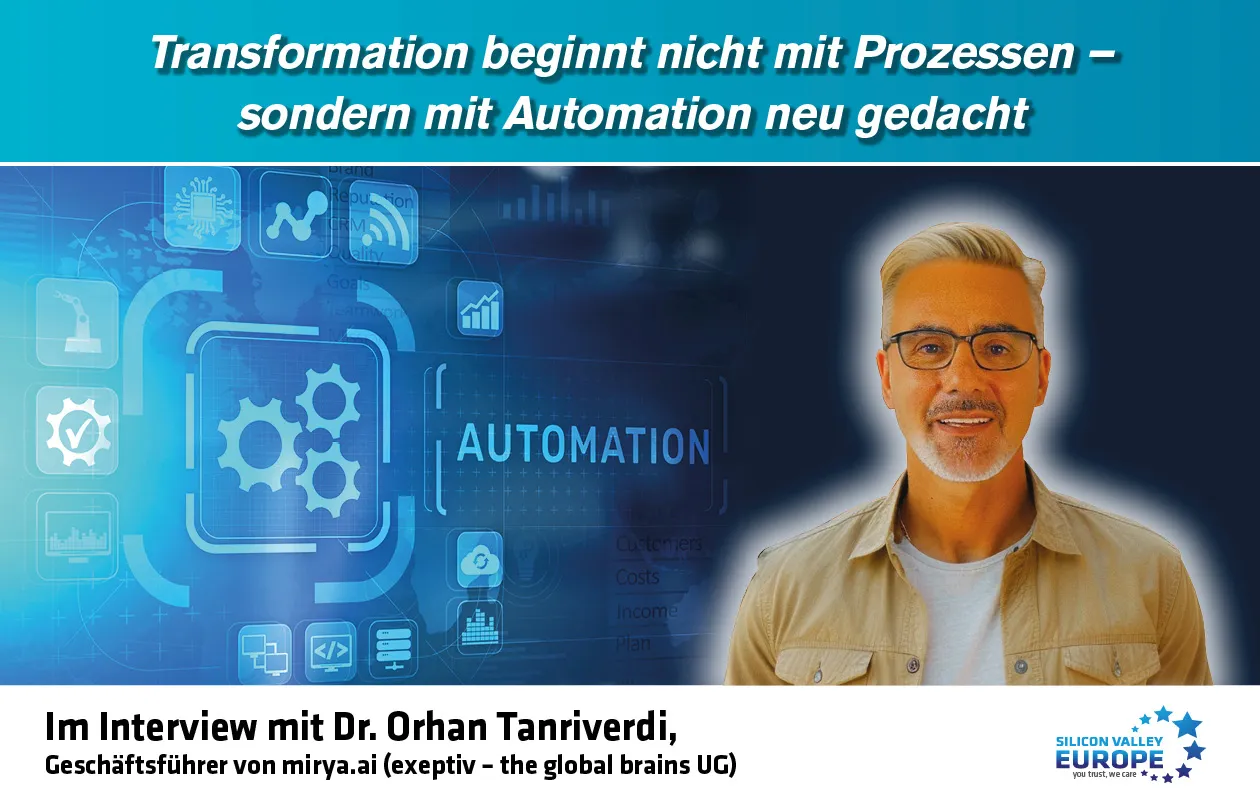
When it comes to the future of automation, Dr. Orhan Tanriverdi is one of the voices worth listening to. As CEO and Founder of MIRYA, he pursues a clear vision: automation must become radically simpler, smarter, and above all accessible to specialist departments themselves – without complex IT dependencies and on-premise.
With MIRYA, Orhan Tanriverdi has created a platform that goes far beyond classic Robotic Process Automation. Instead of rigid bots, the system relies on “human logic”: processes are not only executed but understood. Data is analyzed, patterns are recognized, and decisions are made in real time – fast, precise, and reliable. The special feature: automations are created via drag & drop or “Record & Prompt”, i.e., through simple recording or intuitive inputs. Programming knowledge? Not required – you still want to code? No problem. No Code first – Code when you need.
In an exclusive interview with Silicon Valley Europe, Orhan Tanriverdi provides exciting insights into the next evolutionary stage of automation. Why do the greatest efficiency potentials lie not in individual tools, but at the interfaces between systems, processes, and organizations? And how can companies address this without months-long integration projects?
MIRYA addresses this operational level precisely: as an execution layer that connects existing systems with each other and executes processes across systems – even where APIs are missing or legacy structures dominate. Whether it’s intelligent document processing, end-to-end service processes, or the automation of complex asset lifecycles, the platform promises productive results within days rather than months.
However, Dr. Tanriverdi’s approach is not only technologically exciting but also strategically highly relevant: in times of increasing complexity and growing demands for data sovereignty, MIRYA relies on on-premise deployment and full control over sensitive data.
What drives an entrepreneur with an impressive career from marketing and AdTech to AI-supported automation? What role will no-code play in the future of corporate management? And how is the collaboration between humans and machines really changing?
Answers to these questions – and a look behind the scenes of one of Europe’s most exciting automation platforms – are provided in this interview.
Silicon Valley Europe: Mr. Dr. Orhan Tanriverdi, you have developed with MIRYA a platform that radically simplifies automation. What was the decisive moment or insight that led you to found MIRYA?
Dr. Orhan Tanriverdi: The decisive insight for me was that automation has become unnecessarily complicated in many companies. Many classic RPA and automation platforms were developed for specialists – not for the people who actually execute the processes on a daily basis.
In projects, I repeatedly saw companies having to analyse processes for months, commission external developers, and invest large budgets just to automate repetitive tasks. At the same time, there were people in the specialist departments who knew exactly how the processes worked but had no way of taking action themselves.
This gave rise to the vision of MIRYA:
Automation must become as simple as using modern software.
That’s why we consistently follow the approach: “No-Code first – Code when you need.”
With MIRYA, users can record processes, create them via drag-and-drop, and soon even describe them using natural language, interact with MIRYA “personally,” ask questions, and collaborate on processes—just like with a “real person.” The platform understands workflows, recognizes patterns, and generates intelligent automations from them. Our goal was never just to “build bots.” We wanted to develop a platform that acts like a digital employee—with cognitive skills, visually intuitive, capable of learning, and understandable for every person in the company.
Silicon Valley Europe: MIRYA embraces the “No-Code first – Code when you need” approach. How does this approach specifically change the role of specialist departments compared to traditional IT-driven automation?
Dr. Orhan Tanriverdi: The difference is fundamental.
In traditional automation projects, there is often a strong dependency on IT or external developers. Specialist departments define requirements, wait for resources, and receive initial results only after weeks or months. With MIRYA, this dynamic shifts completely. The specialist departments themselves become active designers of automation. Employees from purchasing, HR, finance, customer service or logistics can independently record, adapt and automate processes – without any programming knowledge. This means: This creates three major advantages: At the same time, we do not exclude developers. That is precisely why we say: Complex requirements, APIs or individual extensions can still be added via code. However, the standard case should no longer depend on developers today, but rather on user autonomy. We believe that the future of automation is not developer-centric, but human-centric. Silicon Valley Europe: You talk about MIRYA not only executing processes but also understanding data and making decisions independently. Can you give us a practical example of how this "human logic" works in everyday business? Dr. Orhan Tanriverdi: A very simple practical example could be the processing of incoming emails in customer service or technical support. A classic bot would simply execute defined rules. MIRYA analyzes content, recognizes relationships, interprets, classifies, understands documents, and decides which action is appropriate based on the context. For example, MIRYA can: For example, when a maintenance report is received, MIRYA automatically identifies: MIRYA can then autonomously: The key point is: MIRYA no longer operates purely based on rules, but rather on context. This creates a form of “human logic” that significantly extends classic automation. Silicon Valley Europe: A key promise of MIRYA is fast time-to-value—automations within days instead of months. How do you achieve this speed advantage over traditional solutions? Dr. Orhan Tanriverdi: The speed advantage comes from several factors working together. First: In many cases, MIRYA does not require complex integrations or APIs. Second: We drastically reduce the technical entry barrier. Many customers experience productive results within just a few days and achieve an ROI within weeks. This also changes the perception of automation: Silicon Valley Europe: Many companies struggle with heterogeneous system landscapes and legacy systems. How does MIRYA manage to work across systems, even without existing APIs or complex integrations? Dr. Orhan Tanriverdi: This is actually one of the biggest advantages of MIRYA. The reality in companies rarely consists of modern cloud systems with perfect APIs. Instead, we often see legacy ERP systems, terminal applications, desktop software, web portals, in-house developments, and Excel-based processes. MIRYA was developed precisely for this reality. The platform works visually and surface-based – similar to a human employee with cognitive capabilities. We often say: “Automate everything without changing anything.” This is especially advantageous for SMEs, where historically grown system landscapes are common. Silicon Valley Europe: You emphasize that the greatest efficiency potentials lie at the interfaces between processes. Why do you think these areas are underestimated in companies so far? Dr. Orhan Tanriverdi: Many companies often view their processes in isolation rather than as part of an interconnected overall system. Optimization typically takes place only within individual departments, software solutions, or teams. However, the greatest inefficiencies and friction losses usually occur precisely where information, responsibilities, or systems meet – i.e., at the interfaces. Typical examples of such problem areas include handoffs between sales and service, manual data transfers between ERP and CRM systems, email-based approval processes, media discontinuities between desktop applications and web systems, and documents that must be read by humans and re-entered into other systems. At these interfaces, waiting times, errors, duplicate work, lack of transparency, and inefficient communication arise, slowing down the entire process and generating costs. The problem is: These frictions often seem “normal” in everyday life because companies have grown accustomed to them over the years. Many classic automation approaches focus on individual tasks or isolated processes. At MIRYA, we take a different approach: We look at entire process chains and especially the transitions between them. Because ultimately, that’s where it is decided how efficiently a company really operates. That’s why MIRYA doesn’t just automate individual tasks—it can read, understand, transfer, and intelligently connect information across systems, even in heterogeneous IT landscapes without APIs. I believe the next major efficiency revolution won’t happen within individual systems, but between them. The future belongs to platforms that break down silos and orchestrate processes holistically. Silicon Valley Europe: An exciting aspect is intelligent document processing (IDP). What role does this technology play in practice, particularly in areas such as maintenance, service, or technical processes? Dr. Orhan Tanriverdi: Intelligent Document Processing (IDP) will play a key role in the coming years. The reason for this is that companies have to process enormous amounts of unstructured information. In practice, this involves a wide variety of documents such as maintenance reports, service logs, invoices, delivery notes, technical documentation, emails, PDFs, images, and handwritten notes. Classic systems often reach their limits when processing such content. MIRYA, on the other hand, offers a solution: the software can analyze documents, understand their content, structure it, and derive processes directly from it. A clear example of this is technical service: after a technician has completed an assignment, they send photos, a PDF report, and handwritten notes. MIRYA is thus able to automatically extract relevant data from these different sources, identify error codes, recognize spare parts, update maintenance histories, generate service reports, and create follow-up orders. It becomes particularly exciting when combined with modern AI technologies and intelligent assistance systems. Another crucial aspect is that at MIRYA, we consciously rely on professional enterprise IDP technology from a global market leader: ABBYY We provide companies with highly precise and at the same time GDPR-compliant document processing that meets even the highest security and compliance requirements. The underlying technology is internationally certified multiple times and is used worldwide in strictly regulated industries. Our IDP solution (Intelligent Document Processing) can intelligently process documents of almost any type. To do this, the documents are first read, analyzed, structured, classified, and validated. This supports over 200 languages, including handwriting recognition, complex tables, technical documents, forms, invoices, service reports, or unstructured content. What is particularly important to us is that this processing works without the use of commercial generative AI services such as ChatGPT, Claude, or comparable external models. This is a key advantage, especially in the European business environment, as many customers consciously do not want to transfer sensitive data, technical information, or personal content to public AI systems. With MIRYA, companies thus gain intelligent document processing at an enterprise level: The future belongs to systems that not only store information but understand it. Silicon Valley Europe: With your on-premise approach, you also address issues such as data sovereignty and compliance. How important is this topic currently for your customers – especially in the European context? Dr. Orhan Tanriverdi: This topic is more relevant than ever. In Europe in particular, we are seeing a strong focus on data protection, data sovereignty, compliance and regulatory requirements. Many companies hesitate to fully outsource sensitive data to external cloud environments. That’s why it was clear to us early on: MIRYA must be fully operable on-premise. Our customers – particularly from sectors such as the public sector, industry, healthcare, financial services and insurance – value full control over their processes, data, AI models and infrastructure. This is a decisive factor. I am convinced that European companies will in future make very conscious decisions about which AI and automation systems they use and where their data is processed. Silicon Valley Europe: Your career began in marketing and AdTech, leading you through various leadership positions to AI-driven automation. Which experiences from these stages most strongly shape your work at MIRYA today? Dr. Orhan Tanriverdi: Not just there, we were already “automating” before the pandemic – specifically, B2B sales processes. With the exeptiv sales engagement platform, you can automate emails, InMails, SMS, WhatsApp, LinkedIn messages – here we mimic human behavior. AI-supported and rule-based. The marketing and AdTech environment was also extremely data-driven and highly dynamic. There, you quickly learn to scale processes, make data-driven decisions and pragmatically deploy technologies. Above all, I have learned: Many enterprise systems fail not due to a lack of functionality, but because of complexity. This insight continues to shape MIRYA today. I quickly recognized how crucial speed and user experience are, because even the most powerful technologies often lose value due to complicated interfaces. That’s why at MIRYA, we place special emphasis on ease of use and intuitive design: We focus on intuitive UX and visual processes to reduce complexity. Interaction should be as intuitive as a conversation through the use of natural language, complemented by an AI assistant that intelligently automates and simplifies tasks. Our goal is to minimize technical barriers so that the technology can be used without extensive technical knowledge. Silicon Valley Europe: If you look into the future: How will the collaboration between humans and machines develop over the next five years—and what role will MIRYA play in this? Dr. Orhan Tanriverdi: We are only at the beginning of a profound transformation: In the next five years, software will no longer be used passively but will actively collaborate with humans. The line between user and system will increasingly blur. In the future, people will be able to define processes by describing them verbally, demonstrating them via recording, or specifying them through prompts. Based on this, intelligent systems will generate executable processes independently. This is precisely the vision pursued by MIRYA. Our vision is that of a visual AI assistant capable of communicating with people, understanding complex processes, creating automations, supporting decisions, and executing tasks autonomously. Our stated goal is not to replace people but to relieve them of operational complexity. We firmly believe that the most successful companies of the future will be those that intelligently combine humans and AI rather than pitting them against each other. Silicon Valley Europe: To conclude: What specific first steps do you recommend for companies looking to start with automation today or take their existing processes to the next level? Dr. Orhan Tanriverdi: My most important advice on automation is not to start too big. Companies often try to automate complete end-to-end processes right away, which frequently leads to lengthy projects and frustration. Instead, I recommend starting with smaller, clearly defined processes. These typically include repetitive tasks such as email processing, data transfer, document handling, report generation, ERP system entries, or service ticket processing. For successful automation, three key areas are crucial. Firstly, early involvement of the specialist departments is essential, as the most practical automation ideas arise directly from employees' day-to-day work. Secondly, the focus must be on employees: automation must not remain purely a technical development discipline, but must become an integral part of corporate culture. Thirdly, choosing the right platform is important; here, the focus should be on flexible, scalable and, above all, user-friendly solutions. With the goal of making automation simpler, faster and more human, MIRYA was developed. Silicon Valley Europe: Thank you for this extremely exciting and, above all, forward-looking interview on the subject of automation. Thank you for the invitation and the exciting conversation. I am convinced: companies that start early to strategically implement intelligent automation will secure massive competitive advantages. And that is exactly where we want to support with MIRYA.
The people who know the processes best can optimize them directly.
“No-Code first – Code when you need.”
MIRYA goes much further.
The platform operates visually on existing interfaces—similar to how a human would. This eliminates lengthy integration projects.
By using recording, visual workflows, and AI-supported process logic, companies can create productive automations extremely quickly.
Third: We avoid classic project structures with long conception phases.
Our philosophy is:
“Build fast. Improve continuously.”
It is no longer seen as a lengthy IT project, but as an operational tool for rapid improvements.
This means: MIRYA can click, read, write, navigate, and make decisions, regardless of the underlying system.As a result, companies do not need to replace or extensively rebuild their existing IT landscape.
highly precise, multilingual, scalable, and at the same time privacy-oriented.
Technology only delivers real added value when people can actually use it.
We don’t develop technology for specialists.
We develop technology for real workflows.
The coming years will be extremely exciting for companies, as AI and automation are becoming truly mass-market for the first time.